Tournament Recovery for Pickleball Players
Tournament Recovery for Pickleball Players: Nutrition, Sleep, and Tools That Work
By: Susie Reiner, PhD
Late in a tournament, the margins get smaller.
Points are decided by positioning, timing, and split-second decisions. Fatigue is the first thing that erodes them — and you don’t need a major breakdown for it to show up. Just a few small delays, repeated over time.
That’s why recovery isn’t just about feeling good between matches. It’s part of performance.
What you eat, how you hydrate, whether you keep moving between matches, and how you handle the hours after play all shape how the next match feels. This article breaks down the strategies the research consistently supports — and how to apply them in a tournament setting.
Why Tournament Play Is Physically Different
A single match doesn’t tell you much about how your body handles competitive stress. Five or six matches over two days is a completely different challenge.
Fatigue stacks up through three main mechanisms: glycogen depletion (your muscles running low on stored fuel), exercise-induced muscle damage, and central nervous system stress (the neural fatigue that slows reaction time and decision-making).
When recovery between rounds isn’t enough, those effects carry into the next match.
Research on intermittent sports like pickleball — sports built on repeated bursts of high-intensity effort — consistently shows declines in power output, coordination, and decision-making when athletes compete without adequate recovery (1).
The goal during a tournament isn’t complete physiological recovery. That’s not realistic in the time you have. The realistic goal is maintaining enough physical and cognitive function to compete with confidence in your next match.
Fueling Across Matches and Days
Carbs are your primary fuel for repeated high-intensity effort. In intermittent sports, carbohydrate intake has been shown to improve exercise capacity, with the biggest effects appearing late in competition — exactly when fatigue and low blood sugar threaten performance the most (1).
Between matches, smaller and more frequent carb intake works better than a big meal that sits heavy. Easy-to-digest foods that absorb quickly serve you better than nutritionally “perfect” options that weigh you down.
Protein matters across the day, too.
Research supports a daily target of roughly 1.4–1.6 g/kg for active athletes maintaining muscle function across repeated efforts (2). Spread that intake across several smaller servings rather than one big post-match meal — it produces a more consistent muscle-repair response throughout the day.
For example, a 150-pound (~70 kg) player would target roughly 100–110 grams of protein per day — about 25–30 grams across four servings:
- Breakfast: Greek yogurt + eggs (~30g)
- Midday meal: turkey wrap or chicken bowl (~30g)
- Between later matches: protein shake or jerky (~25g)
- Dinner: salmon or chicken with sides (~25g)
Hydration affects both your muscles and your nervous system. Fluid loss across multiple matches reduces muscle contractile capacity and slows recovery. When matches are long, closely spaced, or you’re sweating heavily, replacing electrolytes matters as much as replacing fluid.
Key Strategies
- Carbs are the primary fuel source for repeated high-intensity match play — replenish them between rounds
- Target 1.4–1.6 g/kg of protein daily to support muscle repair across tournament days
- Smaller, frequent meals and snacks beat large meals between matches
- Replace electrolytes, not just fluid, on multi-match days
Between-Match Recovery Strategies
Light movement between matches — walking, easy cycling, gentle dynamic activity — keeps your circulation moving and prevents the stiffness that builds up from sitting. Staying sedentary between rounds is one of the fastest ways to feel tight when you walk back on the court.
Self-myofascial release tools (foam rollers and the like) can address localized restriction when time is tight.
Foam rolling has moderate-to-large effects on soreness and small-to-large improvements in sprint time, power, and dynamic strength-endurance (3). Brief, targeted use — a few minutes on what’s actually restricted — is the right approach for a tight recovery window.
For example, focus your between-match rolling on the areas pickleball loads the most. Spend 30 to 60 seconds per area:
- Quads: addresses the deceleration and lunging load
- Glutes and lateral hips: targets the side-to-side movement demands
- Calves: relieves push-off and lateral-bound stress
- Upper back (thoracic spine): improves rotation for serves and overheads
Percussive therapy devices (massage gun) show similar short-term benefits. One recent analysis found that both foam rolling and percussive massage accelerate recovery of muscle tone, stiffness, and elasticity compared to passive rest (4). Used briefly and appropriately, both tools can make movement feel smoother heading into the next round.
Key Strategies
- Light movement between matches beats extended sitting for circulation and stiffness
- Foam rolling reduces muscle soreness and supports dynamic performance after intense exercise
- Percussive therapy delivers similar short-term benefits for range of motion and tissue stiffness
- Keep tool use brief and targeted — 5 to 10 minutes on restricted areas, not a full-body session
|
Recovery shouldn’t be guesswork. AIM7 delivers personalized sleep, hydration, and recovery recommendations built around your body and your training load — so you show up ready for your next match instead of running on fumes. Use code PTVIP for free lifetime access. Click here to download AIM7. |
Cold Water Immersion
Cold water immersion (CWI) is one of the better-researched recovery tools in sport. A systematic review with meta-analysis found CWI effective for reducing delayed-onset muscle soreness (DOMS) at 1, 24, and 48 hours after high-intensity exercise (5). The mechanisms involve reduced pain perception and lower local inflammation — both of which can make you feel more recovered, even when underlying tissue repair is still ongoing.
A network meta-analysis of 55 randomized controlled trials found that medium-duration, medium-temperature CWI (10 to 15 minutes at 11–15°C / ~52–59°F) was the most effective protocol for reducing DOMS. Slightly colder water (5–10°C / ~41–50°F) at the same duration performed best for jump performance recovery and reducing creatine kinase, a blood marker of muscle damage (6).
PRO TIP: You may experience a temporary drop in strength and power output immediately after CWI. That makes cold immersion best used after the final match of the day — not in the short window between back-to-back rounds.
Key Strategies
- CWI reduces soreness most effectively at 1, 24, and 48 hours after high-intensity exercise
- Medium-duration immersion (10–15 minutes) at 11–15°C (~52–59°F) is well supported for reducing soreness
- Use it after your last match of the day, not between back-to-back rounds
Sleep Between Tournament Days
Sleep is the single most reliable predictor of next-day recovery and readiness. Even short-term sleep deprivation reduces strength, power, and endurance, slows reaction time, and disrupts cognitive function (7).
Why? During deep sleep, your body releases the hormones that drive tissue repair and muscle recovery (8). In addition, your brain uses sleep to clear metabolic waste, and enhance brain function — both critical for the split-second shot selection and reactive movement pickleball demands.
Sleep duration may even reduce your injury risk directly.
Athletes sleeping eight or more hours per night show significantly lower rates of injury and illness than those who get less (9). Given that pickleball depends on quick directional changes, reactive movement, and repeated lateral loading — exactly the kind of movement that gets sloppy when you’re underslept — the neuromuscular consequences of poor sleep matter.
For multi-day tournaments, short naps can offset some of the accumulated fatigue.
A systematic review found that napping improves perceived fatigue and muscle soreness in athletes and may benefit ratings of perceived exertion (10). 20-minute naps are generally recommended — long enough to deliver a meaningful recovery benefit, short enough to avoid sleep inertia, the grogginess that comes from waking out of deeper sleep.
Key Strategies
- Sleep is the most impactful recovery tool you have across tournament days
- Even modest sleep deprivation impairs reaction time, strength, and decision-making
- Athletes sleeping ≥8 hours have significantly lower injury and illness rates
- 20-minute naps between tournament days can reduce perceived fatigue and improve alertness without affecting nighttime sleep
Recovery Timing at a Glance
Here’s how the priorities shift across a tournament day:
|
Timing |
Focus |
Key Actions |
|
Between matches |
Maintain |
Fuel, hydrate, light movement |
|
After the last match |
Recover |
Eat, rehydrate, reduce soreness |
|
Evening |
Reset |
Relax, replenish, and prepare for sleep |
|
Overnight |
Restore |
Sleep (primary recovery driver) |
Recover Like a Pro — Without the Guesswork

Tournament performance comes down to the small recovery decisions you make between points, between matches, and between days. AIM7 turns those decisions into a personalized plan:
Fueling and hydration guidance for before, during, and after matches — so you sustain output when fatigue starts to bite.
Post-match cooldowns with video-guided stretching and mobility work to reduce stiffness and accelerate recovery.
Sleep recommendations tailored to your personal biometrics — the single most powerful recovery tool you have.
Whether you’re playing a one-day local or a multi-day tournament, AIM7 keeps you ready for what’s next.
Use code PTVIP for free lifetime access — a $200 value. Click here to download.
Putting It Together
Most recovery advice sounds complicated until you strip it back to what actually matters.
Between matches: carbs, fluids, and movement.
After your last match: food, water, and sleep.
The tools — foam rollers, cold tubs, massage guns — are useful additions, not the foundation. They work best when the basics are already locked in. Reaching for a massage gun while skipping meals is a poor trade.
What separates players in the back half of a two-day tournament is rarely fitness. It’s the accumulation of small recovery decisions — or the absence of them. The research is consistent on this, and the practical implications are simple enough that there’s no reason to overcomplicate it.

References
- 1. Baker LB, Rollo I, Stein KW, Jeukendrup AE. Acute Effects of Carbohydrate Supplementation on Intermittent Sports Performance. Nutrients. 2015;7(7):5733-5763. doi:10.3390/nu7075249
- 2. Kerksick CM, Wilborn CD, Roberts MD, et al. ISSN exercise & sports nutrition review update: research & recommendations. J Int Soc Sports Nutr. 2018;15(1):38. doi:10.1186/s12970-018-0242-y
- 3. Pearcey GE, Bradbury-Squires DJ, Kawamoto JE, Drinkwater EJ, Behm DG, Button DC. Foam rolling for delayed-onset muscle soreness and recovery of dynamic performance measures. J Athl Train. 2015;50(1):5-13. doi:10.4085/1062-6050-50.1.01
- 4. Szajkowski S, Pasek J, Cieślar G. Foam Rolling or Percussive Massage for Muscle Recovery: Insights into Delayed-Onset Muscle Soreness (DOMS). J Funct Morphol Kinesiol. 2025;10(3):249. doi:10.3390/jfmk10030249
- 5. Moore E, Fuller JT, Bellenger CR, et al. Effects of Cold-Water Immersion Compared with Other Recovery Modalities on Athletic Performance Following Acute Strenuous Exercise in Physically Active Participants: A Systematic Review, Meta-Analysis, and Meta-Regression. Sports Med. 2023;53(3):687-705. doi:10.1007/s40279-022-01800-1
- 6. Wang H, Wang L, Pan Y. Impact of different doses of cold water immersion (duration and temperature variations) on recovery from acute exercise-induced muscle damage: a network meta-analysis. Front Physiol. 2025;16:1525726. doi:10.3389/fphys.2025.1525726
- 7. Kaczmarek F, Bartkowiak-Wieczorek J, Matecka M, et al. Sleep and Athletic Performance: A Multidimensional Review of Physiological and Molecular Mechanisms. J Clin Med. 2025;14(21):7606. doi:10.3390/jcm14217606
- 8. Doherty R, Madigan S, Warrington G, Ellis J. Sleep and Nutrition Interactions: Implications for Athletes. Nutrients. 2019;11(4):822. doi:10.3390/nu11040822
- 9. von Rosen P, Frohm A, Kottorp A, Fridén C, Heijne A. Multiple factors explain injury risk in adolescent elite athletes: Applying a biopsychosocial perspective. Scand J Med Sci Sports. 2017;27(12):2059-2069. doi:10.1111/sms.12855
- 10. Lastella M, Halson SL, Vitale JA, Memon AR, Vincent GE. To Nap or Not to Nap? A Systematic Review Evaluating Napping Behavior in Athletes and the Impact on Various Measures of Athletic Performance. Nat Sci Sleep. 2021;13:841-862. doi:10.2147/NSS.S315556
Related articles
Five pickleball tips to improve your game from beginner to 4.0
Coach Jess breaks down concepts that can help players win more points, improve consistency, and avoid common mistakes on the court.
2 days ago
-Pickleball.com Staff
.png?width=592&height=237&optimizer=image)
Five ways to elevate your dink game like a pro
These strategies can help you make smarter decisions and gain the upper hand in kitchen line battles.
8 days ago
-Pickleball.com Staff
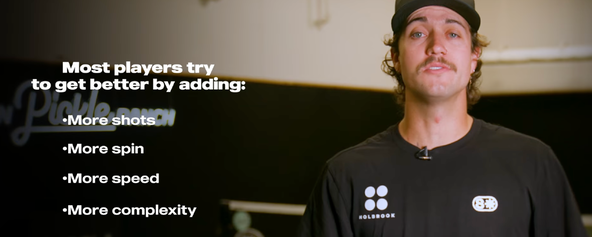
Five mindset shifts every pickleball player should know
Michael Lloyd shares lessons that changed the way he approaches the game, from redefining aggression to letting the ball dictate every shot.
9 days ago
-Pickleball.com Staff
Want to improve fast? Start with these 5 priorities
Build a smarter game with these must-practice fundamentals alongside coach Jordan Briones.
13 days ago
-Pickleball.com Staff