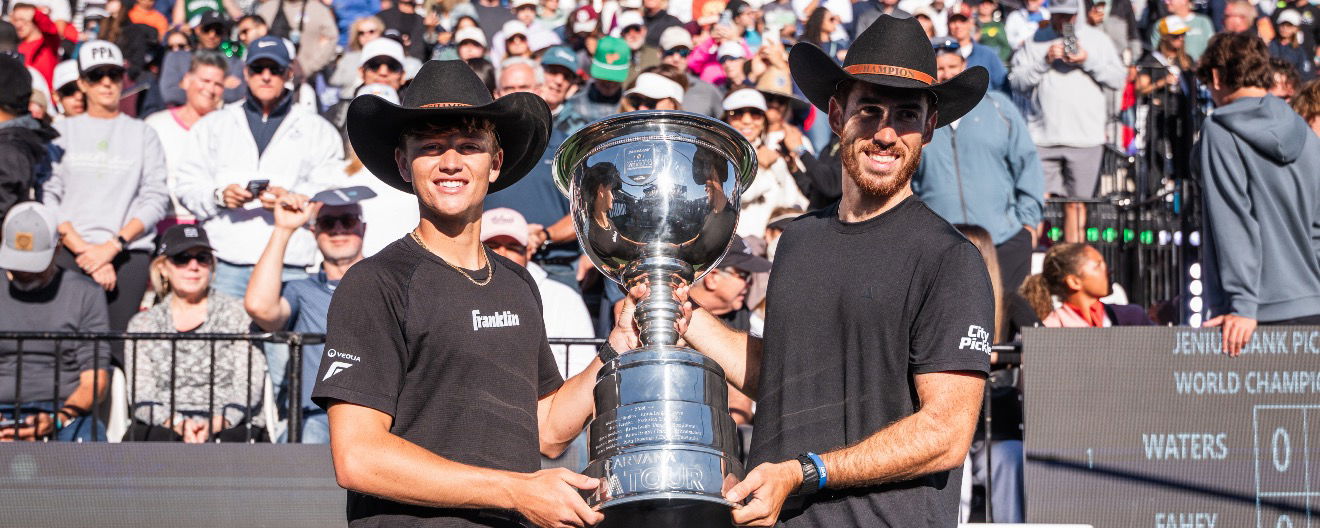
A final look at the Jenius Bank Pickleball World Championships
Jim Kloss
Nov 11 2025 8:30 AM ET
The Jenius Bank Pickleball World Championships is in the books. Over 3,500 pickleball players descended on Brookhaven Country Club to play and to see the pros play. The crowds were large every day, with standing room only on Championship Sunday. All five events had their share of drama.
1. The Anna’s get revenge
Anna Leigh Waters and Anna Bright have dominated women’s doubles in 2025, although not quite to the extent many suspected they would. One of their two losses was to Jorja Johnson and Tyra Black. Those four met in the semifinal, which for many of us was seen as the true gold medal match, as it featured the two best duos in women’s pro pickleball. The first game was very close, and Johnson/Black could easily have won it. But Waters/Bright prevailed and won the match 11-9, 11-2. In the final, Waters/Bright easily defeated Catherine Parenteau/Parris Todd 11-2, 11-2, 11-5. Ever since Waters dropped Parenteau as her doubles partner, Parenteau just appears mentally defeated whenever she faces Waters now as an opponent, and thus none of their matches are really close.
Waters and Bright were dominant all week, but did lose a game to Tina Pisnik/Kate Fahey. Otherwise, there were only two games where opponents were able to score six or more points in a game. Only the pairs of Johnson/Black and the Kawamotos appear to be able to play the combination of consistent defense paired with strong counters that is needed to win two of three games against Waters/Bright.
2. Staksrud/Patriquin win an emotional gold in men’s doubles
Federico Staksrud and Hayden Patriquin have been a top team for nearly two years, but they have had trouble breaking through to gold in 2025, mainly because the Ben Johns/Gabe Tardio powerhouse has defeated them each time they have played. Before they could play Johns/Tardio, Staksrud/Patriquin were heavily tested by Jonathan Truong/Jaume Martinez Vich in the quarters. The experience of Staksrud/Patriquin was just enough for them to get through 12-10, 12-10.
In an epic semifinal, Staksrud/Patriquin finally defeated Johns/Tardio by a relatively easy score of 11-8, 11-5. Staksrud was understandably emotional about the big win. He obviously felt like a mountain had been climbed. But they still had to face JW Johnson/CJ Klinger in the final. Johnson/Klinger took game one 11-8, but Staksrud/Patriquin came back to sweep the next three 11-7, 11-4, 11-8.
The big news on the Staksrud/Patriquin partnership is the now permanent move of Staksrud to the right side, allowing the more athletic Patriquin to man the left side. A switch like this is done for one and only one reason: the partnership agrees that the former right side player is now the better overall player and thus should man the dominant left side. Patriquin certainly believed he was playing at the higher level and thus should play the left side. Staksrud, to his credit, has accepted the right side assignment and he will only get better at it. Thus, there is upside for this pairing. Can Patriquin overtake Johns in 2026 as the best player on the planet?
3. ALW/Ben get tested, but persevere
Anna Leigh Waters and Ben Johns continue to control the mixed doubles draw each tournament. It was no different at Worlds, but they did face a very tough semifinal with Anna Bright/Hayden Patriquin. Bright/Patriquin won a game, but ultimately the top seeds won 11-6, 12-14, 11-5.
The other semifinal was also a close match. Jorja and JW Johnson prevailed over Tyra Black/Christian Alshon 9-11, 11-5, 11-6.
In the final, it was all Waters/Johns, as they defeated the Johnsons 11-7, 11-4, 11-7. Several partnerships are catching up to Waters/Johns, giving them very tough matches. But so far, the top seeds are able to grind out the victories. I do expect they will suffer some defeats over the next year as these other teams improve.
4. ALW completes the triple in singles
Anna Leigh Waters has consistently run over the women’s singles field all year. Worlds had the same result, a gold medal for Waters. She was tested, especially in the semifinal by Kaitlyn Christian. Christian took game one 11-9. But, as always, Waters continued to grind and won the next two games 11-2, 11-6. Waters is the best woman player at many different skills, but arguably her best skill is her competitive drive that has her operating at 100%+ every match, every game, every point, every shot. Some players lose game one and can let down, but not her.
In the final, Kate Fahey was tough as usual, but Waters won 11-4, 12-10. The singles gold, combined with victories in women’s doubles and mixed doubles, gave Waters yet another Triple Crown.
5. Staksrud takes over #1 in men’s singles
Men’s singles, as is always true, was the toughest event to win at Brookhaven. More upsets happen in men’s singles than any other event. Three of the four quarterfinal matches went three games. Federico Staksrud, as the second seed, had a target on his back and the lower seeds were out to get him. In the Round of 16, Zane Ford won game one 11-7, but Staksrud came back to win 11-3, 11-2. In the quarters, Jaume Martinez Vich took game one 11-8, but again Staksrud fought back 11-5, 11-7 to move into the semifinals. Staksrud had a relatively easy time with Connor Garnett in the semifinal and then defeated Chris Haworth in the final 11-9, 11-1. Staksrud thereby regained the #1 ranking over Hunter Johnson, who took the bronze medal. Staksrud and Johnson will undoubtedly trade the number one ranking back and forth over the course of the next few months.
6. Prediction summary
I went with some upsets this week. Best prediction was hitting on Staksrud/Patriquin to defeat Johns/Tardio. I liked the fact that match would take place in the semis, so that Staksrud/Patruquin would only need to win two of three and not three of five as would be true in a final. But my prediction that Johnson/Black could take down Waters/Bright went south. Overall, I hit on six of the 10 finalists, which is decent. The competition continues to get tougher, making it harder to predict the outcomes of matches.
With the holidays approaching, only two tournaments are left on the PPA schedule for 2025. Next up is the Veolia Lakeland Open presented by Six Zero. The year will close out with the Florida Dairy Farmers Daytona Beach Open in December. All the action will be on Pickleballtv.
Follow me on X @pickleball_jim.
Related articles
Mojo Energy Pouches Virginia Beach Open: Everything you need to know
With several star players heading overseas, a big opportunity awaits for other players to claim a title.
2 hours ago
-Pickleball.com Staff
Virginia Beach features wide open draws
No Anna Leigh Waters and no Ben Johns means it is anyone’s tournament to make a mark.
1 day ago
-Jim Kloss
Anna Leigh Waters notches 200th title at Veolia Chicago Cup
The milestones just keep piling up for the young superstar.
1 day ago
-Jim Kloss
Bellamy powers past Haworth for first 2026 title as Waters earns Triple Crown
Roscoe Bellamy earned his second career PPA Tour title in the Windy City. He'll look to replicate this week's success at next week's event in Virginia Beach.
2 days ago
-Pickleball.com Staff