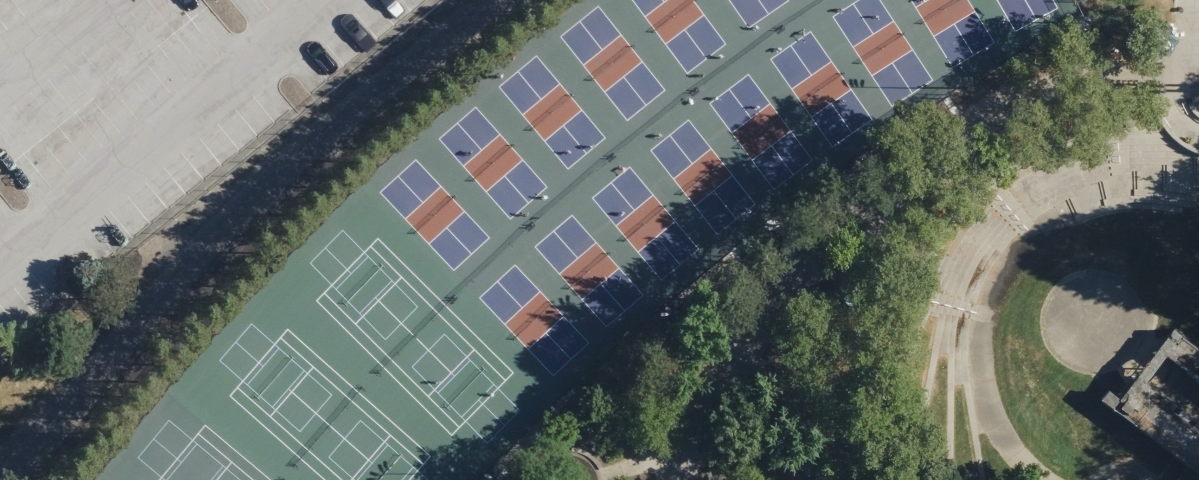
New York Times shares aerial photographs of tennis courts converted into pickleball courts
It's already well established that pickleball is America's fastest-growing sport.
And if you want another indicator, look no further than a story published earlier this week by New York Times reporter Ethan Singer, who penned a revealing piece entitled "How Pickleball Took Over Thousands of Tennis Courts, as Seen From the Sky."
If you want to literally see just how far pickleball has come popularity-wise in the United States, Singer definitely has you covered.
"By analyzing nearly 100,000 aerial photographs, we were able to identify more than 26,000 outdoor pickleball courts made in the last seven years - a majority of them at the expense of once-exclusive tennis spaces and created since the onset of the pandemic in 2020," he writes. "In total, we found more than 8,000 tennis courts that had been transformed for pickleball."
The New York Times' analysis doesn't account for all of the tennis courts (270,000) and pickleball courts (68,000) in the U.S., of course, but Singer's reporting still provides extremely valuable insight on a growing trend.
"The photographs are an expansive, bird's-eye view of what has been happening on the ground in all corners of the country," he explains. "There's only so much ready asphalt to go around, and pickleball can't get enough of it."
Singer spoke with Jon Neeter, the owner of the Santa Monica Pickleball Center, who changed the focus of his business from tennis to pickleball a couple of years ago.
Talk about success.
"By 2024, just a year after the pickleball conversion, Mr. Neeter said the business was bringing in seven times as much revenue as it ever did as a tennis-only shop," noted Singer. "One basic explanation is geometry. Using the same square footage (on his lone tennis court), Mr. Neeter can now host four times as many people, across four times as many classes and events. He can schedule different programs simultaneously, like a children's camp on one court and a competitive drill on another, or lessons at two different skill levels."


There's no denying the math in that example.
Singer makes that abundantly clear.
"The most common approach, our analysis showed, is to overlay a single pickleball court in the middle of the tennis court, where they share a net. But there are far more variations available," he emphasizes. "A pickleball court is 20 feet wide and 44 feet long — just under a third of the size of a tennis court, even less if you count the out-of-bounds running space afforded to tennis courts. That means there are multiple ways to draw two pickleball courts on a tennis court. Or three. Or even four."
What do tennis officials think about all this?
Singer addressed that as well with a little help from the United States Tennis Association's (USTA) Managing Director of Section Partnerships, Ted Loehrke.
"Tensions between tennis and pickleball have eased in the last year or so, Mr. Loehrke said, as stand-alone pickleball courts have become more popular," shared Singer. "Indeed, our analysis found that the number of new pickleball courts created atop tennis courts declined for the first time last year, even as the number of new stand-alone courts — and pickleball courts overall — continued to rise."
In short, pickleball is trending in the right direction.
And that will only continue.
"When asked if there’s a risk he might regret switching his business from tennis to pickleball, Mr. Neeter said there was a "zero percent chance" that it’s a temporary fad," wrote Singer. "It’s weaving into "the fabric of people’s lives," he said. "It’s their social circles. It’s like everything. There’s an addiction to it."
Tennis, however, is still thriving.
Singer stresses that.
"None of this means that tennis is a dying sport. According to research by the USTA, tennis participation has seen a boost since the pandemic, though not as propulsive as pickleball’s," he mentioned. "But even tennis die-hards acknowledge there’s more the sport can do to be welcoming."
That's where red ball tennis, which is being showcased at the 2025 U.S. Open, comes into play.
Singer writes that it's a "fast-paced, more social version of tennis that's also beginner-friendly."
"The sport, developed in collaboration with research firms, is optimized for doubles," he concluded. "It uses shorter rackets and slower balls, and is best played on smaller courts — like pickleball courts."