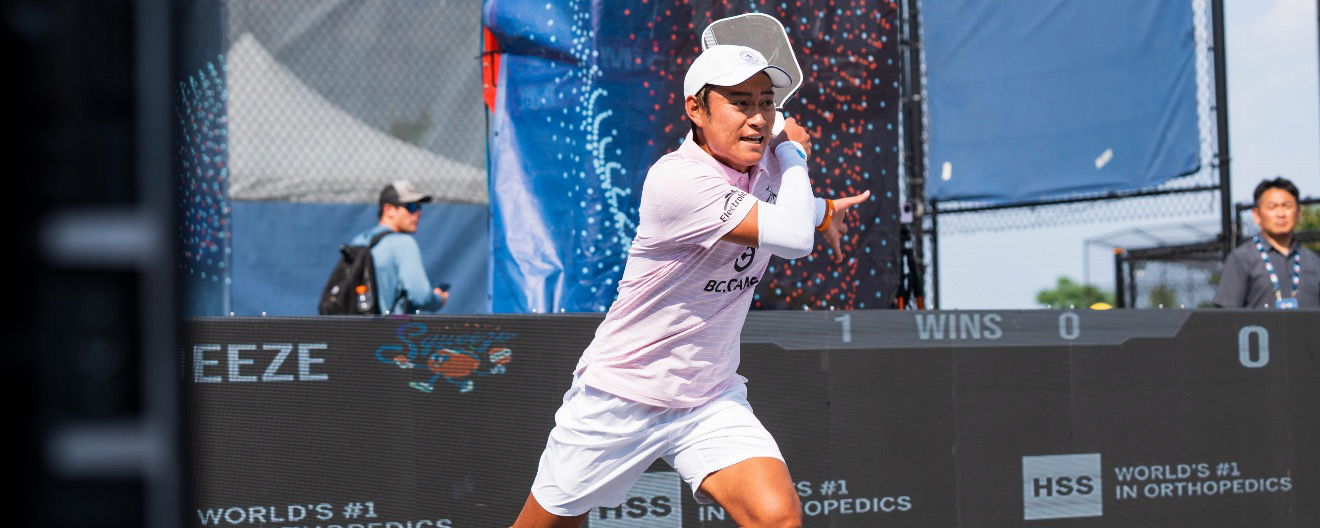
Ten questions with Yuta Funemizu
Toray recently published an exclusive interview with Yuta Funemizu, who earlier this year made history as the first Japanese-born player to sign an exclusive contract with the UPA to compete on the PPA Tour and be eligible to be drafted into MLP.
A Japanese materials manufacturer, Toray is a platinum partner of MLP with kitchen branding at the league’s events.
Here are some key highlights from the conversation with Funemizu:
How did you discover pickleball?
Yuta Funemizu: In 2020, shortly after I became a professional soft tennis player, all domestic and international tournaments were canceled due to the pandemic. As I struggled with feelings of helplessness, an acquaintance introduced me to pickleball, mentioning how it was growing rapidly in the United States.
Having already won almost all titles in soft tennis, including world championships, I reasoned that if I had that ability, I might also be successful in pickleball. I immediately contacted the Japan Pickleball Association, and they gave me an opportunity to hear from the Japan champion at the time.
What did you find appealing after trying it?
Yuta Funemizu: The court is narrower than soft tennis, and I like that it was easier to continue the rally. I had previously taught soft tennis classes all around Japan, and I know how difficult it is to teach racquet sports. Beginners often struggle just to serve, and if the rally doesn’t carry on, they quickly lose interest. In that respect, with pickleball, even beginners can keep a rally going after just 10 or 20 minutes of practice, and enjoy the game. And when playing doubles, you stand close to each other, making it easier to communicate on the court, such as encouraging your partner to take the next shot. I think it’s a sport that fosters connections between people.
How did you feel about the excitement for pickleball in the U.S., where the sport was born?
Yuta Funemizu: When I visited Los Angeles for the first time in 2023, I was surprised to find that pickleball courts were everywhere in the city. Even on weekday mornings, the courts were full, with long waiting times for them to become available. From free public courts to members-only clubs, it seemed that an atmosphere had been established where people from all walks of life could enjoy the game. I felt the potential for pickleball to become popular in Japan at some point.
You had already built a career in soft tennis. What made you decide to try the new world of pickleball?
Yuta Funemizu: I was motivated by the idea of how I could make use of the skills I had mastered in soft tennis to compete on the big stage in the United States. I also felt that pickleball had the potential to be a “gateway” to boost racquet sports in general. My hope is that once people came to know the fun of racquet sports through pickleball, they would also become interested in other sports such as tennis, badminton, and table tennis. As a pioneer aiming to be the best in the world, I had a dream of leading the boom in Japan.
You went to the U.S. on your own. You must have faced a lot of difficulties.
Yuta Funemizu: It was quite difficult at first. I could barely speak English, so I couldn't find a practice partner, and no one wanted to pair up with me in doubles. My playing style was unique, incorporating soft tennis techniques, so I think that made others even more hesitant.
Still, at the match venues, I would approach people and ask if they would like to practice together, or pair up for a match at some point, and we would exchange contact information. As I continued to win matches, others gradually came to accept me as a doubles partner.
How do you make use of your soft tennis skills in pickleball?
Yuta Funemizu: In pickleball volleys, like in regulation-ball tennis, you use different sides of the paddle for forehand or backhand. In soft tennis, however, you use the same side for both. No other player uses this soft tennis style of swing, so my opponents have trouble reading the ball, making it difficult to return.
Did this technique work from the start?
Yuta Funemizu: No. For the first two months, I couldn’t even beat amateurs, so my coach and other players would tell me that I should give up on that style. In fact, I switched to the basic way of playing for about a week. However, with so many rivals, I thought that I wouldn’t be able to win in this sport unless I broke with convention, so I decided to stick with my own style. Nowadays, this is called “YUTA style”, and top players often ask me how they can do it.
In March, you were drafted by the Miami Pickleball Club, becoming the first Japanese MLP player. How did you feel?
Yuta Funemizu: I had won the professional qualifiers a week before the draft, but since few people knew who I was, I was anxious that I might not get picked. To increase my chances, I sent direct messages to all the teams, asking them to take a look at my skills. Fortunately, six teams contacted me for tryouts in response.
It was a hectic week. I flew to Los Angeles for one tryout, took a midnight flight to Miami for another, and then returned to Los Angeles for the third. Despite the intense schedule, I felt the tryouts went well. Still, with the draft approaching, I assumed most teams had already finalized their rosters, so I didn’t have high expectations. That’s why I was genuinely surprised and thrilled when I was drafted. It was an unforgettable moment.
How has life changed for you since becoming an MLP player?
Yuta Funemizu: Joining MLP has brought a major shift in my life. As a player, you gain access to a wide range of support from your team, and the way you're treated changes dramatically. In taxis or at hotels, when people ask if I’m visiting for sightseeing, and I explain that I play professional pickleball in the major leagues, the reaction is always one of excitement. Americans have a lot of respect for pickleball players, and I feel that MLP players in particular, enjoy a special status.
Finally, what are your goals for the future?
Yuta Funemizu: Simply put, my goal is to become the best in the world. That is, to compete as an individual on the PPA Tour and win the world’s premier team competition, MLP. Each team has passionate fans, and the enthusiasm of the people watching the game is growing. I want to thrive in these fiercely competitive matches and make a name for myself as a Japanese athlete. The path ahead won’t be easy, but I’m committed to pushing forward without giving up.
Related articles

Everything you missed in pickleball in September
It was another busy month in the picklesphere.
12 days ago
-Victoria Radnothy

Tama Shimabukuro makes his mark at Veolia Atlanta Pickleball Championships
Let’s go over what Shimabukuro did, and examine some reasons for why it happened.
162 days ago
-Jim Kloss

Miami ends skid with sweep of Hustlers as Funemizu makes history
Yuta Funemizu made history Friday afternoon when he became the first Japanese player ever to record a game win in Major League Pickleball.
466 days ago
-Will Daughton