.jpg?width=1320&height=528&optimizer=image)
DUPR Algorithm Update: What It Changes for Tournaments
Why the New DUPR Rating Algorithm Matters for Tournament Directors
DUPR recently announced a significant update to its rating algorithm—and it has important implications for tournament directors and players alike.
Under this new system, DUPR ratings are no longer determined solely by wins and losses. Instead, the algorithm now evaluates how a player performs compared to what was expected before the match began. This performance-based approach gives a more accurate picture of a player’s true skill level and makes every point in a match more meaningful.
What’s Changed in the DUPR Algorithm?
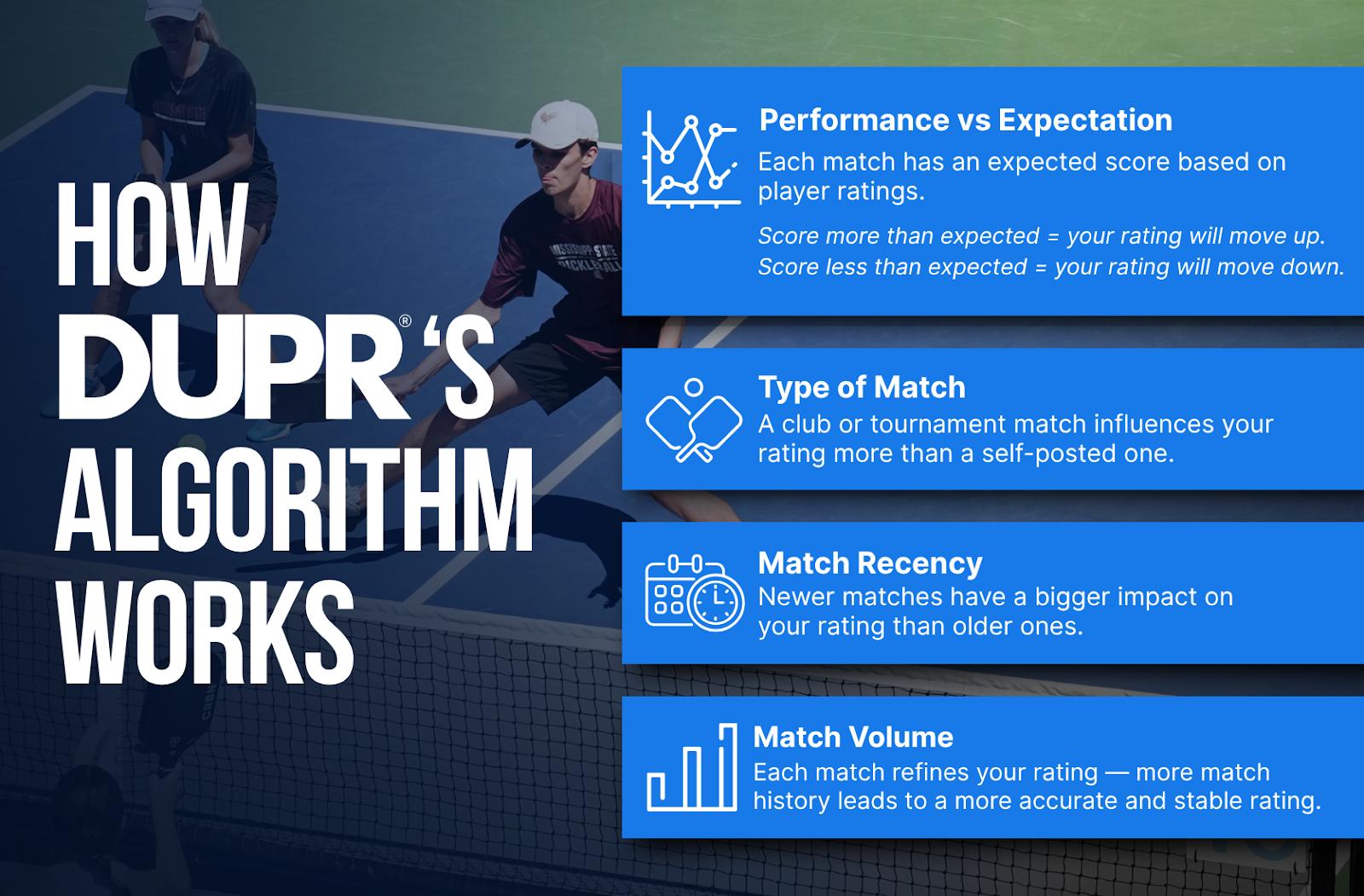
The updated algorithm introduces a concept called “performance vs. expectation.”
Before each match, DUPR calculates an expected score based on the ratings of the players or teams involved. After the match is completed, the system compares the actual score to that predicted outcome.
A player’s rating then adjusts based on how their performance compares to that expectation.
Here’s how it works:
• Outperform expectations: Your rating increases—even if you lose the match.
• Underperform expectations: Your rating decreases—even if you win the match.
This represents a major shift from the previous system, where winners always gained rating points and losers always lost them.
Examples That Matter to Your Players
Understanding the impact of this change is easier when looking at real match scenarios.
Doubles Example
Imagine a team is expected to win a match 11–3 based on their ratings.
If that team wins 11–8, they actually underperformed relative to the expectation, so their rating could decrease.
Meanwhile, the losing team exceeded expectations by keeping the match much closer than predicted, so their rating may increase despite the loss.
Singles Example
A 3.5-rated player is expected to lose to a 4.0-rated opponent with a predicted score of 5–11.
If the final score ends up being 9–11, the 3.5 player has significantly exceeded expectations. As a result, their rating will likely increase, even though they didn’t win the match.
Why This Matters for Tournament Directors
Tournament directors play an important role in creating fair and competitive events. The updated DUPR algorithm supports that goal in several ways.
More Accurate Ratings
The new system evaluates how competitive matches actually are, rather than relying only on final outcomes. This improves rating accuracy, especially for players who are rapidly improving.
Rewards Competitive Play
Players are now rewarded for pushing stronger opponents and keeping matches close, which encourages more competitive gameplay across all skill levels.
Encourages Better Matchups
Because close matches can benefit both players’ ratings, participants may feel more comfortable entering divisions with stronger competition.
Stronger Seeding and Brackets
More accurate ratings help tournament directors create better:
• Seeds
• Bracket structures
• Competitive divisions
This leads to fairer tournaments and a better overall experience for players.
Every Point Matters More Than Ever
One of the biggest impacts of this update is that every point in a match now carries more weight.
Under the new algorithm:
• A close loss can still improve a rating
• A narrow win might hurt a rating if expectations aren’t met
• Competitive rallies directly influence rating changes
This system encourages players to fight for every point, regardless of the scoreline.
Why This Helps Mixed Skill Events
This update is especially valuable in formats where players of different skill levels compete together, such as:
• Round robin events
• Age and skill combined divisions
• Open tournaments
Players can now feel confident that their performance will be recognized, even if they face stronger opponents.
What This Means for Your Players
The updated DUPR system reflects a more realistic picture of player ability.
Players who consistently perform well against stronger competition will see their ratings improve—even when they don’t win every match.
As DUPR describes it:
“Whether you're the underdog or the favorite, the algorithm rewards players who perform above expectations.”
Next Steps for Tournament Directors
Tournament directors can help players understand the impact of these changes by encouraging them to explore DUPR’s updated algorithm resources.
Understanding how the system works helps players:
• Choose appropriate divisions
• Interpret rating changes correctly
• Focus on competitive performance rather than just wins and losses
Final Thoughts
The new DUPR algorithm represents an important step forward for pickleball competition.
By measuring performance relative to expectations, the rating system now better reflects how players actually compete on the court. For tournament directors, this means stronger seeding, more accurate brackets, and a competitive environment players can trust.
In the end, this update reinforces something tournament organizers already know: great competition deserves to be recognized—and now the rating system reflects that more accurately than ever before.
Related articles
.png?width=592&height=237&optimizer=image)
DUPR rating too low? Start reporting your rec games
Your weekly games can help your DUPR rating reflect how you really play.
16 days ago
-Joseph Sutton

The best pickleball ball machines to elevate your game
It's a simple way to improve on the court.
29 days ago
-Victoria Radnothy

The DUPR Reset Confirmed Something We Already Knew About Getting Better
123 days ago
-Tyrece Warner

DUPR Rating Reset: What Players Need to Know
213 days ago
-Tyrece Warner