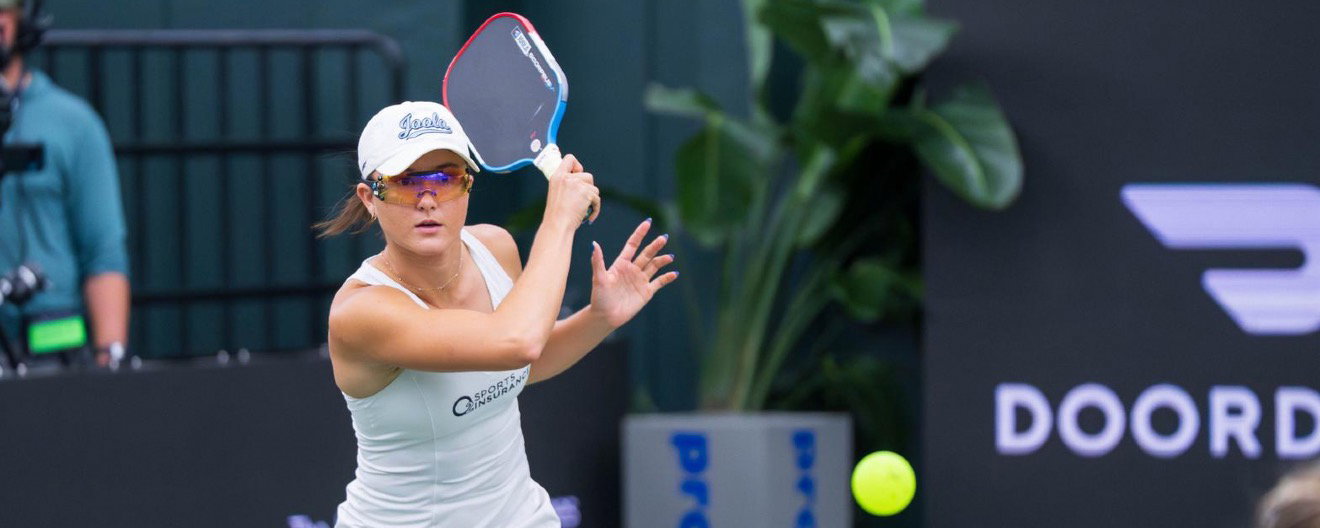
Anna Bright shares how to raise your pickleball ceiling
If you've been playing pickleball consistently but feel like your progress has stalled, you may have reached a performance plateau. According to Anna Bright, the key to breaking through isn't always reducing mistakes, it's learning how to raise your ceiling by becoming a more dangerous and unpredictable player.
Know whether it's time to raise your ceiling
Before focusing on advanced skills, video yourself playing and watch your matches. If you're losing because of unforced errors then consistency should remain your priority. However, if you're reaching the kitchen, keeping rallies alive, and still struggling to beat stronger opponents, the problem may be that you're not applying enough pressure.
When opponents feel comfortable hitting to you, it's a sign that your game needs more offensive options rather than fewer mistakes.
Build variety without sacrificing consistency
One of the biggest factors in pickleball strategy is expanding your shot arsenal. Variety includes your ability to change speed, spin, placement, and trajectory while attacking from different positions on the court.
Developing weapons such as forehand speed-ups, backhand flicks, aggressive dinks, and effective attacks off the bounce makes you much harder to predict.
However, variety only works when it's built on consistency. Having every shot in your toolbox doesn't help if you can't execute them reliably or choose the right moment to use them.
Improve your pickleball IQ
Shot selection is just as important as shot execution. Great players don't simply possess more skills, they know exactly when to use them.
Improving your pickleball IQ means recognizing attackable balls, understanding your opponents' weaknesses, and making smarter decisions throughout each rally. Watching your own matches helps identify situations where a better decision could have created more offensive pressure.
Develop weapons on both sides
A balanced offensive game prevents opponents from targeting your weaknesses.
Ideally, you should have reliable attacking options:
-
Off the bounce on both forehand and backhand
-
Out of the air on both forehand and backhand
If one side lacks an offensive threat, experienced opponents will repeatedly direct the ball there until they force an error. Adding even one dependable weapon to each wing makes your entire game more difficult to exploit.
Apply constant pressure
Anna Bright emphasizes that pressure is the defining characteristic of elite pickleball. Pressure doesn't simply mean hitting harder, it means making opponents feel like every slight mistake will be punished.
You create pressure by:
-
Attacking high dinks
-
Keeping opponents deep after returns
-
Moving the ball to uncomfortable locations
-
Using aggressive court positioning
-
Mixing pace, spin, and placement
The goal is to make opponents feel like nothing is safe, forcing rushed decisions and creating opportunities to finish points.
Focus on the fourth shot
A lot of players are hyper fixated on the third shot. But oftentimes, the fourth shot is an underutilized weapon. Since it appears in nearly every rally, developing a stronger fourth shot can help keep opponents from advancing comfortably to the kitchen and immediately shift momentum in your favor.
Improving your pickleball strategy isn't just about eliminating mistakes. Once your fundamentals are solid, raising your ceiling requires smarter decision-making, greater shot variety, and the ability to apply relentless pressure. By honestly evaluating your game, expanding your offensive options, and learning when to attack, you'll become a far more complete player and give your opponents far fewer places to hide.
To keep up to date on all things pickleball, follow us on Instagram.
Related articles
How to completely change your pickleball serve in 10 minutes
A few simple adjustments could help you add power, improve accuracy and eliminate the yips.
5 days ago
-Pickleball.com Staff
.png?width=592&height=237&optimizer=image)
Five ways to elevate your dink game like a pro
These strategies can help you make smarter decisions and gain the upper hand in kitchen line battles.
5 days ago
-Pickleball.com Staff
Five mindset shifts every pickleball player should know
Michael Lloyd shares lessons that changed the way he approaches the game, from redefining aggression to letting the ball dictate every shot.
6 days ago
-Pickleball.com Staff
Want to improve fast? Start with these 5 priorities
Build a smarter game with these must-practice fundamentals alongside coach Jordan Briones.
10 days ago
-Pickleball.com Staff