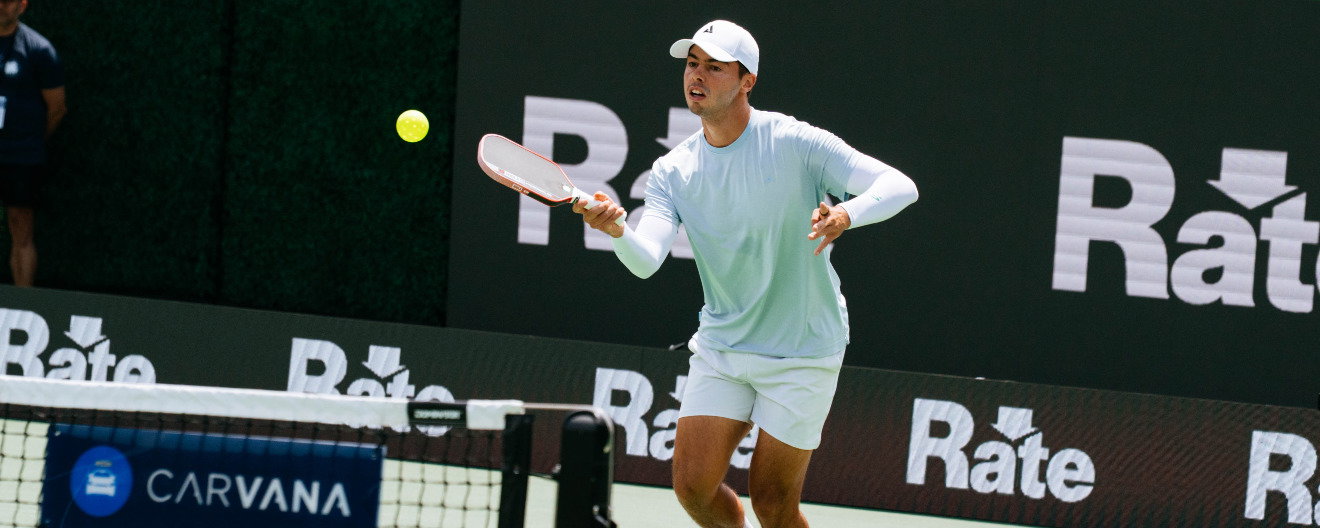
How to build mental toughness on the pickleball court, with Ben Johns
If you’ve ever played pickleball, you know just how quickly things can move in a game.
One moment, it’s 0-0-2, and you’re feeling confident and ready to go; the next, it’s 0-8, and you feel like you couldn’t hit the side of a barn with the ball if you tried.
Regulating your mental state on court is one of the most important, yet underrated, aspects of bringing your best level to every match.
Ben Johns, considered the GOAT of pro pickleball on the men’s side, discusses how to build mental toughness on the pickleball court in this video:
Here are some of the GOAT’s keys to developing that crucial skill.
Find Your Optimal Mental State
At the heart of Johns’ perspective is the idea that every player needs to discover the mental state that allows them to perform at their best.
This state isn’t accidental. It’s something you learn to access across everything you could encounter, including pressure-filled situations, stressful moments, and changing conditions.
Pickleball presents constant mental challenges; opponents, environment, and momentum all influence how you feel and think. The key is learning how to return to a state where you are clear, composed, and effective regardless of those inputs.
Use Triggers to Reset Your Mind
For players who are still developing this skill, Johns recommends using simple physical or mental triggers to return to the right state.
These can be small, deliberate actions such as tapping the fence, touching your arm, or any consistent gesture that signals a reset. The choice is yours!
The purpose of a trigger is to tell your mind: “Return to my best state.”
Over time, this process becomes more automatic. What starts as something intentional eventually becomes a habit you don’t have to think about.
Don’t Treat the Mind as an Enemy
A unique and important idea Johns shares is that many players approach mental toughness the wrong way: they see it as a battle against themselves.
Instead of fighting frustration or forcing focus, he suggests adopting a different mindset:
- View your ideal mental state as something you want to reach
- Recognize that being in that state feels good
- See it as satisfying and repeatable, not stressful
Mental toughness isn’t about struggle—it’s about consistently returning to a state that helps you play well and feel good doing it.
Train Mental Toughness Like a Skill
In short, Johns is adamant that mental toughness isn’t something you either have or you don’t; rather, it’s a skill that must be practiced.
Just like a third shot drop or a midcourt reset, it requires repetition, intention, and conscious effort.
At first, maintaining focus and resetting your mindset takes effort. But over time, with enough practice, it becomes automatic—something you do without thinking.
That’s the goal: reaching a point where your mental game runs on autopilot in a positive way.
Try thinking about these points the next time you’re on court, and see how your mental toughness develops!
Related articles
Five pickleball tips to improve your game from beginner to 4.0
Coach Jess breaks down concepts that can help players win more points, improve consistency, and avoid common mistakes on the court.
5 hours ago
-Pickleball.com Staff
How to completely change your pickleball serve in 10 minutes
A few simple adjustments could help you add power, improve accuracy and eliminate the yips.
6 days ago
-Pickleball.com Staff
.png?width=592&height=237&optimizer=image)
Five ways to elevate your dink game like a pro
These strategies can help you make smarter decisions and gain the upper hand in kitchen line battles.
6 days ago
-Pickleball.com Staff
Five mindset shifts every pickleball player should know
Michael Lloyd shares lessons that changed the way he approaches the game, from redefining aggression to letting the ball dictate every shot.
7 days ago
-Pickleball.com Staff