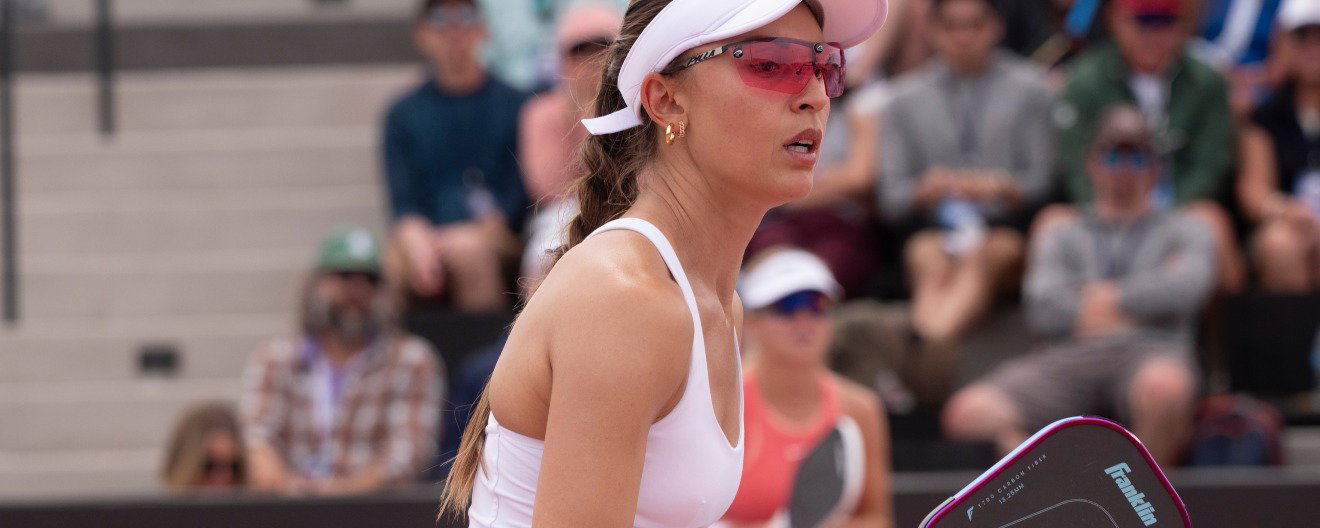
Parris Todd: The real way to play mixed doubles
Mixed doubles isn’t just pickleball with a man and a woman on the court, it’s a completely different game. Many players would argue it’s the toughest event to truly master. The rhythm changes, the shot selection shifts, and the mental side becomes just as important as the physical. When everything clicks, it feels effortless, almost like you’re playing in sync without thinking. But when it doesn’t, it can unravel fast. So what actually makes great mixed teams work? Let’s break down the unspoken formula the best in the game rely on.
1. Court coverage: The myth, the math, and the reality
Here’s the truth: The male player should be covering roughly 60–85% of the court. Not because the woman can’t hang, but because mixed doubles is built around pressure, angles, and who can consistently generate offense from the middle.
Most balls that come to the woman’s left foot are actually easier and more efficient for the man to take. Those are the balls that sit up in the “danger zone,” the zone where a guy can step in, rip, and immediately force the other team to panic.
But here’s where guys mess up in mixed: Overextending to her right foot. That’s a trap. The minute the guy stretches all the way across his partner’s body to take balls on her right foot, he abandons his line, his angle, and his backside.
That’s when opponents say, “Thank you very much,” and burn him down the line or
behind him. Stay in your lane, guys. Be big, not reckless and don’t overextend.
2. What the woman actually controls (Hint: It’s not less important, it’s more)
In great mixed teams, the woman is the anchor. She’s the one setting the tone. When she plays steady, consistent, and low error, it gives the guy all the freedom in the world to be aggressive.
A consistent woman gives her partner better margins to take risks. A high-error woman forces her partner to play safer, which basically cancels out the whole point of mixed. The man can’t come flying middle if he’s worried she’s about to pop up a dink or sail a drive long.
So ladies, think consistency, easy depth, clean resets, smart dinks. Not passive, not timid. Just smart.
3. Third-shot roles (This is where mixed gets fun)
A top mixed team does this without even talking: The male player will often come over and take the middle third shot, whether that is a drop or a drive, especially if the ball is drifting even slightly toward his zone.
But when the woman does take her third shot, the man should crash to put pressure on his opponents. You drop it? He’s already on top of the kitchen, suffocating the other team’s girl, picking off the pop up, and finishing the point before anyone knows what happened.
This is textbook mixed pressure.
4. Targeting, but not being predictable
Yes, let’s not pretend, opponents target the woman in mixed, Everyone knows it. But the good mixed players don’t just mindlessly go after her on every shot or opportunity They stay unpredictable.
Smart teams will:
• Target the woman early
• Go behind the male player when he shades too far middle
• Then go right back to the woman’s left foot, the most vulnerable spot in mixed to open her up again.
This is how you keep the other team off-balance.
5. The woman’s offense: When and where to strike
Ladies, you can speed up, just do it intentionally.
Timing matters. The best moment? When the opposing male overextends himself to his partner’s side, usually on dinks to his partner’s left or right foot (whenever he is drifting over to the middle, or even more over to her right foot), the best spot to speed up in these circumstances would be up his line (to his backside/backhand/open court behind him).
That’s the moment you rip behind him to keep him honest, freeze his feet, and make him second guess shading middle again.
This isn’t “Being aggressive for no reason.” This is holding your real estate.
When both players understand their lanes, mixed becomes electric. You don’t outmuscle people. You out-think, out-time, and out-pressure them.
Related articles
Gabe Tardio embraced the right side
It helped the 21-year-old reach the top of men’s doubles.
1 day ago
-Victoria Radnothy
Five pickleball tips to improve your game from beginner to 4.0
Coach Jess breaks down concepts that can help players win more points, improve consistency, and avoid common mistakes on the court.
4 days ago
-Pickleball.com Staff
How to completely change your pickleball serve in 10 minutes
A few simple adjustments could help you add power, improve accuracy and eliminate the yips.
10 days ago
-Pickleball.com Staff
.png?width=592&height=237&optimizer=image)
Five ways to elevate your dink game like a pro
These strategies can help you make smarter decisions and gain the upper hand in kitchen line battles.
10 days ago
-Pickleball.com Staff