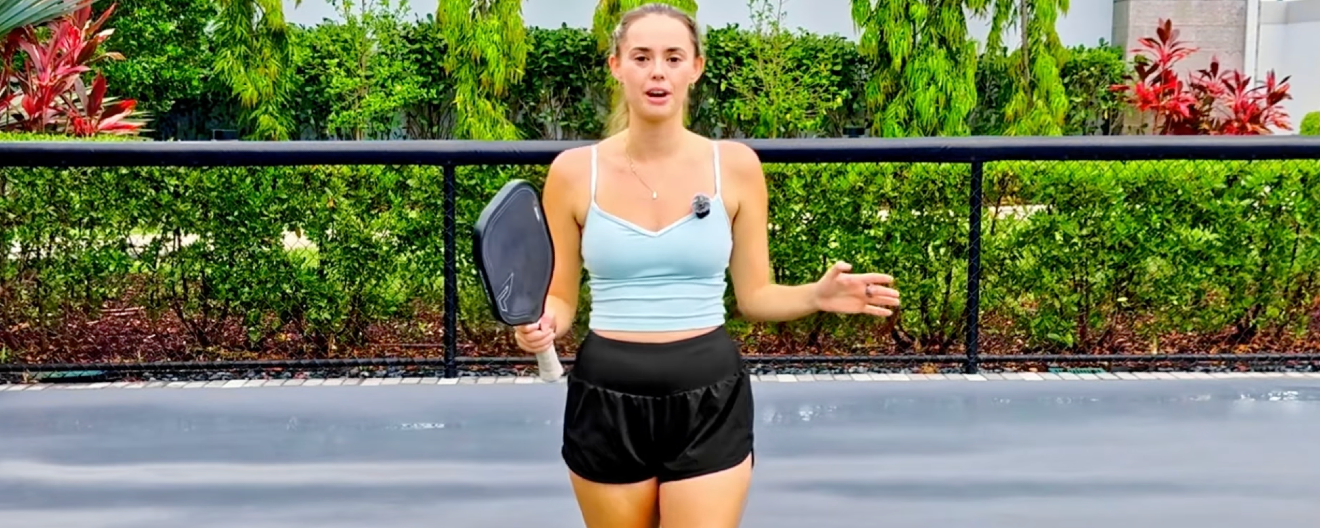
Three must-know pickleball patterns you’re already using (but not mastering yet)
Many pickleball players assume that “patterns” are advanced concepts reserved for high-level pros, but according to PPA Tour player Ava Ignatowich, that is not actually the case. She explains that most players are already using these patterns in their games without realizing it, but they are not yet executing them with intention or consistency.
In the first part of her series on patterns, she breaks down three of the most common and important sequences in pickleball. She also explains how players can train them so they become automatic during real match play.
Pattern 1: Third shot drive into a fifth shot drop
One of the most important transition patterns in modern pickleball is the combination of a third shot drive followed by a fifth shot drop. Instead of always relying on a third shot drop, many higher-level players choose to drive the ball aggressively first and then reset the point with a controlled drop as they move forward.
This pattern is effective because the third shot drive can immediately pressure opponents and sometimes force weak returns or outright errors. It also allows players to target one opponent and disrupt defensive positioning early in the rally. When the drive is solid, the fifth shot becomes easier to manage because the opponents are often on the defensive and less able to apply pressure.
Ignatowich emphasizes that this pattern is especially important for players in the mid-level range because it teaches them how to handle the transition zone, which is where many points are lost. She explains that most amateur players struggle in this area because it is difficult and uncomfortable, but it is also where matches are often decided.
To practice this pattern, she recommends starting with one player at the baseline and another at the kitchen line. The baseline player hits a third shot drive, then both players continue the rally as if it were a live point, with the expectation that a fifth shot drop will be required. She also encourages players to practice both crosscourt and down-the-line variations, with a strong emphasis on crosscourt execution because it offers more margin for error.
Pattern 2: Crosscourt dinks into a down-the-line speed-up
The second common pattern appears at the kitchen line and is one that players already use frequently, even if they do not recognize it. It begins with crosscourt dinking and transitions into a down-the-line speed-up when the opportunity arises.
In this pattern, all four players are positioned at the kitchen line and engaged in a controlled crosscourt dink exchange. During this phase, players are waiting for a high or weak dink that can be attacked. When that opportunity appears, the attacking player speeds the ball up down the line.
This pattern is effective because crosscourt dinking naturally creates rhythm and opens up slight weaknesses in positioning. The down-the-line speed-up then targets an opponent who is often less prepared for a sudden change in direction, which increases the chance of winning the point.
To train this pattern, Ignatowich suggests practicing crosscourt dinking with a partner while actively searching for attackable balls. She also recommends aiming at a target during the speed-up phase to improve accuracy and decision-making under pressure. The key is not simply to attack, but to recognize when the pattern presents itself in real time.
Pattern 3: Wide dink, wide dink, then middle attack
The third pattern is slightly more advanced but follows a simple structure. It involves hitting a wide dink to one opponent, then a wide dink to the other opponent, and finally attacking the middle of the court.
This pattern works because it forces both defenders to move laterally and recover before the attack occurs. When players are stretched wide in both directions, they often become slightly off-balance or slower to recover to the center of the court. The middle attack then targets that moment of instability.
Ignatowich explains that this is one of the most effective ways to create openings at the kitchen line because it does not rely on raw power. Instead, it relies on displacement, timing, and disguise.
To practice this pattern, players can work with a partner using fed balls or structured drills. One player should execute the sequence of wide dink, wide dink, and then a controlled attack through the middle. She also stresses the importance of disguise, noting that the best players do not reveal the speed-up early and instead keep their intention hidden until the final moment.
The bigger picture: Learning to see the game in sequences
Across all three patterns, the central idea is that pickleball is not a random collection of shots. Instead, it is a game built on repeatable sequences that appear consistently under pressure.
According to Ignatowich, players who learn to recognize these patterns gain a significant advantage because they are no longer reacting to individual shots in isolation. Instead, they begin to see how points are developing before they fully unfold.
As she continues this series, she plans to explore more advanced patterns, including transition variations and ways that pros intentionally disrupt these common sequences
Related articles
Five pickleball tips to improve your game from beginner to 4.0
Coach Jess breaks down concepts that can help players win more points, improve consistency, and avoid common mistakes on the court.
5 hours ago
-Pickleball.com Staff
How to completely change your pickleball serve in 10 minutes
A few simple adjustments could help you add power, improve accuracy and eliminate the yips.
6 days ago
-Pickleball.com Staff
.png?width=592&height=237&optimizer=image)
Five ways to elevate your dink game like a pro
These strategies can help you make smarter decisions and gain the upper hand in kitchen line battles.
6 days ago
-Pickleball.com Staff

Five mindset shifts every pickleball player should know
Michael Lloyd shares lessons that changed the way he approaches the game, from redefining aggression to letting the ball dictate every shot.
7 days ago
-Pickleball.com Staff