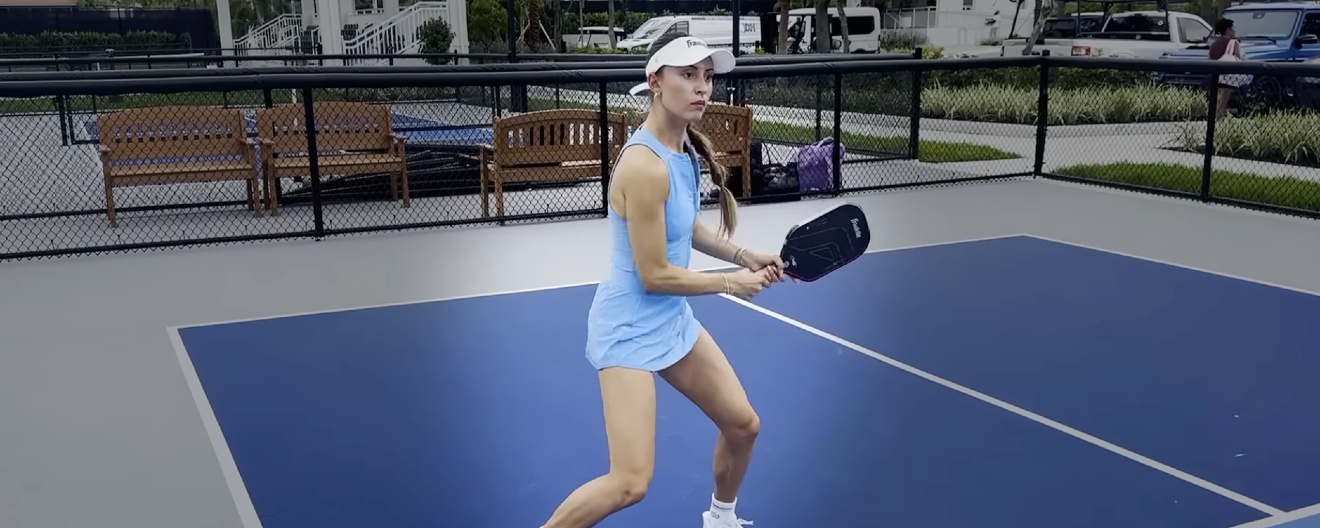
Inside Parris Todd’s two-handed backhand counter
If you’ve ever felt rushed or overpowered at the net, the two-handed backhand counter might be the shot you’re missing. One of the fastest and most effective weapons in modern pickleball, it allows players to turn defense into offense in a split second. In this breakdown, Parris Todd walks through exactly how she reads the speed-up, positions her body, and executes a clean, compact counter with precision.
Step 1: Recognize the Speed-Up Early
The two-handed backhand counter begins before your opponent even makes contact with the ball. Parris Todd emphasizes the importance of reading early cues, especially during dink rallies.
She explains that if an opponent takes a slightly bigger swing, it is usually a sign that they are about to speed the ball up.
“If I feel like you're taking slightly a bigger swing, then I'm going to make sure I load my body and get ready.”
Once she recognizes this, she prepares by shifting her body, turning into position, and anticipating that the ball may come directly toward her body.
Step 2: Take Away Your Opponent’s Easiest Shot
Todd focuses heavily on positioning. Her goal is to take away her opponent’s highest-percentage shot, which is typically the speed-up down the line.
She accomplishes this by following the ball after every dink and adjusting her positioning accordingly. If she hits a ball to a certain spot, she moves to cover the most likely return from that position.
If a player fails to move and adjust, they leave open space on the court, which makes it easier for their opponent to attack.
Step 3: Master the Mechanics
The mechanics of the two-handed backhand counter rely on efficiency and timing rather than a large swing.
Todd begins in a balanced ready position with her hands near her core. As she recognizes the incoming ball, she turns her body to load power and prepares for contact.
She generates power primarily through her core while also absorbing the pace of her opponent’s shot. This allows her to redirect the ball effectively without needing a big backswing.
Step 4: Keep the Swing Compact and Controlled
Todd keeps her swing short and controlled to maintain proper timing. She avoids taking a big swing because it would cause her to be late on the ball.
She makes contact in front of her body, keeps her paddle square to the net, and pushes through the ball rather than wrapping around it.
She also prefers to hit the ball flatter. Because the game has become faster, adding spin often requires more time and can reduce consistency. A flatter contact allows her to react quickly and keep the shot simple.
Step 5: Avoid Getting Jammed
One of the keys to executing this shot successfully is avoiding being jammed when the ball is hit toward the body.
Todd explains that she slides early to create space and slightly favors her backhand side, especially when playing on the right side of the court. Even if she initially guesses incorrectly, she continues to adjust her positioning at the last moment.
At times, she moves so aggressively to create space that she ends up off the court. In those situations, her partner must cover the middle to prevent leaving an open gap.
Step 6: Know When to Add Shape
Todd makes a clear distinction between when to hit flat and when to add shape to the ball.
If the ball is above net level, she recommends hitting it flat and driving through it. If the ball is below the net, she advises adding shape to lift it back over.
Trying to add spin to a fast ball at chest height is unnecessary and often leads to mistakes because it takes extra time and reduces consistency.
The two-handed backhand counter is not just about technique; it is about anticipation, positioning, and efficiency.
By recognizing the speed-up early, moving into the correct position, and keeping the swing compact, players can turn a defensive situation into an offensive opportunity.
Mastering this shot allows players to react quickly and stay in control of fast-paced exchanges at the net.
Related articles
Five pickleball tips to improve your game from beginner to 4.0
Coach Jess breaks down concepts that can help players win more points, improve consistency, and avoid common mistakes on the court.
5 hours ago
-Pickleball.com Staff
How to completely change your pickleball serve in 10 minutes
A few simple adjustments could help you add power, improve accuracy and eliminate the yips.
6 days ago
-Pickleball.com Staff
.png?width=592&height=237&optimizer=image)
Five ways to elevate your dink game like a pro
These strategies can help you make smarter decisions and gain the upper hand in kitchen line battles.
6 days ago
-Pickleball.com Staff
Five mindset shifts every pickleball player should know
Michael Lloyd shares lessons that changed the way he approaches the game, from redefining aggression to letting the ball dictate every shot.
7 days ago
-Pickleball.com Staff