Understanding swing weight and twist weight by paddle shape
Walk through any paddle spec sheet and you'll find the static weight listed front and center, usually something like 7.8 or 8.1 ounces. It's the number everybody checks first, and it's also the number that tells you the least. Two paddles with identical static weights can feel completely different in your hand, and the reason comes down to two measurements that matter far more: swing weight and twist weight.
The good news is that neither concept is complicated, and once you know what counts as low, medium, or high for the shape you're shopping, you can read a spec sheet and know how a paddle will feel before you ever hit a ball with it.
What these numbers mean, and why static weight falls short
Swing weight measures how heavy a paddle feels when you actually swing it. The key insight is that it's driven by where the weight sits, not just how much of it there is. Picture a hammer. Swing it the normal way and it feels heavy and slow. Now flip it around and hold it by the head. Suddenly it whips through the air with almost no effort, even though the hammer weighs exactly the same. Nothing changed except where the mass sits relative to your hand.
Paddles work the same way. Weight concentrated up in the head makes a paddle swing heavy. Weight down near the handle makes it swing light. Static weight can't tell you which one you're getting, which is why a 7.6 ounce paddle can feel slower in a firefight than an 8.1 ounce paddle. The scale doesn't know where the weight lives. Swing weight does.
Twist weight measures something different: how well the paddle face resists rotating when you hit the ball off center. If you've ever caught a reset toward the edge of the face and felt the paddle torque in your hand while the ball died into the net, you've experienced low twist weight firsthand. A higher twist weight means the face stays put on those misses, which in practical terms means a bigger, more forgiving sweet spot.
That's the whole vocabulary. Swing weight is how the paddle moves. Twist weight is how it forgives.
How to use the numbers
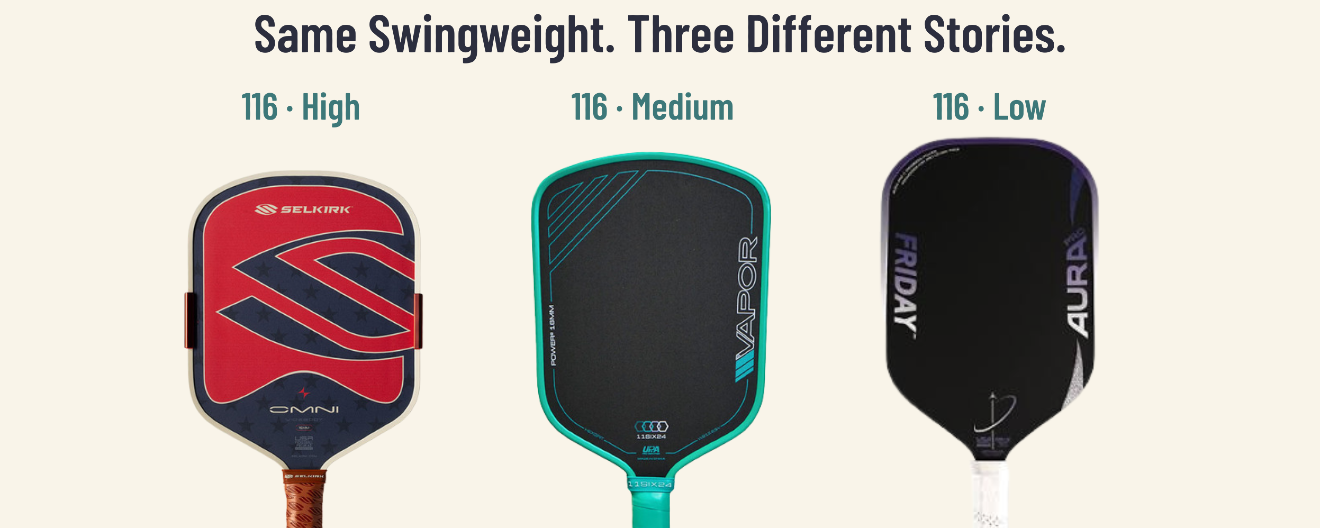
Here's where most explainers leave you hanging. They give you the concepts and then wave at a range like "swing weights run from 100 to 140" without telling you what number to actually look for. The problem is that the answer depends entirely on the shape of the paddle, because each shape carries its weight differently. Elongated paddles put more mass farther from your hand, so their swing weights run naturally higher. Widebodies keep the mass closer in and spread it toward the edges, so they swing lighter and resist twisting better. A 116 swing weight is heavy for a widebody, dead average for a hybrid, and light for an elongated. Same number, three different meanings.
So instead of one range, you need a table. We built these from measured data across hundreds of paddles, broken out by shape. Find the shape you're shopping, then check where a paddle's numbers land.
Swing weight by shape
| Shape | Very Low | Low | Medium | High | Very High |
|---|---|---|---|---|---|
| Widebody | ≤ 102 | 103–108 | 109–111 | 112–115 | ≥ 116 |
| Hybrid | ≤ 107 | 108–112 | 113–116 | 117–118 | ≥ 119 |
| Elongated | ≤ 110 | 111–116 | 117–119 | 120–124 | ≥ 125 |
Twist weight by shape
| Shape | Very Low | Low | Medium | High | Very High |
|---|---|---|---|---|---|
| Widebody | ≤ 6.1 | 6.2–6.8 | 6.9–7.1 | 7.2–7.5 | ≥ 7.6 |
| Hybrid | ≤ 5.8 | 5.9–6.3 | 6.4–6.7 | 6.8–7.0 | ≥ 7.1 |
| Elongated | ≤ 5.4 | 5.5–5.9 | 6.0–6.2 | 6.3–6.7 | ≥ 6.8 |
A note on the extremes: Very Low and Very High mark true outliers, not just the light or heavy end of normal. A paddle in the Very High swing weight column for its shape is a genuine tank, the kind of thing former tennis players seek out and everyone else finds exhausting. The middle three columns describe the vast majority of what's on the market.
One important thing before you start hunting for the lowest numbers you can find: high swing weight is not a flaw. It's a tradeoff. More swing weight means the paddle plows through the ball instead of getting pushed around by it, which shows up as more power on full swings and more stability when you're blocking a hard drive or resetting out of trouble. What you give up is hand speed. Low swing weight buys you quickness at the net and costs you that mass behind the ball.
And here's the part that surprises people: going too low can actually work against you physically. A very light-swinging paddle transfers more impact shock to your arm because there's less mass absorbing the collision with the ball. If you deal with tennis elbow and impact shock is part of the problem, dropping to the lightest paddle you can find may make things worse, not better. A moderate swing weight that lets the paddle do more of the work is often the friendlier choice for your arm. The goal isn't low. The goal is the highest swing weight you can comfortably move for every shot in your game.
Matching the numbers to your game
The table tells you what the numbers mean. Here's how they combine for the way you actually play.
The counterpuncher who lives at the kitchen. If your game is fast hands, quick counters, and winning the firefight, prioritize a Low to Medium swing weight for your shape so the paddle gets around fast, paired with a Medium or better twist weight so your blocks stay stable when someone tees off on you. A hybrid around 110 to 113 swing weight with a twist weight of 6.4 or better is a classic setup here.
The driver who wins from the baseline. If your points end with pace, look High on swing weight for your shape. That extra mass is where plow-through and putaway power come from, and you'll feel it most on full ground strokes. An elongated in the 120 to 124 range gives you that heavy ball, and since elongated shapes naturally run lower on twist weight, a little lead tape at three and nine o'clock shores up the misses.
The player battling arm trouble. Counterintuitively, don't chase the lightest paddle on the shelf. Look Medium on swing weight so the paddle absorbs impact instead of your elbow, and prioritize a High twist weight, because off-center hits are where the nastiest shock comes from and a stable face takes the sting out of them. A widebody with a twist weight of 7.2 or better is the most forgiving platform available.
The all-court player who wants one paddle for everything. Sit in the Medium column on both numbers for your preferred shape. You give up the extremes in exchange for a paddle that never feels like the wrong tool, which is worth more than most players realize.
The newer player still finding their contact. Forgiveness is worth more than power while your sweet-spot consistency develops, so weight twist weight heavily. A widebody in the High or Very High twist weight column keeps mishits playable, and a Low to Medium swing weight keeps the paddle easy to maneuver while you build your swings.
FAQ
Can I lower my paddle's swing weight? Not really. Adding weight to the handle lowers the balance point, which some players perceive as more maneuverable, but it never lowers the swing weight. You can't make something swing lighter by adding mass to it. The two real options are removing weight from high on the paddle, which usually isn't practical, or choking up on the handle, which brings the mass closer to your hand and effectively reduces swing weight by a meaningful amount.
Can I raise it? Yes, easily, and where you put the weight matters enormously. Tape placed low near the throat barely moves swing weight. The same tape at the top corners of the face raises it substantially. If you want stability without much added swing weight, stay at or below the midpoint of the paddle, right around three and nine o'clock, which is also the placement that raises twist weight the most.
Is a five point swing weight difference actually noticeable? For most players, yes. Five points is right at the threshold where you can feel it swinging two paddles back to back. Ten points is obvious to anybody. Differences under five points take a sensitive hand to detect, so don't agonize over a two point gap between paddles you're comparing.
Why do reviewers list a swing weight range instead of one number? Manufacturing variance. Paddles of the same model vary in static weight from unit to unit, and swing weight varies with it. A model listed at 112 to 115 means your individual paddle will land somewhere in that window. Judge the range against the table, not a single number.
Is high twist weight always better? Mostly, but not infinitely. Twist weight is the closest thing to a free lunch in paddle specs since more stability rarely hurts, but stacking a lot of weight at three and nine can slow down wrist-roll motions at the net. If you're a wristy player who lives on flicks and rolls, there's a point where maximum twist weight starts costing you. For most players, more is better within the ranges on the table.
My paddle isn't listed with these specs. How do I find them? More manufacturers publish swing weight now than ever, but coverage is still spotty. Independent testing databases fill most of the gaps, and if you know the numbers for a paddle you already like, you can use the table to find its band and shop for paddles in the same one.
Related articles
.png?width=592&height=237&optimizer=image)
JOOLA Power FX first look, JOOLA’s first all-foam paddle
JOOLA's first all-foam paddle delivers effortless power, a grittier surface than the Pro V, and a stiff, hollow feel that sets it apart in the foam market.
13 days ago
-Joseph Sutton

20 things pros wish they knew earlier in pickleball
These quick tips can help you level up your game fast.
24 days ago
-Victoria Radnothy

Which JOOLA paddle is right for you? Your complete buying guide
Choosing the perfect paddle can feel overwhelming, but the experts at Pickleball Central make it a whole lot easier.
27 days ago
-Victoria Radnothy
.jpg?width=592&height=237&optimizer=image)
RPM Jade: Is it worth the hype?
There were 10,000 pre-orders before anyone outside the company had even hit one.
27 days ago
-Joseph Sutton