.png?width=1320&height=528&optimizer=image)
How the OWL paddle got USAP approved: The untold story
For about two and a half years now, the OWL paddle has occupied a strange spot in the sport. It's best known for its carpet-like surface texture that significantly dampens the sound of hitting a ball, but players who have spent real time with one, especially after it breaks in, will tell you it produces a level of spin higher than anything else on the USAP approved list. The paddle testing community (John Kew, Pickleball Studio, etc) has said the same thing in public, yet the paddle has carried USA Pickleball's full tournament approval the entire time, sold across an expanding product line, with nothing on the approved equipment page to suggest the approval was anything other than ordinary.
John Kew's OWL Paddle Testing Results
As someone who's played against the OWL many times, I've been trying to understand how that approval came to be, and after a long exchange with USA Pickleball I have a much clearer picture. The short version is that the approval of the OWL lineup is actually provisional, but that detail was kept from the public and the rest of the industry. OWL paddles couldn't be approved through the traditional process as the surface roughness test that every other USAP approved paddle needs to pass was waived because OWL's Acoustene surface couldn't be measured by it. USAP has reasons for all of that, and I am going to lay those reasons out in full, in their own words, because they deserve a voice in the discussion, but the reasons don't resolve the part that actually matters. What is a compliance standard worth when one company's products can be exempted from it without notice and sold freely for years while everyone else is still held to it?
"What is a compliance standard worth when one company's products can be exempted from it without notice and sold freely for years while everyone else is still held to it?"
How the OWL got here
OWL entered the market through USAP's Quiet Category, which was created to address pickleball's noise problem, one that is very real. The sound of the game has become a genuine obstacle to its growth in certain areas leading to municipal ordinances and building codes that restrict where people can play, and USAP is right to treat it as a priority. When the category launched, the announcement was explicit that this was a way to get quiet products in the market even if they weren't fully competition legal.
In order to speed development in this category, there is specification relief for products solely designed for non-sanctioned events, such as this first product from OWL.
USAP Quiet Category announcement. https://usapickleball.org/usap-news/equipment-news/usa-pickleball-announces-its-first-certified-quiet-product-the-owl-by-owl-sport/
That tracked. The Quiet Category was for non-sanctioned play, and it came with specification relief. Full competition certification, the approval that gets a paddle into real tournaments, was supposed to be the higher bar. The line made sense.
Then in early 2024 the line moved. OWL received competition certification, announced through a PRNewswire release that described the paddle as
100% USAP tournament play-approved and certified for amateur and professional players to use at any event or competition in the world.
PRNewswire competition certification release
There is no qualifier in that sentence, and there was none on the approved list either. As far as any player or buyer could tell, the OWL had cleared the same bar as everything else. What I have since confirmed is that it had not, and that USAP knew it had not at the time.
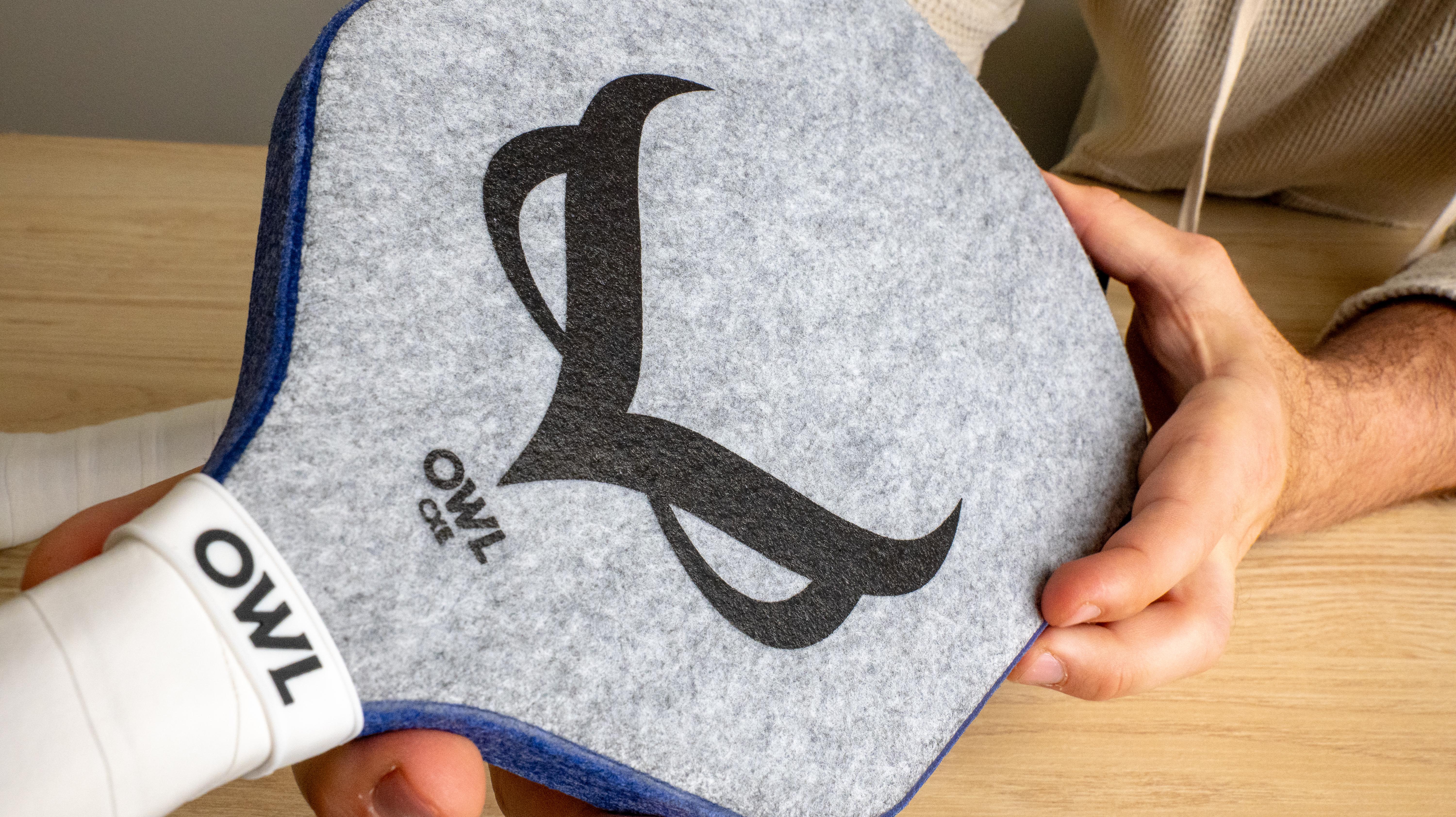
Check out the OWL Lineup for yourself HERE
What USAP confirmed
I put my questions to Carl Schmits, USA Pickleball's Chief Technical Officer, and to his credit he answered them in detail and on the record. Three things came out of that exchange that change the story.
The first is that the Acoustene surface cannot be evaluated by the conventional roughness test that anchors paddle certification. In Schmits's words, it "could not be certified by measuring roughness conventionally with a profilometer." So the surface roughness requirement was waived entirely for the OWL lineup. The paddle still cleared the other tests every paddle clears, including coefficient of friction (CoF) and PBCoR for power, with no relief on either. The OWL was not given CoF in exchange for skipping roughness, since every paddle has to pass CoF anyway. It got a pass on the roughness test, with CoF left to carry the spin-bounding job roughness would normally share.
The second is that the competition certification was provisional, granted in the first quarter of 2024 with the intent, in Schmits's words, "to re-evaluate once spinrate had been completed." USAP has reportedly been working on a lab spin test for a few years now. The reason for the provisional status was that the surface's spin impact could not be measured at the time, because the test to measure it did not yet exist.
The third is the one I find most troubling. I asked whether the provisional status and its terms were published anywhere a player, buyer, or manufacturer would actually see them. The answer was that they were not. Schmits's answer below:
"Internal until ready for disclosure. Any determination realized through this process that has a public impact will be clearly communicated with reasonable timelines and implementation."
So the provisional nature of the approval was a matter of internal record by design. The public-facing message was full certification. The internal reality was a conditional approval on a surface USAP itself could not fully test, and the two were never reconciled for the people buying the paddle.
Why the secrecy is the problem, not the provision itself
I want to be careful here, because a provisional approval is not inherently wrong. USAP was facing a surface that solved a problem the sport needed solved, that it could not measure with its existing tools, and it made a judgment call to certify conditionally while it built better tools. Schmits describes this as bounding the certification until a proper scientific approach could answer the open questions, and as a conscious decision to act on what they knew they did not know. Taken on its own terms, that is a defensible piece of caution.
The trouble is that a relief lane nobody can see is a relief lane nobody else can ask for. Every other manufacturer was still being measured against the published standard, because none of them had any way of knowing an unpublished pathway existed. During the same stretch, OWL expanded into multiple models on the same surface and sold thousands of paddles under a banner that read 100 percent approved. Whatever the intent behind the provisional approval, its practical result was an extended commercial head start on a measurable on-court advantage, available to exactly one company, granted through a process no competitor could enter.
"A relief lane nobody can see is a relief lane nobody else can ask for."
Even as this article is being written, certain small brands are under investigation by the USAP for exceeding surface roughness with the threat of being de-listed. You can see them for yourself at USAP compliance page. The question is about the integrity of the regime rather than the physics. If the roughness standard is firm enough to pull a paddle from a smaller brand and make that brand answer for it publicly, it is hard to explain why the same standard could be set aside for a novel surface, with no public notice, for years. A test that can be enforced against one company and waived off the record for another is not really functioning as a standard.
The spin question, and USAP's answer to it in full
The best independent testing available to the public, John Kew's, puts the OWL at the top of the field for spin, and finds that the advantage grows as the paddle is broken in. It matches what competitive players report once an OWL has some hours on it, and it is the reason the paddle has the reputation it does at the higher levels of the game.
John Kew's OWL Paddle Testing Results
I told Schmits plainly that this is the heart of the piece, that a brand new surface cleared certification while its real-world spin, in independent testing, comes in higher than paddles that were pulled for failing the roughness test. I said I would rather have his response sitting in the article than left hanging, and I committed to running whatever he gave me in full. Here is his answer, in two parts, exactly as he sent it:
We're nearing completion of spinrate definition and we'll reach a determination for outliers. While we don't recognize any current spinrate test as robust a lab-grade solution relative to that which we are launching, we'd be interested in reviewing that independent data as well as the viability of the test itself.
As your research into this article likely revealed, extreme textures that would fail a surface roughness test may also yield an unexpected inverse result after a certain point, essentially decreasing the material 'contact patch' between paddle and ball.
On the underlying metric, Schmits's position is that coefficient of friction is doing real work. He describes dynamic CoF as "a fundamental parameter in contact mechanics" that has "reliably held spin in check since its intro in 2020, bounding both surface roughness and coatings as significant spin contributors," and says the data gathered during spinrate development supports that. USAP considered retiring the roughness test entirely and kept it because it still has value for field compliance.
I have thought hard about this, and I do not think it answers the question players are actually asking. CoF being a sound parameter in the abstract is not the same as CoF capturing what the OWL does on a worn face in the eleventh game of the day, and the one public dataset that looks at exactly that, Kew's, points the other way. Schmits's response to that dataset is to set it aside as not lab-grade while acknowledging that USAP's own lab-grade test is not finished. That is a deferral rather than a rebuttal, and the deferral is not neutral, because OWL continues to sell into the window the deferral creates. The contact-patch point in his second paragraph is real physics, and it is worth taking seriously, but it is offered without any evidence that it actually describes the OWL's felt surface, and it argues against the field data rather than engaging it.
There is also a fairness issue in how the spin gets characterized. USAP is willing to call independent testing insufficient while the marketplace waits on a standard that has been coming for over two years. In the meantime the people most affected, the players, already know what these paddles do. You do not need an ASTM-grade rig to notice that a broken-in OWL spins the ball in a way the rest of the field does not, and a governing body telling players to wait for the real test is a hard sell when a paddle excused from the existing test is winning points right now.
The precedent USAP leans on
When I pressed on how something stays provisional for this long, Schmits pointed to precedent, arguing that provisional approval is not unique. He noted that the UPA-A granted provisional approval to manufacturers roughly fifteen months ahead of its formal specification rollout in September 2025, and he cited the first paddle to receive provisional UPA-A certification, in June 2024, as having come from a product that had previously failed USAP certification and that was later sunset under PBCoR.
I went to the UPA-A to check that account, and the picture I got back does not match Schmits's. According to Jason Aspes, President of the UPA-A, the paddle Schmits is describing as that first provisional certification, the JOOLA 3S, is still approved by the UPA-A and now by USAP as well, the only difference being a smoother surface, because the UPA-A measures spin rather than grit. The paddle Schmits appears to be thinking of is the JOOLA Gen 3, which USAP delisted for being too powerful and which would not have passed the UPA-A's standards at any stage, provisional, interim, or full. If that is correct, then the example USAP is using to show that provisional approval is a known and reasonable pathway is mixing up two different paddles, which does not do much to reassure me that the long provisional window here is well understood by the people defending it.
One more fact worth putting on the table without editorializing on it. The PRNewswire release announcing OWL's 100 percent approval went out the same day as the announcement of OWL's partnership with the APP Tour.
Full OWL USAP Approval and APP Partnership Announcement
Where I come down
I went into this with some bias against the OWL paddles having played them with and against them and feeling they gave an unfair advantage on court. The truth is the tech is pretty cool and offering a quieter paddle option is good for the game. My biggest issue is with the secret provisional approval. What started as a rules exception that allowed a quiet product to be used in tournament settings ended up as a years long competitive advantage across an entire product line that wasn't disclosed as provisional to consumers or available to other manufacturers. That's not cool.
"The provisional approval may have been sensible. Keeping it invisible was not."
The fix is not complicated. A provisional approval should say it is provisional, on the approved list, where buyers look. The terms should be public, so that any manufacturer with a surface that cannot be measured by the current tests knows the same lane is open to them. And the spin standard that has justified two and a half years of waiting needs to actually arrive, with a real determination for the paddles already in the field, the OWL included. Until then, the honest description of the situation is that the most spin-heavy surface in the sport is being sold as fully certified on the strength of a test that was never designed to measure it, and a future test that is not here yet.
I asked the hard questions and USAP answered them, which is more than a lot of governing bodies would do, and Schmits's full response to the spin issue is printed above so you can weigh it yourself. I just do not think the answers hold up the way they are meant to.
Check out the OWL Lineup for yourself HERE
Related articles
.png?width=592&height=237&optimizer=image)
JOOLA Power FX first look, JOOLA’s first all-foam paddle
JOOLA's first all-foam paddle delivers effortless power, a grittier surface than the Pro V, and a stiff, hollow feel that sets it apart in the foam market.
9 days ago
-Joseph Sutton
20 things pros wish they knew earlier in pickleball
These quick tips can help you level up your game fast.
20 days ago
-Victoria Radnothy
Which JOOLA paddle is right for you? Your complete buying guide
Choosing the perfect paddle can feel overwhelming, but the experts at Pickleball Central make it a whole lot easier.
23 days ago
-Victoria Radnothy
.jpg?width=592&height=237&optimizer=image)
RPM Jade: Is it worth the hype?
There were 10,000 pre-orders before anyone outside the company had even hit one.
24 days ago
-Joseph Sutton