
A salary cap is coming to MLP (and that’s a good thing)
Jim Kloss
Jun 25 2026 3:00 PM ET
MLP announced the June 30 trade deadline has been moved back to July 12. The stated reason was to give teams time to adjust to coming changes to the league structure for 2027. The proposed structural changes are focused on a “salary cap” for all teams and implementation of a player franchise tag. The issues are complex, with the devil in the details. Let’s go through what a cap and tag system is, why it is needed, and some ideas on how it will work.
1. What is a salary cap?
Most sports have a salary cap, i.e., a maximum amount each team can spend on player salaries. The effect of a cap is to prevent richer teams/richer owners from buying up all the best players, leading to competitive imbalance. For example, in the NFL, each team can spend a maximum of $301m on players for 2026. The result is that in 20 of the last 24 years, at least one NFL team has gone from worst in its division to first the next year. Major League Baseball, with no salary cap, went over 100 years at one point without a team going worst to first. Today, even with six divisions, a worst to first team happens in baseball about one-fifth as often as it occurs in the NFL. A salary cap levels the playing field and helps to promote competitive balance.
For MLP, teams do not directly pay player salaries. Players are acquired in a yearly auction draft, with teams bidding to obtain each player; high bid wins. Thus, in MLP, it would be a player acquisition cap, not a salary cap. However, as “salary cap” is the common term, we will continue to refer to the cap as a salary cap. Just keep in mind that the numbers are not actual player salaries. The cap would apply to what the teams pay to acquire the players in the yearly auctions. For example, Anna Bright was famously the subject of a $1.2m bid; Jorja Johnson was $800,000. The cap would apply to these numbers.
2. What is a franchise tag?
Under the MLP draft/auction system, when a player is picked, the team picking them is allowed to keep that player up to three years. For example, if a player was drafted in 2026 for $100,000, that team can decide to keep or release the player in 2027. If they release the player, they can be redrafted in 2027 by any team; if they are kept, the team originally drafting them can pay another $100,000 to keep the player for 2027. Same process for 2028. But, a player drafted in 2026, can only be kept a maximum of three years, meaning they could not be kept for 2029.
The franchise tag is a method by which a player could be kept for more than three years. Each team would have the right to “tag” a player, i.e., designate them as a franchise player and thereby would be allowed to keep them a fourth year. The player tagged would have to have a player acquisition number assigned to them. For example, the NFL has a franchise tag system. The player’s tag number is equal to the average of the top five salaries at their position, or 120% of their salary the prior year, whichever is higher. For example, the tag number for a quarterback is about $44m for 2026. But, if the player being tagged has a 2025 salary of $40m, then the tag number would be $48m.
Applying a tag system to MLP, it would mean each team could tag a player from the 2024 draft. Right now, all 2024 draftees have to be released next year. But if a tag system is now implemented, each team could choose one player drafted in 2024 to keep for 2027. The player would have a tag number assigned (to be determined).
3. What should the cap be for MLP teams?
Now that we all understand the terms, and why a cap system makes sense for MLP, we have to get to the details: what should the cap be? Initially in 2024, there was a cap of $1m. Each team was allowed to draft players for acquisition costs of a maximum of $1m. There was also a minimum in 2024, with each team spending at least $500k. That minimum and cap was not kept for 2025 or 2026. The effect was that some teams spent very little, well under $500k, while spending by a few top teams exploded. Anna Bright alone was $1.2m. The extreme imbalance among teams is the main cause of the push for a cap.
In a perfect world, the cap would be set at $1m, as it was in 2024. The problem is the $1.2m bid for Anna Bright and the $800k bid for Jorja Johnson, both in 2026. To now set the cap at $1m would punish St. Louis and New Jersey unfairly, as they followed the rules. One idea that has been floated is to reset the numbers for Bright and Johnson to the franchise tag number, which with a cap of $1m would likely be $500k. However, resetting the numbers for Bright and Johnson seems kind of artificial, so I could see MLP declining that move.
The difficulty then becomes how to determine a proper cap number, in light of the very high 2026 bids, especially as compared to the auction prices in 2024. One method would be to set it high for 2027, and then adjust it downward year by year, to give teams a chance to adjust. The NFL does adjust the cap every year, so cap adjustments are nothing new. A reasonable format would be to set a cap for 2027 of $2m, and then lower it by $250k each year for the following years. It would be $2m for 2027, and then lowered by $250k each year until it finally settles back to the original $1m in 2031. With a 2027 cap of $2m, even St. Louis would have room to bid on a good, full roster for 2027, even with the $1.2m cap number for Bright. But at the same time, lowering the cap slowly but steadily eventually gets the league back to the $1m number that worked so well and made so much sense in 2024.
The cap number for 2027 cannot be any higher than $2m, or it would not serve any purpose. Indeed, a reasonable argument can be made for a cap number of less than $2m. The high spending teams would just need to adjust their strategy. They may have to cut some very good players, simply because their auction number is too high. Cap casualties of this kind happen every year in the NFL.
4. What should the franchise tag number be?
The next issue is deciding what number to set for the franchise tag. In the NFL, the tag is reserved for the best of the best. In 2026, only three of the 32 teams used the franchise tag. For MLP, only a couple players should be tagged in any given year. If we see 7, 8, 9 players get tagged, that is a very clear sign the tag number is too low, allowing teams to tag players who should be back in the draft and available for any team.
Using the NFL’s mathematical method, the average of the most expensive five MLP players is just over $800k. Thus, $800k makes sense as the franchise tag number for 2027. Setting it lower, such as at $500k, would be a mistake as far too many players would be tagged, thus thwarting the whole idea of creating more balance among the teams. Tagging a player has to cause the team at least a little pain. It has to cause the team to operate under a fairly tight budget in acquiring additional players. An $800k franchise tag number, with an initial cap of $2m, would leave the team able to spend another $1.2m for the other five players on the roster; that is plenty of room to spend.
5. How about a salary floor?
In addition to a cap (a maximum amount teams could spend on acquiring players), there is a need for MLP to set a salary floor, i.e., a minimum amount each team would have to spend every year. In the NFL, each team must spend 90% of the salary cap. Thus, no team can dominate by spending too much, but also no team can fall too far behind by spending too little.
In MLP, the original cap in 2024 was $1m, and the floor for minimum spending was $500k. All current problems were created by abandoning the cap in 2025 and 2026. Either way, a minimum needs to come back. The spending by some teams has become embarrassingly low. Player spending is important. If you compare player spending to team performance, it tracks very closely, with a very high correlation. All top performing teams are high spenders; all low performing teams are low spenders. Bringing back the minimum required yearly spend of $500k is a needed item; if anything, the floor is more important than the cap. With a maximum of $2m, and a floor of $500k, there will still be a fairly big disparity in team spending. But if the cap is lowered year over year until it is $1m, that will create a better ratio between high and low teams.
6. What do the teams think?
As part of the research for this article, I talked to a number of team owners/GMs about the cap and tag issues. I spoke with both high and low spending teams. What I found was unanimity that a cap is needed. Even the higher spending teams agreed a cap is necessary. Everyone sees the imbalance of talent across the teams. There was also general agreement that a player acquisition floor is needed. There was disagreement on the details. Some people favor a high ceiling, some a lower one. Some favor a higher floor, others a lower one. Some like my idea to start the cap higher and then lower it as we go forward, while others say rip off the bandaid and re-institute the $1m cap that really did very well in 2024.
Not every MLP team has the same financial assets. There may be a need to consolidate some teams, and lower the total number of teams below 20. Eliminating some teams would help to raise the talent level of the weaker teams. The simple fact is there is not enough talent right now to support 20 good teams. The league would be better off if there were 16 teams.
In summary, a salary cap and franchise tag system is coming. Hopefully, it will have the right structure, with a maximum spending per team that is not too high, and a tag system that has a high number, so it is very rarely used. A minimum required spending number for each team is also needed. All of these measures will help to promote talent balance across the league. There will still be smart, well run teams that will do better, and teams not so well run that will do worse. But at least money will not be the dominant factor. If MLP does it right.
Follow me on X for the latest updates @pickleball_jim.
Related articles

Tama Shimabukuro joins Team Asia International for MLP Nations Cup, replaces Hien Truong
The 15-year-old will join a roster that also includes Rika Fujiwara, Lingwei Kong, Jimmy Liong, Jack Wong, and Macy Ybañez.
1 day ago
-Pickleball.com Staff
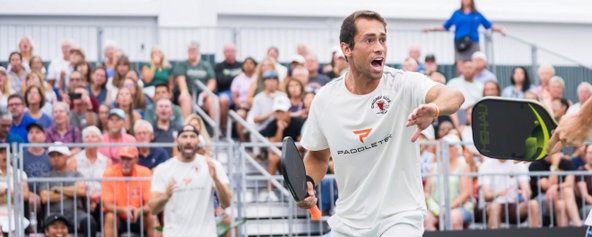
Zane Navratil talks pro pickleball’s taunting debate: ‘Players should be allowed to scream’
He argues that letting pros express themselves freely can make pickleball more entertaining for fans.
2 days ago
-Victoria Radnothy

Rachel Rohrabacher’s wedding takes unexpected turn after Nor’easter forces last-minute change
Her wedding day turned into a rom-com-worthy celebration with two unforgettable ceremonies.
23 days ago
-Victoria Radnothy

Groups, team rosters, and team captains announced for MLP Nations Cup
Texas Ranchers teammates Eric Oncins and Nico Acevedo will represent Team Latin America at the inaugural MLP Nations Cup in late October.
28 days ago
-Pickleball.com Staff