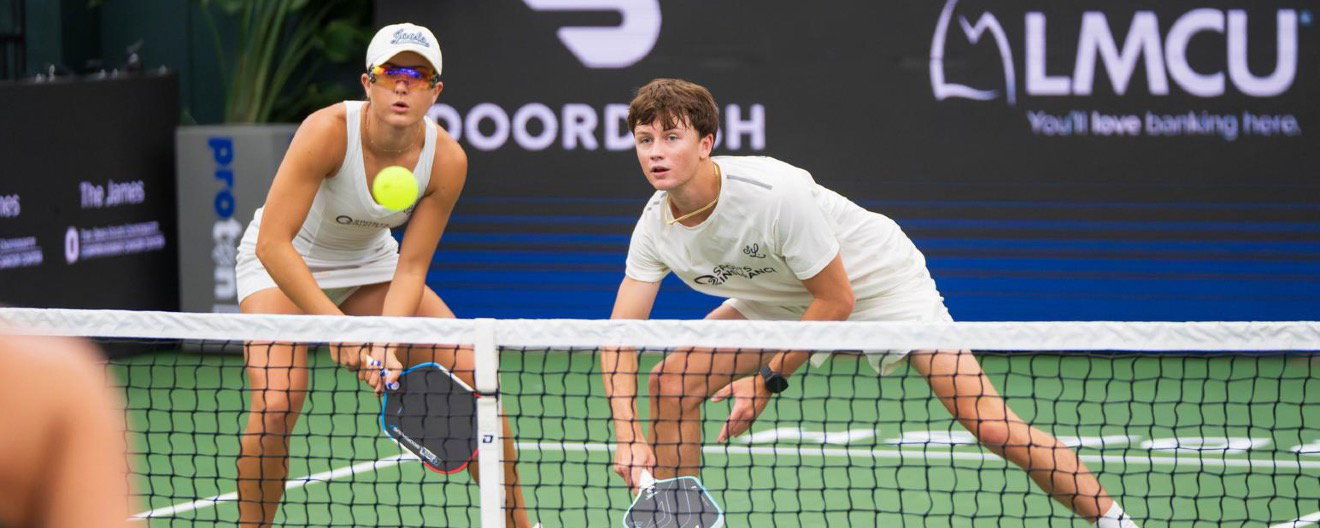
Anna Bright’s DreamBreaker fix: A bold idea to shake up MLP strategy
While I enjoy watching Anna Bright’s day-in-the-life vlogs, her deeper breakdowns of the pro game are just as compelling. In her latest video, “Women Don’t Matter Enough at Major League Pickleball,” Bright takes a closer look at DreamBreakers in MLP and offers her take on how the league can fix the imbalance.
In a DreamBreaker, the typical lineup (man, man, woman, woman) means men end up playing a disproportionate share of the points. In a match that reaches 21–19, they account for roughly 60% of the action.
Why men matter more in MLP
Despite the gendered doubles and mixed doubles format that’s equal for all players, it’s the DreamBreaker where the imbalance becomes obvious.
“For DreamBreakers, you want your best players playing first because DreamBreakers are usually won at the first or second position,” explained Bright. “For every team in MLP, your best absolute level singles players are men. Men simply play more than women in DreamBreakers.”
DreamBreakers remain entertaining, but in the league’s early days, they frequently featured man-versus-woman matchups.
“They were incredible,” said Bright, citing some of the best moments like Lee Whitwell beating Dekel Barand Yates Johnson. “The highlights from those points are unmatched, and I think a lot has been lost now that we hardly see this anymore.”
Bright believes there’s a way to promote men-versus-women matchups purely for entertainment value.
“Men versus women is the ultimate pressure-ridden, anxiety-filled, David versus Goliath situation that you can really get in sports. It doesn’t really exist in pro sports, but it can exist in Major League Pickleball,” insisted Bright. “The league should encourage this to happen as much as possible. It’s the ultimate battle of the sexes. People still talk about the Bobby Riggs versus Billie Jean King match.”
How to fix the issue
Right now, the home team sets its DreamBreaker lineup first, and the away team responds accordingly, often leading to a man, man, woman, woman order.
“My idea is to fundamentally change how home and away is approached. Instead of the home team announcing their lineup, they announce the matchups,” suggested Bright. “And the other team will react by choosing the order of those four matchups.”
Bright then illustrated what this could look like using a recent DreamBreaker between the St. Louis Shock and the New Jersey 5s.
In that scenario, the outcome could shift immediately based on lineup order and favorable matchups if players still faced the same-gender opponents.
But with a more flexible format, the 5s could strategically mix things up—pairing Anna Leigh Waters against Hayden Patriquin, Noe Khlif against Anna Bright, and creating entirely different matchup dynamics.
That, in turn, would force the Shock into tougher lineup decisions. They would likely still anchor the order with their strongest singles player, John Lucian Goins, but the overall structure of the DreamBreaker would become far more complex and far more intriguing
“It’s a DreamBreaker that the people would absolutely love to see. We’d maximize the male versus female matchups, and DreamBreaker strategy would be totally different,” mentioned Bright. “This would change how currently women don’t matter as much. We would see a lot more women playing first, and we’d see men playing last. We’d see how people deal with the pressure of playing more often, or how they deal with the pressure of playing catch-up. Right now, teams can hide behind having good, but not great women more than you can hide behind having the same for your men.”
Bright pointed to a theoretical DreamBreaker matchup between the Brooklyn Pickleball Team and the California Black Bears. Brooklyn features some of the strongest men’s singles players in the world, while the Black Bears boast top-tier female talent.
Under Bright’s proposed format change, the dynamics of that matchup would shift dramatically, producing far more varied, and arguably more exciting outcomes, depending on how the lineups are constructed and how the teams choose to deploy their players.
“I think this is a win-win for the league because you’d see more male versus female matchups and more women playing first,” concluded Bright. “It would be an unsolved meta, more strategy, more head games, and more game theory, which is always super interesting.”
And ultimately, this is a change the league could implement fairly easily.
Bright—and I—hope to see it introduced in 2027.
To keep up to date on all the latest pickleball action, follow us on Instagram.
Related articles

How to completely change your pickleball serve in 10 minutes
A few simple adjustments could help you add power, improve accuracy and eliminate the yips.
4 days ago
-Pickleball.com Staff
.png?width=592&height=237&optimizer=image)
Five ways to elevate your dink game like a pro
These strategies can help you make smarter decisions and gain the upper hand in kitchen line battles.
4 days ago
-Pickleball.com Staff

Five mindset shifts every pickleball player should know
Michael Lloyd shares lessons that changed the way he approaches the game, from redefining aggression to letting the ball dictate every shot.
5 days ago
-Pickleball.com Staff

Want to improve fast? Start with these 5 priorities
Build a smarter game with these must-practice fundamentals alongside coach Jordan Briones.
9 days ago
-Pickleball.com Staff