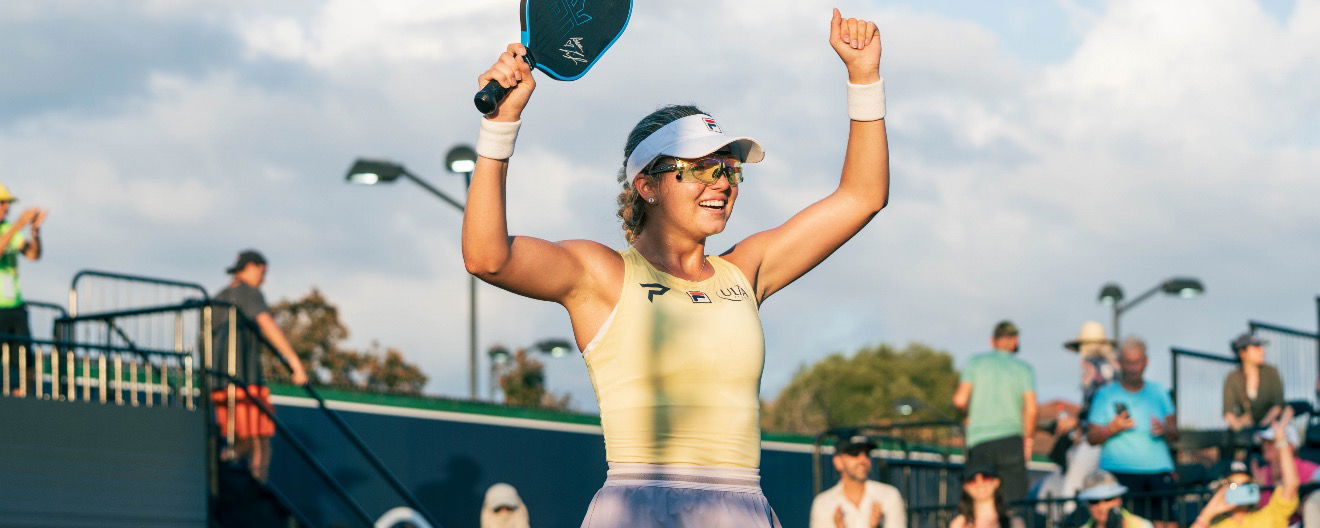
Another Triple for Waters, and other Lakeland takeaways
Jim Kloss
Nov 24 2025 5:30 PM ET
1
The Veolia Lakeland Open presented by Six Zero is in the books, as the PPA tour is on its two stop Florida swing. Next up will be the Dairy Farmers Daytona Beach Open, beginning December 16. Before we get to the Thanksgiving holiday, let’s highlight what happened in the Sunshine State.
1. Waters hits another Triple
They say the only sure things in life are death and taxes, but we may have to add a third, that Anna Leigh Waters will win a Triple Crown. She is cranking them out, one after the other. She seemingly is an unstoppable force right now.
In women’s singles, Waters actually lost a game in Lakeland! That in itself is a rarity. Salome Devidze won game one in the Round of 16, but as always seems to be true, Waters won games two and three and moved on. Waters cruised the rest of the way, defeating Zoey Wang in the final, 11-3, 11-1.
In women’s doubles, Waters combined with Anna Bright to easily win the gold medal. Waters/Bright did not lose a game, and lost only 37 points in 11 games. That translates to an average game score of just over 11-3. That is domination.
Finally, Waters took her third gold in mixed doubles alongside Ben Johns. They were tested in many matches, including the final against #2 seed Jorja and JW Johnson. The two teams split the first four games, driving the match to a fifth and deciding game. Waters, as she acknowledged in a post game interview, toned down her aggressive style in game five, and switched to grinding points out with crosscourt dinks. Waters does have a tendency to be overly aggressive on speedups, often speeding up when several feet behind the kitchen line. That tactic can work in women’s doubles, but is a big no-no in mixed, where a male left side player like JW Johnson can feast on poaching bad speedups. After game five started close, Waters settled down, grinding away with dinks, and Waters and Johns were able to go on a run and close out the match.
2. Men’s singles is absurdly competitive
While Anna Leigh Waters’ gold medals are fairly predictable, there is nothing predictable about men’s singles. In the Round of 32, six of 14 matches (there were two withdrawals) went to three games. In the Round of 16, four of eight matches went the distance. In the quarters, two of four matches needed three games to decide it. In other words, basically 50% of the men’s singles matches in Lakeland were so closely contested that three games were needed to decide a winner. This is why I continually say men’s singles is so unpredictable, you may as well flip a coin to decide who will win.
This week, top seed Federico Staksrud fell in the Round of 16 to Noe Khlif, but Khlif in turn lost to eventual winner Roscoe Bellamy in the semis. #2 seed Hunter Johnson made the final, but lost to Bellamy in a match that, of course, needed three games to decide. It was the first singles gold for Bellamy. Johnson fell short of a gold again, but did regain the #1 singles ranking. Johnson and Staksrud have been trading the #1 spot back and forth now for some time.
3. A comeback for the ages
In men’s doubles, the highlight had to be the comeback win in the semifinals by Andrei Daescu/Christian Alshon. They were playing CJ Klinger/JW Johnson. Klinger and Johnson took game one 11-4 and were leading 8-0 in game two. Daescu and Alshon seemed out of sorts, much as they were when they lost badly in the semis at Worlds to the same Klinger/Johnson duo. But, something clicked for Daescu and Alshon and they suddenly went on a 17-0 run to win game two and take a 6-0 lead in game three. But Klinger and Johnson were not done, getting it back to 6-4, and then coming back to tie it at 9-9 after being down 9-4. But Daescu and Alshon were able to win the final two points and earn a very improbable comeback win.
4. Prediction hits and misses
It was a good week for predictions, as I hit on all six of the doubles finalists and picked the winner correctly in all three doubles finals. The best prediction was to correctly find that the Kawamotos would take the silver.
In Lakeland, Tyra Black paired with Parris Todd, and not Jorja Johnson. Johnson, meanwhile, paired with Rachel Rorhabacher. There are issues with both teams. Black is easily the best player of the four on the left. When Black plays with Johnson, they correctly keep Black on the left and she takes the middle with her excellent forehand. But when Black plays with Todd, they sometimes incorrectly put Todd on the left. Even when Todd plays right side, she often will take middle balls. Todd has a fine backhand, but in no world should Todd be taking backhands over Black hitting forehands.
For Johnson, her pairing with Rohrabacher is a mismatch, as both are better on the right. Johnson is better than Rohrabacher on the left, but they improperly play Rohrabacher on the left most of the time. Rohrabacher has a more effective backhand than forehand, so she is out of place on the left. Johnson and Rohrabacher are both very good players, but their improper positioning was part of what led to them losing to the Kawamotos in the quarterfinals (and anticipating that was why I predicted a silver medal for the Kawamotos).
Tyra Black and Jorja Johnson match perfectly. They are clearly the second best pairing possible in women’s doubles and, barring improvement by another player, they should be playing every event together. I do not see either Black/Todd or Johnson/Rohrabacher as being able to match up with Waters/Bright.
For the singles matches, I completely missed the men’s final, but did correctly have Waters winning the gold. All in all, I hit on four of five gold medal winners and three of five silver medal winners. That is about as good as it gets, especially considering how unpredictable men’s singles is these days,
It is on to Daytona Beach next. That will be the final PPA event of 2025. Catch all the action on Pickleballtv. Make sure you check out Pickleball.com for our end of year player rankings, a review of all 2025 predictions, and our predictions for 2026.
Follow me on X @pickleball_jim.
Related articles
Bellamy powers past Haworth for first 2026 title as Waters earns Triple Crown
Roscoe Bellamy earned his second career PPA Tour title in the Windy City. He'll look to replicate this week's success at next week's event in Virginia Beach.
11 hours ago
-Pickleball.com Staff
Anna Leigh Waters reflects on 200 PPA Tour titles: ‘It’s been a crazy ride’
66 of Waters' titles, including Sunday morning's, have come next to Ben Johns in mixed doubles.
15 hours ago
-Pickleball.com Staff
Order of play for Carvana Championship Sunday at the Veolia Chicago Cup
Hurricane Tyra Black and Catherine Parenteau will take on Anna Leigh Waters and Anna Bright for women's doubles gold for the second time in two weeks.
1 day ago
-Pickleball.com Staff
Acevedo, Martinez Vich surge into men’s doubles final over Braham, Faletto
After falling in the semifinals last week in Las Vegas, Nico Acevedo and Jaume Martinez Vich will have a chance to go for gold in Chicago.
1 day ago
-Pickleball.com Staff