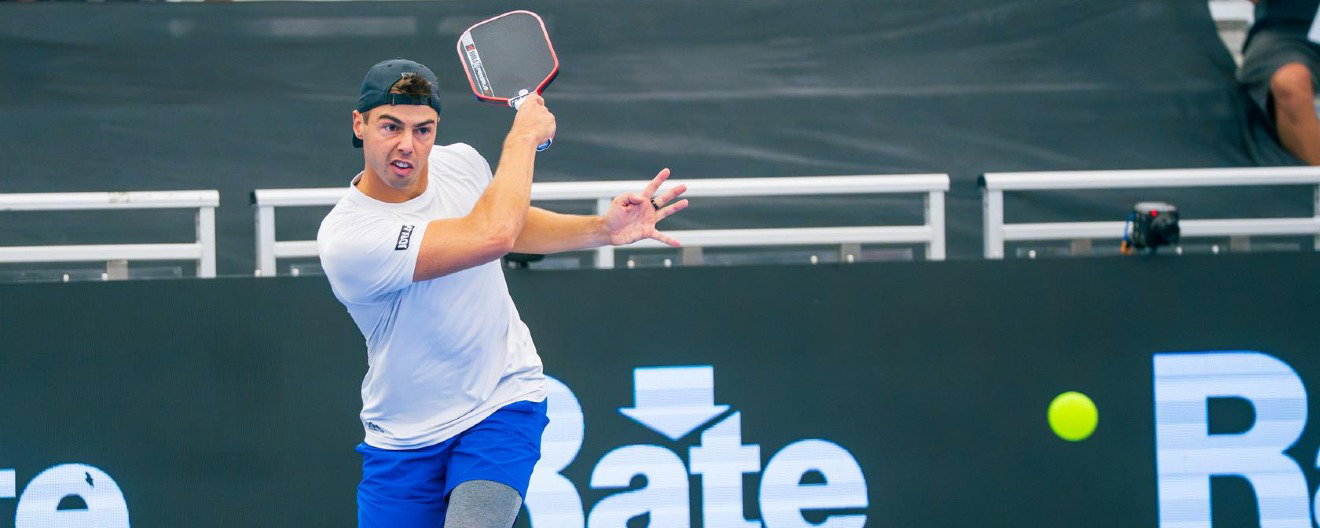
The men’s singles game is undergoing big changes, as exemplified by Ben Johns
Jim Kloss
Oct 9 2026 9:00 AM ET
Men’s singles in 2026 is a different game than it was just a few years ago.
If you watch top players from 2023-2024, everyone played a very similar style; hit the serve return and come to the kitchen line behind it; hit a one-handed backhand; if you were back at the baseline, try to get to the kitchen line whenever you could. The game was totally oriented toward the kitchen line and volleying; there were few, if any, baseline-oriented rallies, with both players staying back and exchanging hard groundstrokes. For example, in a 2024 gold medal match between Ben Johns and Federico Staksrud, both players came to the kitchen line after every serve return, had no rallies exclusively from the baseline, and had pressure rates (how often the player comes to the line) exceeding .700.
Move forward to 2026, and the game has changed drastically. While all players come to the line at least some of the time, the number of rallies where both players stay back the entire rally, or at least for several shots, has climbed dramatically. Players such as Chris Haworth, Hunter Johnson, and John Lucian Goins are comfortable playing from the baseline, and quite willing to exchange a series of groundstrokes with their opponent. Those groundstrokes universally feature a two-hand backhand. Indeed, it is virtually impossible to find any player hitting a one-hand backhand groundstroke now.
There is no better example of the changing nature of the men’s singles game than to look at how Ben Johns now plays. In a recent tournament in Las Vegas, Johns played Dylan Frazier in the Round of 16. They played 53 rallies that went beyond serve and serve return. Frazier played “old school” style, coming in after every serve return and coming in when serving at every opportunity. In those 53 rallies, Frazier came to the line 49 times, a pressure rate of .925. Johns, on the other hand, came to the line just nine times, for a pressure rate of only .170. Further, of the nine times that Johns came to the line, only once was it of his own volition; the other eight times it was due to Frazier hitting drop shots or other shots that forced Johns in to the line. Johns won the match, 11-7, 11-3, indicating it was a purposeful strategy on his part, playing to what he perceived as his best advantage against this opponent. Frazier is mainly a doubles specialist and does not have strong groundstrokes.
In his next two matches, Johns played Christian Alshon and John Lucian Goins, two players with very good groundstrokes. Recognizing this, Johns changed strategies, going back to a more “old school” style. After defeating Alshon 3-11, 11-3, 11-6, Johns faced Goins, one of the best groundstrokers in the men’s game. They played 63 rallies. Of the 63, Goins stayed with his “new style” game, coming to the line only four times the entire match! This pressure rate of .063 is one of the lowest you will ever see in a match. Johns, on the other hand, recognizing that he was likely overmatched from the baseline, came to the kitchen line on 56 of the 63 rallies, a pressure rate of .889! Johns’ strategy is validated by the statistics; he won 31 of his 56 kitchen rallies (.554), but only three of his seven (.429) rallies where he stayed at the baseline. Goins, for his part, won only one of four rallies where he came to the line (.250), but 28 of the 59 (.475) where he stayed back.
Goins is probably the clearest example of the 2026 version of men’s singles. A player quite willing to play every rally from the baseline exclusively. If he sees an opportunity to hit an effective approach shot and come in to the line, he will do so, but he is mostly content to win the point from the baseline. Players like Chris Haworth and Hunter Johnson are more similar to Goins than to the 2024 era style. Haworth and Johnson regularly have pressure rates of 25% to 40%. Even on points where they do come to the line, Haworth and Johnson pick their spots. They tend to rarely come to the line off a serve return, but instead will rally from the baseline, looking for an opportunity to take a shorter ball and drive a deep, corner approach shot and come to the line when their opponent is on their heels.
Where is the game headed in the future? In talking to players, the reason for the change in the men’s singles game is the nature of the ball and paddles. The ball now tends to sit up a little higher on most surfaces, while the paddles are more powerful. Thus, the ball is more receptive to being hit hard, and paddle power makes passing shots more effective. Groundstrokes are more powerful, as are serves, making it easier to push your opponent back. Many players are now standing six, eight, 10 feet behind the baseline when hitting a serve return. It is difficult to come to the kitchen line behind a serve return hit from so far back. Similarly, powerful groundstrokes keep the opponent back behind the baseline, again making the path to the kitchen line longer. At the line, players are more susceptible to being passed by those powerful groundstrokes.
For now, we will continue to see a mix of styles. We have the hard chargers who come to the line as much as they possibly can and as fast as they can, like Dylan Frazier and Connor Garnett. But, that style is ultimately doomed. As more and more player come in with powerful groundstrokes, the “get me to the line as fast as I can” player simply will lose. The style of game played in 2023-2024 is gone and is not coming back.
The combination players are now in front, those who can play from the baseline and can also dominate at the kitchen line. However, the baseline game is starting to dominate. The game is not going to slow down. The length of rallies will continue to increase. The number of rallies where both players stay back for the entire rally or most of the rally will increase. The number of players who are really baseline specialists will increase. Will we see a day when players play an entire game with only a handful of volleys employed? I am not yet ready to predict that, but it may happen. The game has changed so much in the last two to three years that predicting what men’s singles will look like in 2029 is a tricky proposition. A player like John Lucian Goins and a pressure rate of .063 did not exist just a few years ago, so we cannot exclude further evolutionary changes from new players coming on to the scene. In any event, it will be interesting to see how the game continues to change and develop. And it will all be on Pickleballtv.
Follow me on X @pickleball_jim.