The Veolia Cincinnati Showcase is in the books
Jim Kloss
Sep 15 2025 8:00 AM ET
The Veolia Cincinnati Showcase presented by Six Zero finished over the weekend at the beautiful Lindner Family Tennis Center. It drew rave reviews as one of the best facilities used for a PPA Tour event. We even had nice weather, with no rain or wind to interrupt the proceedings. This should be a mainstay facility in the future for the PPA Tour, and we can look forward to new facilities coming online to host future tournaments. Now on to the highlights!
1. Down goes Waters/Bright, again
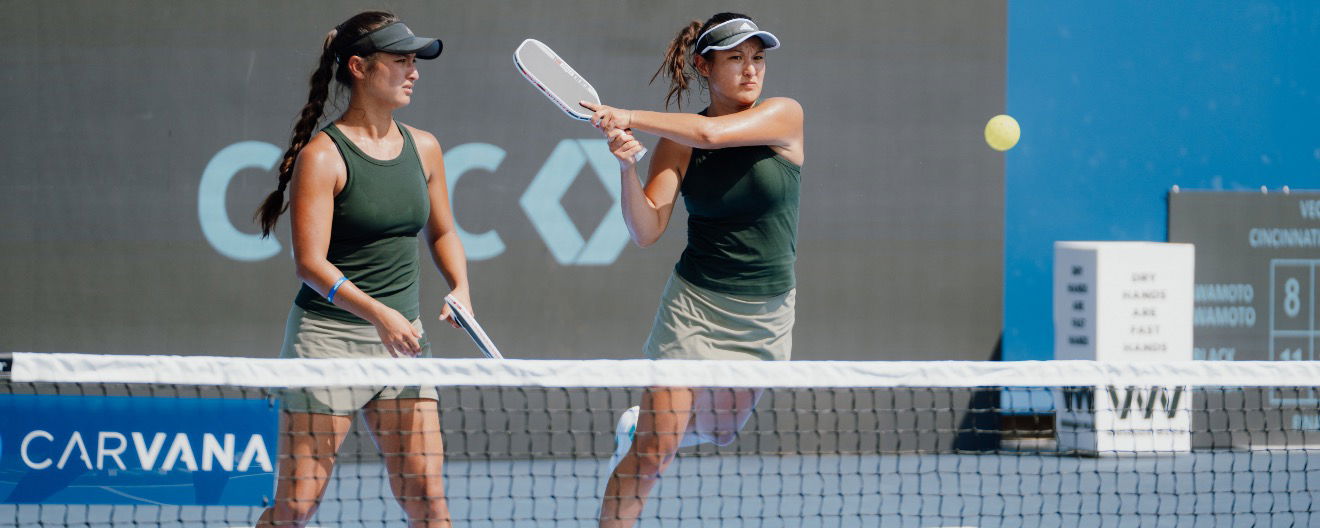
When Anna Leigh Waters and Anna Bright formed their partnership earlier this year, many people (including me) thought they might win every 2025 women’s doubles event. I did at least correctly predict that the likely opponent to defeat them would be Jorja Johnson and Tyra Black, who did indeed accomplish that feat last week in Las Vegas. But who would have predicted a second straight tournament defeat for the top team? It may have been unlikely per the betting lines on Kalshi, but Jade and Jackie Kawamoto defeated Waters/Bright in the semifinals and capped off their great week with a come-from-behind, five-game victory over Johnson/Black in the final.
The issues that hurt Waters/Bright in the Las Vegas final again hurt them in their semifinal loss to the Kawamotos. The strength of Waters/Bright is their unending offense and aggression. They overpower weaker teams that cannot counter that aggression. But, like Johnson/Black, the Kawamotos are both skilled defenders and excellent counterpunchers. Waters/Bright continue to speed up constantly, and often do so on balls that should not be attacked, such as shots from three to four feet behind the kitchen line. Waters/Bright can get away with poor speedup choices against many teams that cannot counter well and compete in firefights. However, the Kawamotos, like Johnson/Black, can take advantage of those poor speedup choices.
One notable strategy by the Kawamotos was how often they backed off the kitchen line during rallies. Keeping your toes as close to the kitchen line is a standard play in pickleball. But, there are occasions when backing off the kitchen line is a beneficial strategy. The Kawamotos found often that if they took a step or two back from the line, it gave them just a little bit more time to react to and counter the aggression from Waters/Bright. A smart play by them helped contribute to the upset.
After the loss by Waters/Bright, social media started to squawk about whether Waters would again switch partners. Waters switched away from Catherine Parenteau for one and only one reason; because she felt Bright gave her the best chance to win. Would switching from Bright improve Waters' chances to win? At this point, I would say no. The fact is that the gap between Waters and the next several women has narrowed in doubles. The gap between Bright, who has been rated as the second best woman for quite awhile, and the rest of the top five, has narrowed even more. At this point, a reasonable argument can be made that Tyra Black or Jorja Johnson are as good as Bright or even very slightly better. But I would rate them as fairly even, so I see no benefit to Waters to change partners, at least not at this time. I do think Bright needs to soften her game against the very best rival women’s teams, becoming more of a defensive player and letting Waters handle more of the offense. I would also keep Bright solely on the right side, again allowing Waters to dictate the action.
In any event, the losses by Waters and Bright are good for the game. We now have a real competition in women’s doubles.
2. A wild men’s singles event goes to Alshon
Men’s singles is about as predictable as flipping a coin. New players come on the scene and can do very well, as demonstrated the last couple tournaments by the gold medals of John Lucian Goins, or the semifinal appearance this past week of #57 seed Chris Haworth. Upsets are more common in men’s singles than in the other four events combined. Further, even as good as World #1 Hunter Johnson is, if he can win one tournament in five, he is doing really well.
This week, I predicted a Christian Alshon win over Alex Crum. Crum had beaten Federico Staksrud twice in a row, and I thought Crum had his number. Boy, was I wrong, as Staksrud handled Crum fairly easily. On the other hand, my Alshon wins the gold prediction came true, which surprised even me. Picking the winner of a men’s singles event is harder than picking the next Super Bowl winner before the season. I will enjoy this one, as it likely will be awhile before I hit another men’s singles winner.
3. Men’s doubles becoming predictable?
As wild and crazy as men’s singles is, are we seeing a large measure of predictability coming to men’s doubles? The Big Four teams, Gabe Tardio/Ben Johns, Christian Alshon/Andrei Daescu, Federico Staksrud/Hayden Patriquin, and CJ Klinger/JW Johnson all made the semifinals as predicted, and it was not a difficult prediction to make. Going into every tournament, if all four of those teams are playing, there is a solid likelihood that all four will make the semifinals. The question before every tournament will be, can anyone else break into the semifinals?
The draw will dictate who plays who in the semifinals. In Cincinnati, Staksrud/Patriquin took on Alshon/Daescu in what was one of the best matches of the week. Back and forth in game one, with Staksrud/Patriquin winning 14-12. Game two was equally close. Alshon/Daescu repeatedly had game points but could not close the deal. Staksrud/Patriquin had a match point of their own, but could not get it done. Ultimately, Alshon/Daescu took game two 13-11. Game three was not close, with Alshon/Daescu running away with it 11-1. Patriquin smashed his paddle at the end, understandably frustrated to have let this one get away. Alshon/Daescu are now 4-0 in this rivalry.
The two teams are very closely matched in skill. Small changes in strategy can make a difference. Alshon/Daescu focused on dinking heavily to Staksrud. This was true even when Staksrud shifted to the right side. One thing you can see in the matches is the impatience of Patriquin. Especially when Staksrud is targeted in the dink game, Patriquin tends to get antsy, such that when he does finally get a ball, he has a tendency to hit improvident speedups that are easily countered by Alshon/Daescu. Patriquin needs to wait for clearer opportunities to go on offense. For a role model, he need look no further than Daescu or Ben Johns, the two most patient players on tour.
4. Final thoughts
In addition to hitting on the Alshon singles win, I also got right the wins by Waters in singles, Waters/Johns in mixed, and Johns/Tardio in men’s doubles. On the other hand, I was 0-5 on predicting who would win the silvers, so all in all, a very inconsistent week for the predictions. But if you had used them on Kalshi, you would have made enough on the 100-1 Alshon prediction to have made some money.
Next up is the Pickleball Central Sacramento Vintage Open. Wooden paddles will be used by the pros and that will lend some unpredictability to the proceedings. Either way, it should be a lot of fun to see pros using paddles from the 1960s! I know I am looking forward to seeing that one, starting September 24. Check it out in person or on Pickleballtv.
Follow me on X @pickleball_jim.
Related articles
Mojo Energy Pouches Virginia Beach Open: Everything you need to know
With several star players heading overseas, a big opportunity awaits for other players to claim a title.
2 hours ago
-Pickleball.com Staff
Virginia Beach features wide open draws
No Anna Leigh Waters and no Ben Johns means it is anyone’s tournament to make a mark.
1 day ago
-Jim Kloss
Anna Leigh Waters notches 200th title at Veolia Chicago Cup
The milestones just keep piling up for the young superstar.
1 day ago
-Jim Kloss
Bellamy powers past Haworth for first 2026 title as Waters earns Triple Crown
Roscoe Bellamy earned his second career PPA Tour title in the Windy City. He'll look to replicate this week's success at next week's event in Virginia Beach.
2 days ago
-Pickleball.com Staff