Toys “R” Us PPA Finals wraps up 2025-26 PPA year
Jim Kloss
May 12 2026 5:30 AM ET
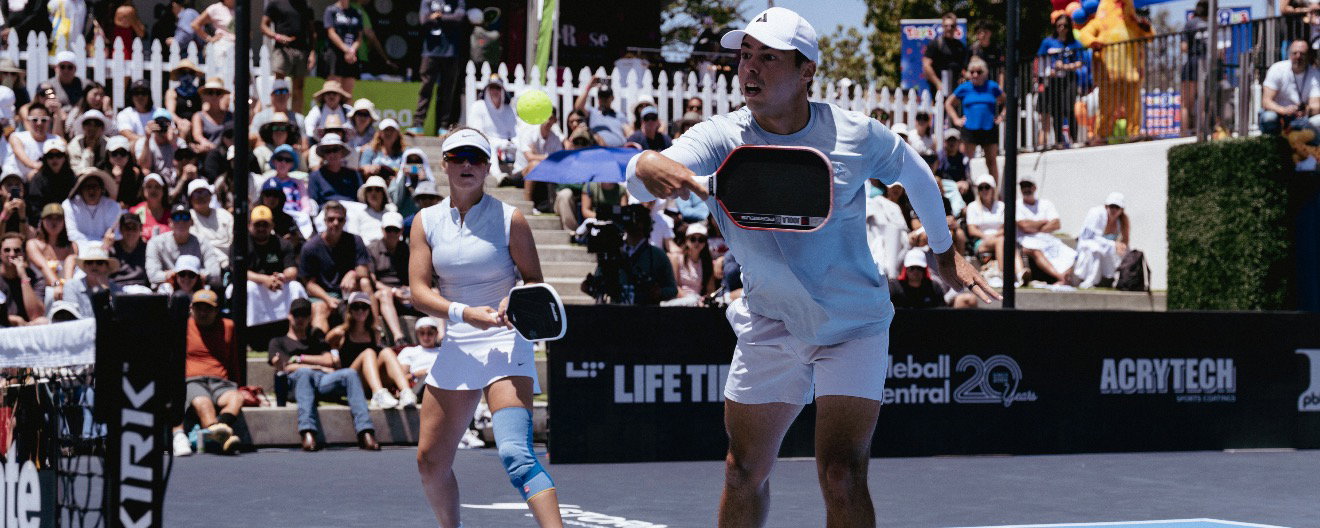
The PPA Finals were just completed in San Clemente, the last tournament of the 2025-26 PPA Year. The top 16 men and women competed in gender and mixed doubles, while the top 8 men and top 8 women competed in singles. The year ended much as it had progressed all year, with Ben Johns and Anna Leigh Waters dominating many of the events. But there were notable upsets along the way, interesting strategies employed by players, and the concurrently run PPA 500 tournament for all other players left us with some guesses about which new players may be playing in the 2027 PPA Finals.
Let’s run through the major stories of the Finals and speculate on how what we learned this year may effect next year.
1. Johns and Waters complete a dominating year
Ben Johns and Anna Leigh Waters lose so infrequently that it is major news when it happens. They did not lose at the PPA Finals, so no major upsets to report involving them. Johns combined with Gabe Tardio to continue their lengthy winning steak. Waters combined with Anna Bright to continue their golden streak. Johns and Waters paired up to continue their long streak of mixed doubles gold medals.
The only small blotch on the record for either was that Waters had to withdraw from singles due to a nagging knee injury. That was apparent proof that the only person who can stop Waters is Waters herself.
2. Haworth stakes claim to being the best singles player in the world
Men’s singles was the most competitive event of the PPA Tour all year. Federico Staksrud, Hunter Johnson, and Chris Haworth all took turns trading the #1 ranking back and forth. Because there are so many good singles players, and the margins between them so thin, a claim by anyone as #1 stands on thin ice, strong enough only to hold until the next tournament. But with that said, Haworth is about as solid at the #1 spot now as anyone has been in quite some time.
Haworth entered as the #1 seed, and after a hiccup in his first match against Connor Garnett (more on this match later), Haworth then ran the table in his next four matches to claim the gold medal and the #1 ranking. He amassed enough ranking points to likely hold the top spot for another tournament or two even if he does not win, but expect everyone to come out firing against him at the Veolia Pickleball National Championships in August.
3. Fahey claims women’s singles in Waters’ absence
Anna Leigh Waters dropping out of women’s singles appeared to scramble the draw. The withdrawal gave the eight other women hope that they could win a gold medal, a rare accomplishment in women’s singles for anyone besides Waters.
However, Kate Fahey entertained no debate about who the best player was not named Waters. She cruised to the gold medal and emphatically closed the 2025-26 year as the #2 women’s singles player.
4. Upsets were the story early at the PPA Finals
Pool play is a unique feature of the PPA Finals. For example, in doubles, four teams are put in a pool, and each plays every opponent, for three total matches. The top two teams move on to semifinal play. The same format is used for singles. This year, in pool play, we had a number of notable upsets.
It started off early, with the first match in men’s singles consisting of #6 seed Connor Garnett taking out #1 seed Chris Haworth. Due to the structure of pool play, Haworth was able to recover by winning his next two matches and make the medal rounds. But the Garnett upset showed what was possible and other competitors followed his early example.
In women’s doubles, Tina Pisnik and Lacy Schneemann defeated Tyra Black and Jorja Johnson. With that upset, and the subsequent loss to Parris Todd/Rachel Rohrabacher, the top team of Black/Johnson was not even able to advance from pool play. Black was suffering from illness and that certainly seemed to affect her play. At the same time, Black/Johnson have appeared to be a little bit off their game the last couple tournaments.
Men’s doubles featured a couple of significant upsets. In an early pool match, Tyson McGuffin and Noe Khlif took down Federico Staksrud and Andrei Daescu. Staksrud/Daescu were only able to advance to pool play due to McGuffin/Khlif being upset in turn by Jay Devilliers/Jaume Martinez Vich, and then an advantageous point differential gave Staksrud/Daescu the tiebreaker.
Perhaps the biggest surprise of the tournament was the 0-3 pool play record of top team JW Johnson/CJ Klinger. They lost in pool play to Johns/Tardio, which can happen to anyone, but they also lost to Dylan Frazier/Eric Oncins and Riley Newman/Connor Garnett. These losses may have been a result of specific strategies employed by their opponents, as we will examine next.
5. Strategy plays a part in the PPA Finals results
All of the players making the PPA Finals are great players, the best of the best. So when you are playing the best, employing optimal startegy can be the difference between winning and losing. Let’s look at a couple of matches to demonstrate.
First, in men’s singles as previously mentioned, Connor Garnett took down Chris Haworth. Not only was the result a bit of a surprise, but so was the 12-10, 11-6 score. The score was fairly close, but Haworth was visibly frustrated by Garnett’s tactics; what did Garnett do to throw Haworth off his game? Haworth’s game is primarily to stay back and win with powerful passing shots. Haworth has one of the lowest pressure rates in the game (percentage of rallies where he comes in to the kitchen line). Garnett is the opposite, with one of the highest pressure rates. Haworth typically likes his opponent to come in, setting up passing shot winners.
But Garnett did it a little bit differently. Garnett mainly hit to Haworth’s forehand and then sat on the line, expecting a down the line passing shot. If Haworth hit a good shot, Garnett did not try any fancy volleys; instead he simply would hit a basic block volley, deep to Haworth’s forehand. Garnett would again sit line. Haworth would tend to either miss or hit the passing shot a little high, allowing Garnett to then volley crosscourt effectively. Haworth’s passing shots are so high quality that no strategy wins all the time, but Garnett’s strategy was enough to create the win.
Second, we look at the men’s doubles pool play match of Dylan Frazier/Eric Oncins against JW Johnson/CJ Klinger. Johnson/Klinger came in as the favorites, but not overwhelmingly so. Frazier and Oncins, though, employed a strategy shown to be effective by Collin Johns and Len Yang in Newport Beach against Johnson/Klinger; hit every possible ball to Klinger and keep it away as much as possible from Johnson’s backhand. The result was a lot of forehand dinks by Frazier to Klinger’s backhand. If Oncins became involved, he would dink middle primarily, as neither Klinger nor Johnson is much of a speedup threat off the forehand. Frazier and Oncins dared Klinger to show he could win it; the result was a close victory for Frazier/Oncins.
In the same pool, Riley Newman and Connor Garnett later played Johnson/Klinger. They clearly had studied the earlier strategy of Frazier/Oncins, and Newman/Garnett even more focused on freezing out Johnson. The result was a close victory for Newman/Garnett.
Again, CJ Klinger is a very good player. But in doubles pickleball, you have to hit to someone. If you think one opponent is stronger than the other, you hit it to the other player whenever you can. Players have clearly concluded Johnson is stronger than Klinger. It will be interesting to see if this strategy is copied against Johnson/Klinger in the fall.
6. Who will break through to next year’s PPA Finals?
A year from now, the pickleball world will be back in San Clemente, again gathered with the 16 best men and women players. Which new faces will we see there?
Some clues were provided by the PPA 500 event held in San Clemente concurrently with the Finals. Everyone not in the Finals was eligible to play. Big winners from the 500 included Kiora Kunimoto winning women’s singles; Rafa Lenhard winning men’s singles; Tama Shimabukuro and Yuta Funemizu taking gold in men’s doubles; the Aussies Sahra Dennehy and Danni-Elle Townsend winning women’s doubles; and Nico Acevedo winning a gold in mixed doubles and a silver in men’s doubles.
All of those listed players could break through to the top 16 for next year. Indeed, some of them, like Kunimoto in singles, seem like a near sure bet to make next year’s finals. Lenhard in men’s singles probably has the toughest road, because men’s singles is just so difficult. Shimabukuro has impressed everyone with his recent play, but as doubles is his stronger event, much depends on partnerships.
The ranking point race will be fun to watch throughout the rest of 2026, on into 2027. Look for some new faces to take center stage and some veteran players to hang on to their lofty perches atop the game.
Follow me on X @pickleball_jim for updates all year.
Related articles

Mojo Energy Pouches Virginia Beach Open: Everything you need to know
With several star players heading overseas, a big opportunity awaits for other players to claim a title.
2 hours ago
-Pickleball.com Staff
Virginia Beach features wide open draws
No Anna Leigh Waters and no Ben Johns means it is anyone’s tournament to make a mark.
1 day ago
-Jim Kloss
Anna Leigh Waters notches 200th title at Veolia Chicago Cup
The milestones just keep piling up for the young superstar.
1 day ago
-Jim Kloss
Bellamy powers past Haworth for first 2026 title as Waters earns Triple Crown
Roscoe Bellamy earned his second career PPA Tour title in the Windy City. He'll look to replicate this week's success at next week's event in Virginia Beach.
2 days ago
-Pickleball.com Staff