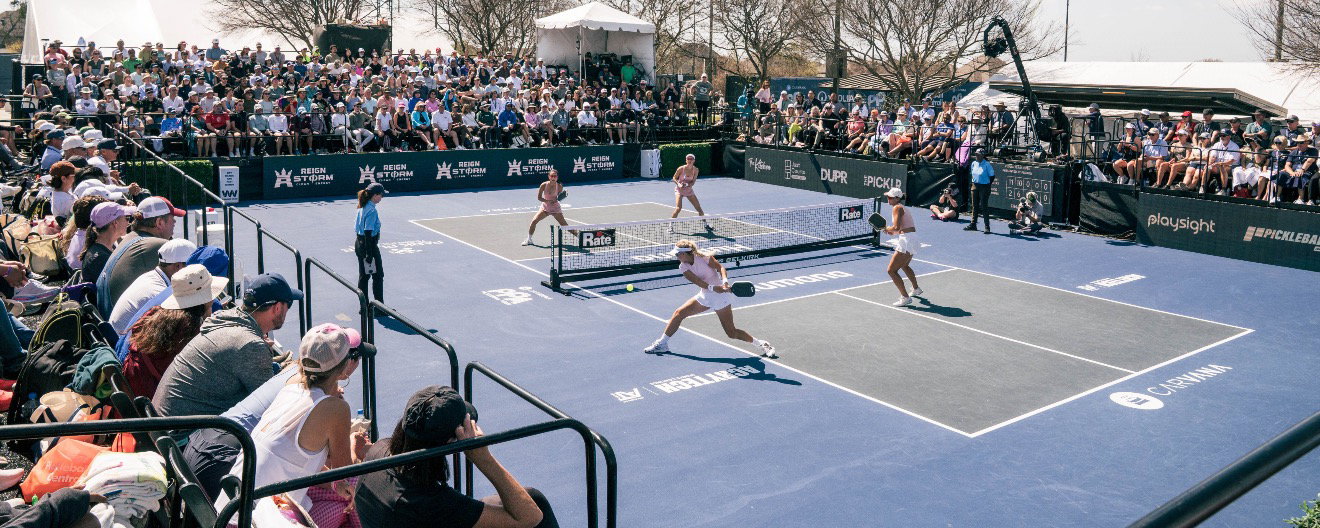
UPA-A releases rulebook to govern PPA Tour, Major League Pickleball matches
The United Pickleball Association of America (UPA-A), which governs both the PPA Tour and Major League Pickleball, has officially released its long-anticipated standalone rulebook.
The 71-page document introduces several notable updates set to take effect on May 22, just ahead of the season-opening Major League Pickleball event in Dallas. It also distinguishes between rules for amateur competition and those applied at the professional level.
Alongside the release, the UPA-A announced two key leadership hires. Referee Onisha Smith has been named Director of Competitive Governance and Compliance, while Howard Hepworth will serve as Director of Referee Training and Development.
Hepworth will also lead the new UPA-A Referee Program, which is designed to “educate, train, and evaluate referees at the highest levels of competitive pickleball, including PPA and MLP.”
Stricter penalties for incorrect calls and failed challenges
At the pro level, teams will receive one free video challenge per game. However, failed challenges now come with escalating consequences designed to discourage unnecessary or incorrect reviews.
If a challenge is unsuccessful:
- The Free Challenge is forfeited.
- If no prior Mark or Foul exists, a Mark is issued.
- If a Mark or Foul has already been assessed, an additional Mark is added and one point is awarded to the opponent.
Major League Pickleball is also partnering with Owl AI to implement automated line calling and in-match challenge support beginning with the 2026 season, further modernizing officiating systems.
Expanded behavior standards and enforcement system
The new rulebook also brings clearer definitions and stricter enforcement around player conduct. A “Mark” (also referred to as a Blue Card) is a formal penalty issued when behavior exceeds a warning level or disrupts match flow, fairness, or administration. Marks accumulate throughout a match.
Situations that can result in a Mark include unsportsmanlike conduct such as repeated profanity, arguing with officials or opponents, striking objects without damage, unnecessary distractions during rallies, damaging balls, or persistent disruptions to match flow.
Marks can also be issued for time and procedural violations, including delays between rallies, failure to be ready within the 15-second window, improper timeout procedures, or equipment-related stoppages caused by a player.
Fair play and integrity violations are also addressed more explicitly, including illegal coaching, unauthorized electronic use during matches, and repeated coaching infractions.
A more severe penalty, the “Foul” (Orange Card), applies to more serious or repeated violations and results in an automatic point awarded to the opposing team. Fouls are cumulative, and repeated infractions escalate further penalties, including additional points.
New rule targets airflow manipulation of the ball
One of the most discussed changes is the formal prohibition of using airflow to influence the ball. Starting later this month, players will no longer be allowed to blow, fan, or otherwise use air movement to alter the ball’s trajectory.
The rule states:
“A player may not attempt to influence, propel, or alter the ball’s flight by any means other than a legal paddle strike (e.g., blowing on or fanning the ball, directing airflow, or using any object, apparel, or body movement to affect its path). A violation of this rule is a fault.”
The update follows recent controversy, including an incident at the Sacramento Open involving Eric Oncins, which sparked debate after a warning was issued for blowing a ball over the net.
The UPA-A also clarified its stance on the situation, stating:
“Actions such as blowing the ball over the net, while not currently prohibited, do not align with the level of professionalism and credibility the sport is striving to establish. As Pickleball continues to evolve, players will inevitably test the boundaries of the rules, and no rulebook can anticipate every possible scenario.
Until May 22, 2026, blowing on the ball before or after it has been struck by a paddle remains legal under the current rules. In the instance where this action was penalized, the ruling was made in real time based on the referee’s judgment, experience, and interpretation of the rules. In all cases, participants are expected to conduct themselves in a manner consistent with accepted standards of conduct and the spirit of fair play as the sport continues to grow.”
Leadership emphasizes consistency and long-term structure
Referee Onisha Smith highlighted the broader intent behind the new rulebook:
“This rulebook is about more than rules, it’s about trust, consistency and the integrity of competition,” Smith said. “Our goal was to create a standard that can be applied uniformly while still respecting the realities of match play.”
UPA-A President Jason Aspes echoed that sentiment, emphasizing the long-term direction of the sport:
“These are foundational steps for the future of competitive pickleball. Rules and officiating shape the integrity of the sport. With a unified rulebook, a formal referee development program and experienced leadership in place, UPA-A is building the infrastructure needed to support the game at the highest levels.”
The full rulebook is now available publicly, outlining detailed regulations that will shape both pro and amateur competition moving forward.
Related articles
UPA set to implement line calling technology
Incorrect line calls will soon be part of the history of pickleball and not the current game.
197 days ago
-Jim Kloss
New UPA-A paddle standards for juniors and senior pros
The changes take effect on August 30.
225 days ago
-Pickleball.com Staff
UPA launches major capital raise, according to Huddle Up report
Entrepreneur and investor Joe Pompliano recently shared the news.
235 days ago
-Pickleball.com Staff
UPA paddle testing protocols are second to none
UPA is setting the highest and toughest standards for paddle approval.
260 days ago
-Jim Kloss