
Ben Johns shares pickleball wisdom during exclusive Q&A
Ben Johns is currently overseas competing in PPA Tour Asia events.
During some recent downtime in Malaysia, he participated in an exclusive Q&A session with Stadium Astro’s Michelle Lee to chat about a variety of topics, including life as a pro athlete, his training routine, and valuable tips for beginners.
Here are a few highlights from the conversation.
MICHELLE LEE: How did your love of pickleball start? At what point did you realize that you could make a professional career out of this?
BEN JOHNS: I started playing quite a long time ago now in 2016, so nine years. At that time, pickleball looked very different. It was not yet really a professional sport. There were some professional tournaments, but there was no professional tour or anything like that. When I picked it up, it was all just about fun. I was just having fun playing every day. I'd travel for tournaments, not because I was trying to make money. If you made money, that was just a bonus. If you came out even on travel expenses, that was a great weekend for you. Everyone played because they loved the game, they loved competing, and it was just one big party. That's kind of what got me into pickleball and that's what kept me playing. It was just incredibly fun and the people were amazing.
I would say it took probably three years of playing and traveling and competing all for fun before I actually started to consider it even really a serious sport or a professional sport because the tournaments were getting bigger, prize money was getting bigger, and sponsors were getting bigger. There were more and more people playing and recognizing it. I remember when I first started playing, if I told somebody I played pickleball, they were like 'What's that?' like 90% of the time, and that turned into, 'Oh yeah, I've heard of that,' and then eventually that turned into more and more tournaments being just worth going to. I was in school at the time, and I would say somewhere between my sophomore and junior year, I kind of started to realize this is actually very real and I can probably play this professionally when I'm done with school if I want to. By the time I graduated, I was like, 'I'm definitely doing this, and I'm not going to use what I studied in school,' so it was a gradual transition.
ML: You played table tennis and tennis. How has that impacted your pickleball game?
BJ: Pickleball is very interesting in that it attracts all types of athletes from a variety of backgrounds and they each kind of bring something special to it. Once you've played pickleball for a while, you can recognize when somebody comes from a certain background sport. You can be like, 'Oh, that's a baseball player, that's a racquetball player,' because they have certain strengths and certain weaknesses. For me, it was about adapting each sport that I played, baseball, tennis, table tennis, and bringing the strengths of whatever game I played into pickleball and trying to get rid of the weaknesses. The more sports you play, the more you can bring over into pickleball, and there's a whole host of strengths and advantages that the sports give you. And then it's more just kind of thinking through what do I need to, the habits that I need to get rid of that are not helping me, and what can I get better at. Sports are incredible, and I'm thankful that I played so many that were helpful for pickleball for me.
ML: Are there any particular drills that you like or that you normally recommend to players who want to improve?
BJ: Once you get to a certain level, it becomes very much a game of isolating very specific things and specific shots that you need to get better at. That's kind of the point I'm at. But before that, it's mostly about repetition and very basic stuff. You want to get very, very good at like three or four basic things. How I got really good initially, one of my favorite drills was just playing half-court singles cross-court, which is basically just playing one-on-one with somebody and only hitting it cross-court to the two sides. It basically simulates doubles, but you get all the balls. You get double the reps. If you have a good drilling partner, play a lot of half-court singles with them. It's helpful for everybody. It still is today.
ML: Pickleball is one of the fastest growing sports in the world. What challenges do you foresee in the future?
BJ: Honestly, pickleball does so many things so well naturally. It just has so much going for it. Any industry like this that is just booming, so to speak, is growing so rapidly. Business, of course, is wonderful. We love business. Business in pickleball is phenomenal. I guess one of the challenges is that it doesn't become too much about that. People still kind of keep in perspective that it is a sport and a game at the end of the day, and it's about enjoyment and health and people. It's not just about business and money, even though that is a healthy part of pickleball as well. I think that can be a challenge for people sometimes. I've seen it before, and it's important to keep perspective. I'm sure there will be a lot more challenges than that. But thus far, I think pickleball does such a great job of overcoming them naturally. I don't think you need to overcoach pickleball. It's a sport that solves its own problems in a lot of ways. There's no mastermind behind pickleball. Pickleball is its own mastermind, so let it do its thing.
ML: I'm sure, as with anybody, you have your tough moments. When you look back on your career so far, what has been the one tough loss that stands out?
BJ: None of them really come to mind. I guess you remember a host of losses, but none of them are ones where I really regretted anything. I think that's important for most people. Losses can hurt, and they do hurt at the time, and they might hurt for a while after that, but the only thing that would be lasting, the only thing that I would remember, and it's kind of a good thing that I don't, is if I didn't feel like I left it all in the court. Like if I didn't give it my all, that's probably the most important thing. As long as you feel like you did your best, even if you lost, it's okay. You know there's more matches to be won and you can't be perfect every time. A lot of people say you learn more from your losses than your wins, and that's maybe not true with all of them, but certainly some of them.
ML: With all your experience, is there a particular shot or tactic that people still fall for even at a pro level?
BJ: I think pickleball is actually a lot about, at least for me, it's not about necessarily doing something unpredictable. I think a lot of people get lost in trying to be unpredictable. That can be good at times. There's some element of that in pickleball. But really the best shots in pickleball are the ones that you see coming and are so good that it doesn't matter, so you try to make a strength in your game that is so good that it doesn't matter if they know it's coming.
ML: If there was one athlete in the world, other than a pickleball player, that you could go up against in a pickleball match, who would it be?
BJ: There are so many phenomenal athletes and there's a lot that I would love to meet and talk to and just kind of pick their brain and hang out with for a day. But I'm going to go with Lewis Hamilton, the Formula One driver.
ML: Who would you partner with then in doubles?
BJ: Well, Lewis would be one. Outside of that, I think Novak Djokovic. Novak is the greatest tennis player of all time and just a spectacular mental athlete besides the physical aspect. I think he would be really, really cool to play with.
ML: If you had one piece of advice to live by, on and off court, what would it be?
BJ: It's probably try to do what you enjoy as much as possible. I think people definitely get lost. Of course, it's so great to be ambitious and achieve your goals and all that, but at the end of the day, I think you should be focusing on what will be most fulfilling for you and try to make sure that what you're doing is fulfilling and that you're not just doing what you're told is going to make you satisfied or happy. Make sure that what you're doing is actually what is going to make you happy.
Related articles
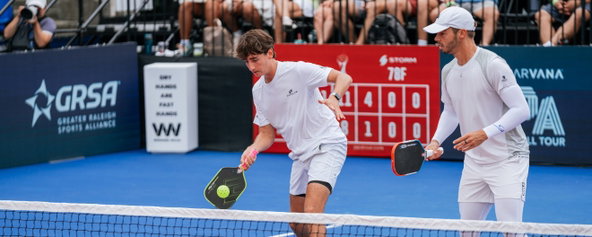
The 6 best male pro pickleball players all fans should know
New to pickleball? These are the players you need to know.
15 days ago
-Pickleball.com Staff

UNREAL COMEBACK vs. Ben Johns & Anna Leigh Waters | Condensed Match
19 days ago
-Pickleball.com Staff
Creating the perfect pickleball playlist
Want to bring a speaker to the courts? Here’s what you should be playing.
19 days ago
-Victoria Radnothy
What pickleball paddles do the pros use? Top 20 players in 2026
Wondering what pickleball paddles the best players in the world are actually using?
26 days ago
-Hannah Johns