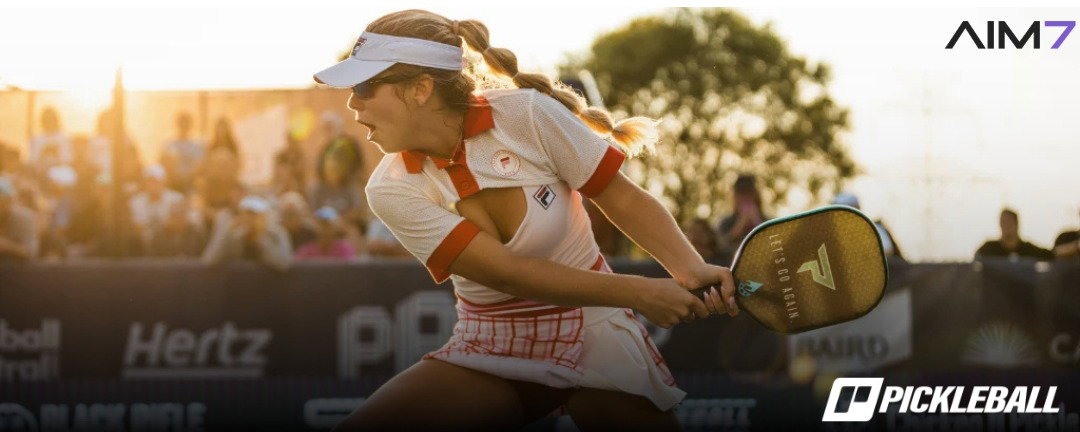
The real secret to reaction time: How to see shots before they happen
It's easy to blame slow hands. But watch the best players in that same exchange and you'll notice something strange: they rarely look rushed. They arrive in the right spot at the right moment, read attacks early, and make difficult gets look routine.
Most people assume this comes down to raw reaction time. The research says otherwise. Elite players aren't reacting faster after the ball is struck — they're gathering information earlier and making better predictions about what's coming next [1,2].
In a game that moves this fast, there often isn't enough time to rely on reflexes alone. The best athletes learn to recognize patterns, anticipate outcomes, and start moving before the ball reaches them [3].
The good news: anticipation is trainable. Below you'll learn how to train your nervous system both on and off the court — with a simple weekly plan you can start using this week. Let's dive in.
The nervous system's role in pickleball performance
Every shot in pickleball begins with information. Your eyes gather visual cues from the environment. Your brain processes those cues and determines the most appropriate response. Your muscles then execute the movement required to perform the shot.
Scientists call this loop perception-action coupling — a fancy way of saying that what you see and how you move are constantly feeding each other [4]. Pickleball stacks an unusually demanding combination of these on you at once.
Players must:
• Track a rapidly moving ball
• Process opponent movement
• Maintain balance during directional changes
• Coordinate precise paddle movements
• Make tactical decisions under time pressure
The nervous system constantly updates movement plans as new information becomes available. This process becomes especially important during kitchen exchanges, transition-zone play, and defensive situations where decisions must be made quickly and accurately.

Successful movement emerges from the interaction between the athlete, the task, and the environment rather than from physical ability alone [5]. The ability to adapt movement to changing situations is a hallmark of skilled performance.
Why experienced players often look faster
Experienced players look faster, but what's really happening is that they're reading their opponent better.
Here's the interesting part: studies comparing experts and beginners consistently find that the two groups use their eyes differently [1,6]. Instead of locking onto the ball, experts pull cues from an opponent's posture, movement, and paddle position — and that lets them see the shot coming before it's hit.
Researchers have found that highly skilled players recognize patterns and predict future actions more effectively than less-skilled athletes [6]. It's why a steady, well-positioned player can dismantle a more athletic opponent — they may not have the quickest hands on the court, but they're rarely in the wrong place. They compensate through superior anticipation, pattern recognition, and decision-making.
Experience does not eliminate age-related changes in processing speed, but it can improve efficiency by helping athletes identify relevant information earlier in the action sequence [7].
Where you look decides what you can do
Where you look is an essential component of play. With more experience, you can develop more accurate visual search behavior (how athletes gather information from their environment), directing your attention toward the most informative cues [6].
For pickleball players, these cues may include:
• Paddle angle before contact
• Opponent body position
• Weight transfer and foot placement
• Court positioning
• Shot tendencies observed earlier in the match
Many players focus exclusively on the ball. While ball tracking is important, experienced athletes often gain valuable information before contact occurs. By learning to identify these cues, you can begin preparing your response earlier, effectively increasing the time available to make decisions [8].
Coordination: The link between seeing and moving
Recognizing a shot early is only valuable if the body can respond appropriately. Improving coordination helps you organize multiple parts of your body to achieve a desired movement outcome. In pickleball, coordination influences footwork, balance, paddle positioning, timing, and shot execution.
During a fast exchange, you must simultaneously process visual information, move into position, stabilize your body, and control the paddle face. Research shows that athletes benefit from training environments that challenge both movement and information processing simultaneously [9].
In pickleball, successful performance depends on integrating perception, decision-making, and movement into a single coordinated response. Training these qualities together can help you perform better than training them separately.
|
Know when your nervous system is ready to perform. AIM7 tracks your sleep, recovery, and HRV (a measure of nervous system recovery) to deliver a daily readiness score — a single number that tells you when to push hard on reaction and decision-making work, and when to back off so fatigue doesn't blunt your edge. Pickleball Tournament players get a free lifetime premium membership (a $200+ value) with code PTVIP in the App Store. |
Practice should resemble competition
If you're spending a significant amount of time on predictable drills in your practice sessions, it may be time to add some variety. While repetition is valuable for developing technique, highly predictable practice environments may not fully prepare you for the demands of competition.
Research suggests that practice environments that closely resemble competition may more effectively facilitate the transfer of skills to game situations than highly scripted drills [10,11]. This translates to live-ball drills, constrained games, variable shot patterns, and scenario-based practice whenever possible.
Training the nervous system for pickleball: A practical guide
Improving nervous system performance doesn't require complicated equipment. The goal is to create practice situations that simultaneously challenge perception, anticipation, movement, and decision-making.
Train your eyes before the ball gets to you. During practice, start paying attention to your opponent's paddle position, body posture, and court positioning before they hit the ball. A simple way to develop this is during dink rallies, where you challenge yourself to spot visual cues that hint at the direction, speed, or intent of the next shot. Over time, this habit helps you recognize patterns sooner and feel less rushed during points.
Make your drills less predictable. Predictable drills build consistency, but matches require constant adaptation. Once you're comfortable with a drill, add variation by changing the direction, speed, height, or depth of incoming balls. During volley practice, mix balls to the forehand, backhand, body, and feet. During movement drills, remove fixed patterns and respond to random feeds. Small changes in variability encourage faster information processing and more adaptable movement.
Play more competitive kitchen games. The non-volley zone is one of the fastest environments in pickleball and an ideal place to develop coordination and quick decision-making. Incorporate games that emphasize hand speed, paddle control, and recovery between shots. Kitchen-only points, controlled hand battles, and short-court games expose you to rapid exchanges while reinforcing balance and readiness.
Train your first step. Efficient movement often begins before the ball is struck. Practicing a small split step as your opponent makes contact helps position your body to move quickly in any direction [13]. During drills and games, focus on maintaining an athletic stance, staying light on your feet, and preparing to move before you know exactly where the ball is going.
Add decision-making to practice. Many players spend hours repeating shots but little time practicing the decisions that occur during matches. Build decision-making into drills by creating situations that require shot selection based on ball height, court position, or opponent movement. For example, during a dink rally, choose to attack only balls above net height, or challenge yourself to spot reset opportunities.
Use wall training for hand-eye coordination. A wall is an effective tool when court time is limited. Volleying against a wall challenges timing, paddle control, and visual tracking while providing a high number of repetitions in a short period. Increase the challenge by alternating forehands and backhands, changing distances from the wall, or adding lateral movement between contacts.
Challenge your balance. Pickleball players frequently hit shots while reaching, recovering, or moving laterally. Improving balance helps you maintain control in these situations and move more efficiently around the court. Exercises such as single-leg balance holds, controlled lateral hops, split-stance rotations, and step-and-stick drills can be added to a warm-up or strength routine. Research suggests balance training may contribute to improved positioning and more stable shot execution, and has a well-established role in reducing injury risk [14].
Create pressure during practice. Practice and competition often feel very different because scoring, momentum, and consequences influence decision-making. Adding pressure helps bridge that gap. Play games to a score, create challenges that require execution under time constraints, or begin points from disadvantageous court positions.
Sample 20-minute nervous system block. Add one or two of the following to the beginning of practice when you're mentally fresh:
• Kitchen hand battles
• Variable dink drills
• Random-feed movement drills
• Competitive game-based scenarios
• Transition-zone decision-making drills
Spend 5–10 minutes on each activity and rotate them throughout the week.
A nervous system playbook for every DUPR level
3.0 to 3.9: Train your eyes and your first step. Before worrying about fancy drills, build two habits. During dink rallies, practice watching your opponent's paddle and body before they hit, not just tracking the ball. And add a small split step as your opponent makes contact so you're ready to move in any direction [13]. These two changes alone buy you time on nearly every shot.
4.0 to 4.9: Add unpredictability and decisions. You've got the fundamentals — now make practice less scripted. Mix volleys to the forehand, backhand, body, and feet. Respond to random feeds instead of fixed patterns. And build choices into your reps: in a dink rally, attack only balls above net height, or hunt for reset opportunities. Variable, decision-rich practice is what transfers to a real match [10,11].
5.0 and above: Train under pressure and protect recovery. At this level, the gap is rarely physical — it's holding decision quality together when it counts. Play games to a score, start points from bad positions, and add time constraints. Just as important, treat recovery as part of training: fatigue measurably erodes reaction time and decision-making [12], so a tired nervous system undoes the work.
Recovery influences reaction time too
The nervous system can't perform optimally when it's fatigued. Sleep, recovery, hydration, and nutrition all influence cognitive performance, reaction time, attention, and decision-making. Research on sleep and athletic performance has shown that inadequate sleep can impair cognitive function and reaction time while reducing overall performance capacity [12].
When you're competing in tournaments or playing multiple matches in a day, recovery should be viewed as part of performance preparation, not an afterthought. A well-rested athlete is often able to process information more effectively and maintain decision-making quality deeper into competition.
A finely tuned nervous system is built on more than drills. It depends on recovering well enough to react sharply, moving well enough to get into position, and showing up to practice ready to absorb the work.
That's exactly what AIM7 is built for.

AIM7 connects to your wearable and combines your sleep, HRV, and recovery data into a personalized daily readiness score — a single number that tells you how hard to push, when to dial it back, and when your body is primed to perform. It then builds your training around that score, so your strength, mobility, and balance work — the physical foundation behind coordination and quick, stable movement on the court — is always matched to what your body can actually handle that day.
The result: you enhance your reaction time, and you protect your nervous system on the days it needs it — instead of grinding through fatigue that quietly erodes the precision you're working to build.
As a member of the Pickleball Tournaments community, you can get a free lifetime premium membership to AIM7 — a $200+ value — completely free. Use code PTVIP in the App Store.
The bottom line
Fast reactions in pickleball are about much more than quick hands. Performance depends on how effectively your nervous system gathers information, interprets cues, anticipates outcomes, and coordinates movement. Elite players excel because they recognize patterns early, make decisions quickly, and adapt their movements to live changes.
You can build these qualities by working anticipation, vision, coordination, and decision-making into realistic practices and games. The pace might not slow down, but with a finely tuned nervous system, you'll be ahead of every point.
Dr. Susie Reiner is an assistant professor of Exercise and Sport Science at Seton Hall University and an applied research scientist focused on human performance and digital health. She holds a PhD in Health Sciences with a specialization in Human and Sport Performance and completed postdoctoral training at the University of Kentucky’s Sports Medicine Research Institute. She consults with sport tech, wellness, and healthcare companies on research strategy and science-driven content. Her work centers on translating complex science into clear, practical insights for real-world use.
References
- 1. Abernethy B, Russell DG. Expert-novice differences in an applied selective attention task. Journal of Sport Psychology. 1987;9(4):326-345.
- 2. Williams AM, Davids K, Williams JG. Visual Perception and Action in Sport. London: E & FN Spon; 1999.
- 3. Williams AM, Ward P. Anticipation and decision making: Exploring new horizons. In: Tenenbaum G, Eklund RC, editors. Handbook of Sport Psychology. 3rd ed. Hoboken, NJ: Wiley; 2007:203-223.
- 4. Huesmann K, Loffing F. Perception-action coupling in anticipation research: A classification and its application to racket sports. Frontiers in Psychology. 2024;15:1396873.
- 5. Araújo D, Davids K, Hristovski R. The ecological dynamics of decision making in sport. Psychology of Sport and Exercise. 2006;7(6):653-676.
- 6. Mann DTY, Williams AM, Ward P, Janelle CM. Perceptual-cognitive expertise in sport: A meta-analysis. Journal of Sport and Exercise Psychology. 2007;29(4):457-478.
- 7. Müller S, Abernethy B. Expert anticipatory skill in striking sports: A review and a model. Research Quarterly for Exercise and Sport. 2012;83(2):175-187.
- 8. Williams AM, Ford PR, Eccles DW, Ward P. Perceptual-cognitive expertise in sport and its acquisition: Implications for applied cognitive psychology. Applied Cognitive Psychology. 2011;25(3):432-442.
- 9. Wu J, Qiu P, Lv S, Chen M, Li Y. The effects of cognitive-motor dual-task training on athletes' cognition and motor performance. Frontiers in Psychology. 2024;15:1284787.
- 10. Pinder RA, Davids K, Renshaw I, Araújo D. Representative learning design and functionality of research and practice in sport. Journal of Sport and Exercise Psychology. 2011;33(1):146-155.
- 11. Krause L, Farrow D, Pinder R, Buszard T, Kovalchik S, Reid M. Enhancing skill transfer in tennis using representative learning design. Journal of Sports Sciences. 2019;37(22):2560-2568.
- 12. Fullagar HHK, Skorski S, Duffield R, Hammes D, Coutts AJ, Meyer T. Sleep and athletic performance: The effects of sleep loss on exercise performance, and physiological and cognitive responses to exercise. Sports Medicine. 2015;45(2):161-186.
- 13. Uzu R, Shinya M, Oda S. A split-step shortens the time to perform a choice reaction step-and-reach movement in a simulated tennis task. Journal of Sports Sciences. 2009;27(12):1233-1240.
- 14. Hrysomallis C. Balance ability and athletic performance. Sports Medicine. 2011;41(3):221-232.
Related articles
In defense of pros wearing jewelry on the court
Pickleball's top athletes love to add a little extra shine.
21 hours ago
-Victoria Radnothy
20 things pros wish they knew earlier in pickleball
These quick tips can help you level up your game fast.
1 day ago
-Victoria Radnothy
How to break out of 4.0 jail in pickleball
Let professional coach and athlete Tanner Tomassi be your guide.
11 days ago
-Pickleball.com Staff
Must-try singles pickleball drills, straight from the pros
Take your game to the next level with practice tips from the world’s top players.
11 days ago
-Victoria Radnothy