UPA-A: Pickleball’s Gold Standard
UPA-A: Pickleball’s Gold Standard
In 2024 pickleball reached an inflection point.
What was once a backyard hobby had grown into global sport with professional tours, meaningful prize money, and a rapidly growing ecosystem of players, brands, and investors. With that growth came a simple but unavoidable truth: Higher stakes demanded higher standards.
Fast forward less than two years and there is no standard in pickleball more rigorous, more complete, or more future-proof than UPA-A paddle certification.
Not All Certifications Are Created Equal
At a glance, paddle certifications may look similar. They test for performance. They aim to create fairness. But the ‘how’ matters and the differences are significant.
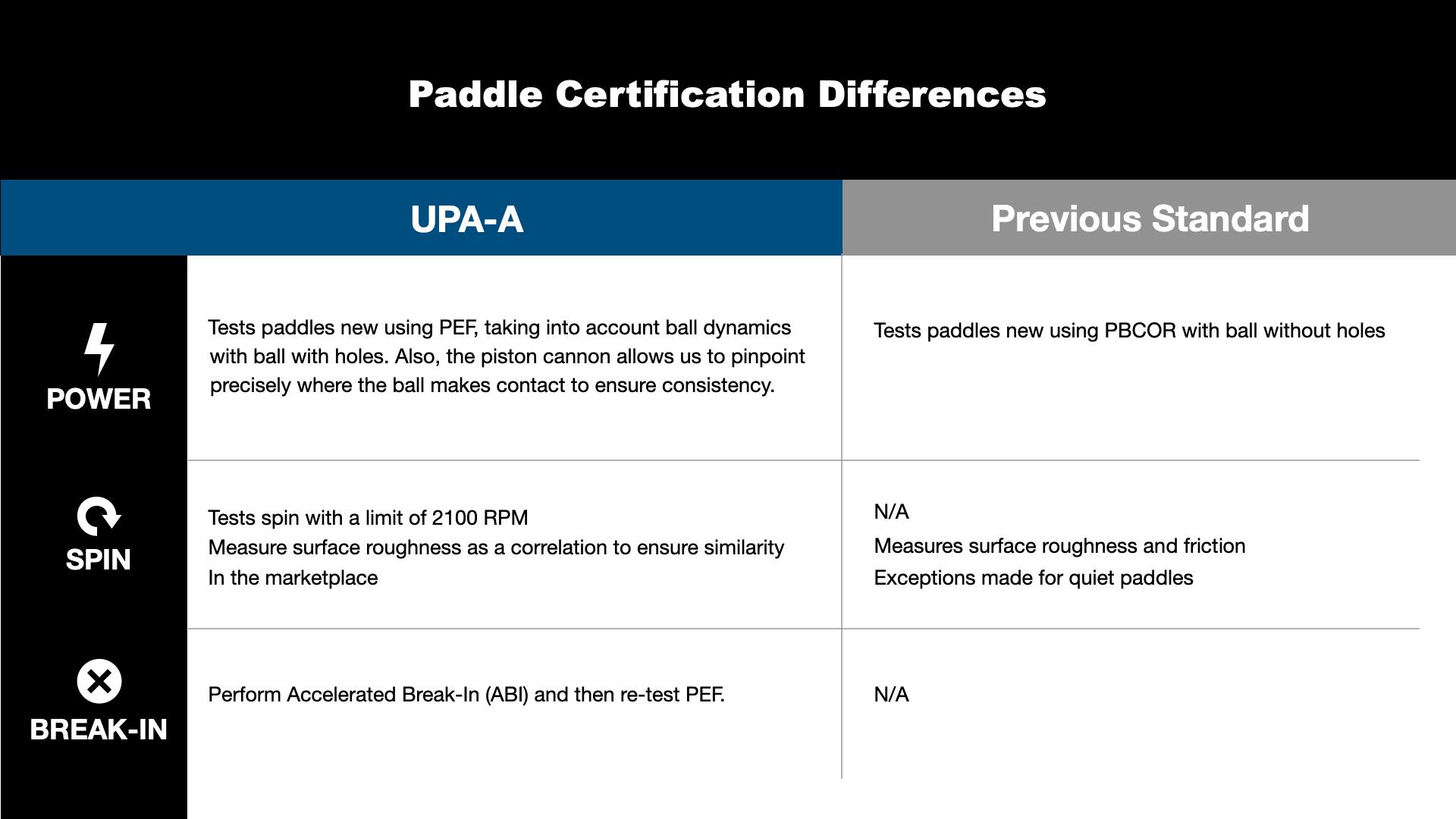
UPA-A paddles are held to:
- Lower power thresholds
- A true spin limit (not a proxy)
- Testing after break-in
That last one is the most important and the most overlooked.
Because the reality is, all paddles change. With each hit, a paddle’s performance will either become more or less powerful. Hit after hit after hit, performance can vary quite dramatically.
If you’re only testing a paddle when it’s unplayed, you’re not testing the paddle players are actually using.
UPA-A is doing just that.
Power: Controlled, Not Unlimited
Not every sport needs equipment regulation, but in order to maintain fairness, some do.
Baseball did it with the Batted Ball Coefficient of Restitution (BBCOR) on bats. Golf uses Overall Distance Standards (ODS) to measure balls and Characteristic Time (CT) for drivers.
Why?
Because unchecked equipment evolution breaks the game. With the growth of the game, the stakes are getting higher. The more players, the more sales, the more money up for grabs, which leads to better engineering and materials. This requires better standards and the proper funding to keep the regulations ahead of those trying to engineer around them.
This isn’t about limiting innovation. It’s about protecting the delicate balance that makes pickleball so special.
Measuring Spin, Not Grit
For years, certification has relied on limiting grit as a proxy for spin. However, more grit does not always result in generating more spin. UPA-A went to Pickle Pro Labs along with the Baseball Research Lab at UMass Lowell and they tested it. Repeatedly. Scientifically.
The conclusion: Turns out measuring grit is not an accurate indicator of a paddle’s ability to generate spin. There is not a consistent correlation between surface roughness and actual spin output. It works sometimes. But if you are taking regulations seriously and want to do what is best for this sport, that isn’t good enough.
So UPA-A invested in creating a test that measures spin directly.
Grit is still accounted for, but only as a compliance check to prevent “bait-and-switch” tactics where manufacturers pass testing with one surface and go to production with another.
That level of rigor matters. Because spin, just like power, changes the game.
Break-In Testing: The Missing Piece
This is where UPA-A separates itself entirely.
Every paddle is tested both brand new and then again after a process known as accelerated break-in (ABI).
Why?
Because players don’t compete with brand-new paddles. With each hit paddles change.
If a paddle passes on day one but exceeds limits on day two, that paddle never should have been certified in the first place. But manufacturers began to understand there was a loophole in the testing.
Paddles breaking in and becoming hot wasn’t a bug, it was a feature.
UPA-A Certification closes that loophole.
Rules Only Matter If They Are Enforced
Standards matter. Regulations matter. But UPA-A doesn’t stop at lab certification. UPA-A understands that production standards can drift over time. To ensure paddles stay within spec, a comprehensive compliance program exists to test paddles randomly in the marketplace.
We also limit paddles certification to 24 months. If paddles remain on the market beyond their 24 month eligibility, they must be retested for certification to ensure they perform the same as they did when they were originally submitted.
The Go/No-Go System
UPA-A uses the Go/No-Go (G/N-G) machine onsite for testing of pro paddle at PPA and MLP events. The G/N-G measures paddle deflection onsite. This data point is correlated, and a reliable proxy for our coefficient of restitution test (PEF as it is referred to at UPA-A) which measures a paddle’s power. Each paddle that receives UPA-A certification has its unique digital fingerprint, allowing us to understand what parameters the paddle will have both new and broken in when presented for competition.
The G/N-G is soon to be available for tournaments everywhere. That means paddles can be tested in real time. Equipment compliance is verifiable for important tournaments, league play, moneyballs, and at every facility that wants to ensure fairness and a level playing field to their members.
The Stakes Argument
If your tournament is played for prize money, valuable gifts, or even just being entered into DUPR, then equipment standards matter.
Without a consistent and enforceable standard, competitors will look for any advantage they can get. The higher the stakes, the more they have to gain, and the more likely you will see people pushing the limits to gain this advantage.
The Market Is Already Deciding
UPA-A as an organization is still less than two years old, with our paddle standard in place for less than a year. There is no secret that UPA-A was met with scepticism, but we have continued to invest in the science, engineers, and delivered clear and thoughtful rules to govern this sport.
Manufacturers, many of whom were outspoken critics, have recognized UPA-A’s approach is better for the game. Today we have over 200 paddles from 50 brands on the UPA-A Approved Paddle List.
We are now seeing smaller, enthusiast brands pursuing UPA-A-only certification. We have invited brands to visit the lab, to meet the engineers, and after seeing the meaningful work we are doing and the investment we have made, the tide has turned.
That doesn’t happen by accident. It happens when the data is clear, the process is transparent, the standard is rooted in science, and repeatable results are expected.
The industry is recognizing that if we want to continue to see sustained growth, higher stakes, international expansion, professional play, and realize our Olympic dreams, a new standard is necessary.
The Bottom Line
UPA-A isn’t just another certification. It’s a complete system built for the most competitive environments all over the world. It has been birthed at the best academic institutions, scientifically evaluated by the best engineers. We have implemented real world performance testing along with pragmatic enforcement to ensure the delicate balance of pickleball can be maintained, no matter where in the world and at what level it is played.
It would have been easy to ask: “Did this paddle pass?”
Instead we asked:
“Does this paddle stay within limits over time, under pressure, in real play?”
That’s the question that matters. And UPA-A has the only standard that can be trusted.
If you would like to review the list of approved UPA-A paddles, check it out here.
UPDATE:
After a lengthy process, UPA-A has recently been granted 501c6 status by the IRS and will transition to a fully independent, not-for-profit organization by the summer of 2026.
Related articles
Five pickleball tips to improve your game from beginner to 4.0
Coach Jess breaks down concepts that can help players win more points, improve consistency, and avoid common mistakes on the court.
5 hours ago
-Pickleball.com Staff
.jpg?width=592&height=237&optimizer=image)
Which Honolulu paddle should you buy? A guide to the lineup
We break down the paddles by shape, core, and surface so you can find the one that fits your game.
5 hours ago
-Joseph Sutton
.jpg?width=592&height=237&optimizer=image)
Gearbox Pressure X MPP vs. EPP: Which one should you play?
Gearbox built two Pressure X paddles on the same core system and frame, then tuned one for a fast release and the other for longer dwell.
6 hours ago
-Joseph Sutton
Best pickleball paddles for women 2026
Discover our top 7 best picks for every playing style, including pro favorites from Anna Leigh Waters and Anna Bright.
4 days ago
-Hannah Johns