.jpg?width=1320&height=528&optimizer=image)
Best pickleball nets of 2026: Top picks for every budget & player
There are more public pickleball courts with permanent nets on them than at any point in the sport's history, and it still isn't enough. Every week another rec crew claims a tennis court at the local park, another school adds pickleball to its PE rotation, another homeowner pours a slab in the backyard and starts trying to figure out what net to go with.
If you shop by price alone, you can very easily end up with too little or too much net for your needs. The better approach is to answer one question first: how often will this net move, and how far? Everything else, including what you should spend, follows from the answer.
The Four Tiers of Net Systems
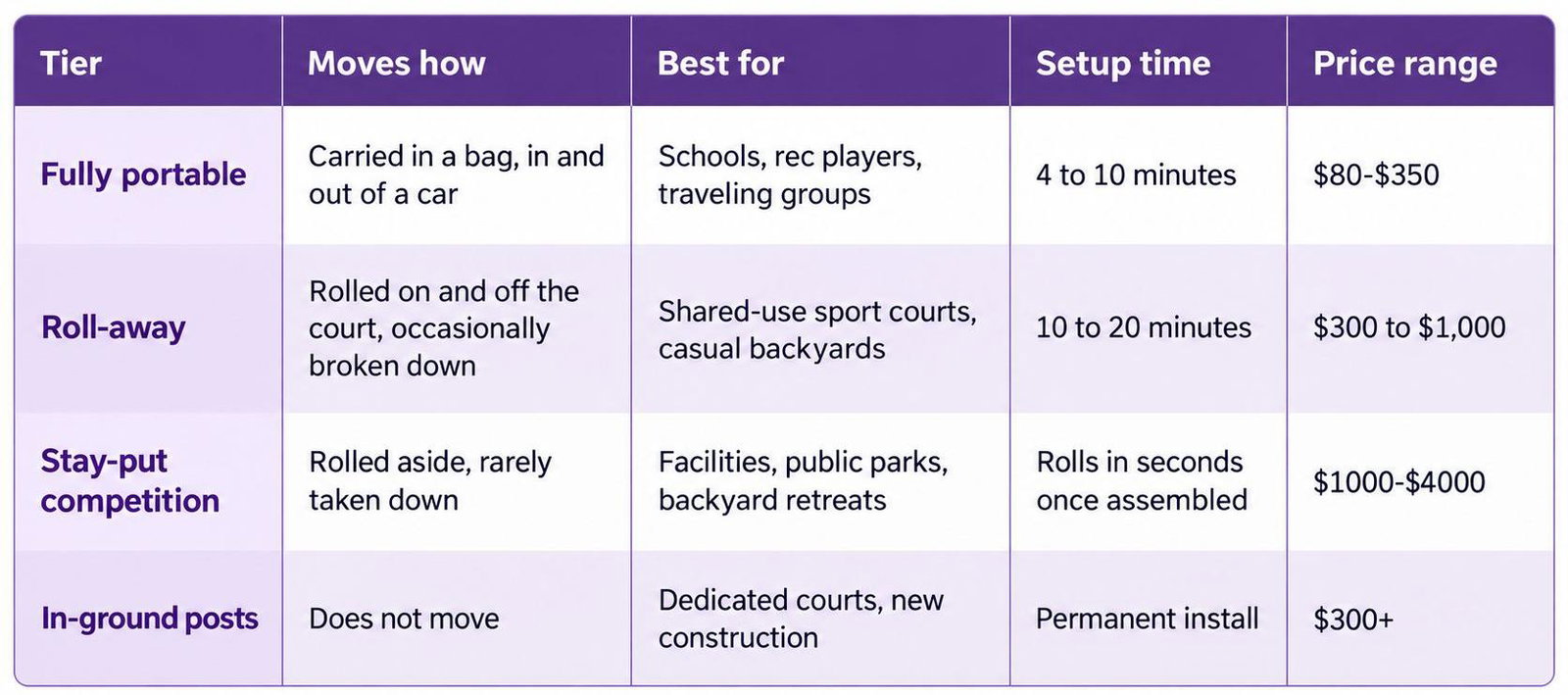
Net systems break down into four practical categories based on how mobile they need to be.
.jpg)
A quick note on naming, because the industry has made this confusing. The word "portable" shows up in product names across three of these four tiers, which is how you end up comparing a Douglas Premier Portable to a Franklin Portable and wondering why one costs six times more than the other. If it helps to keep them straight, think of the tiers as carry it, roll it, park it, and plant it.
Tier One: Fully Portable Nets
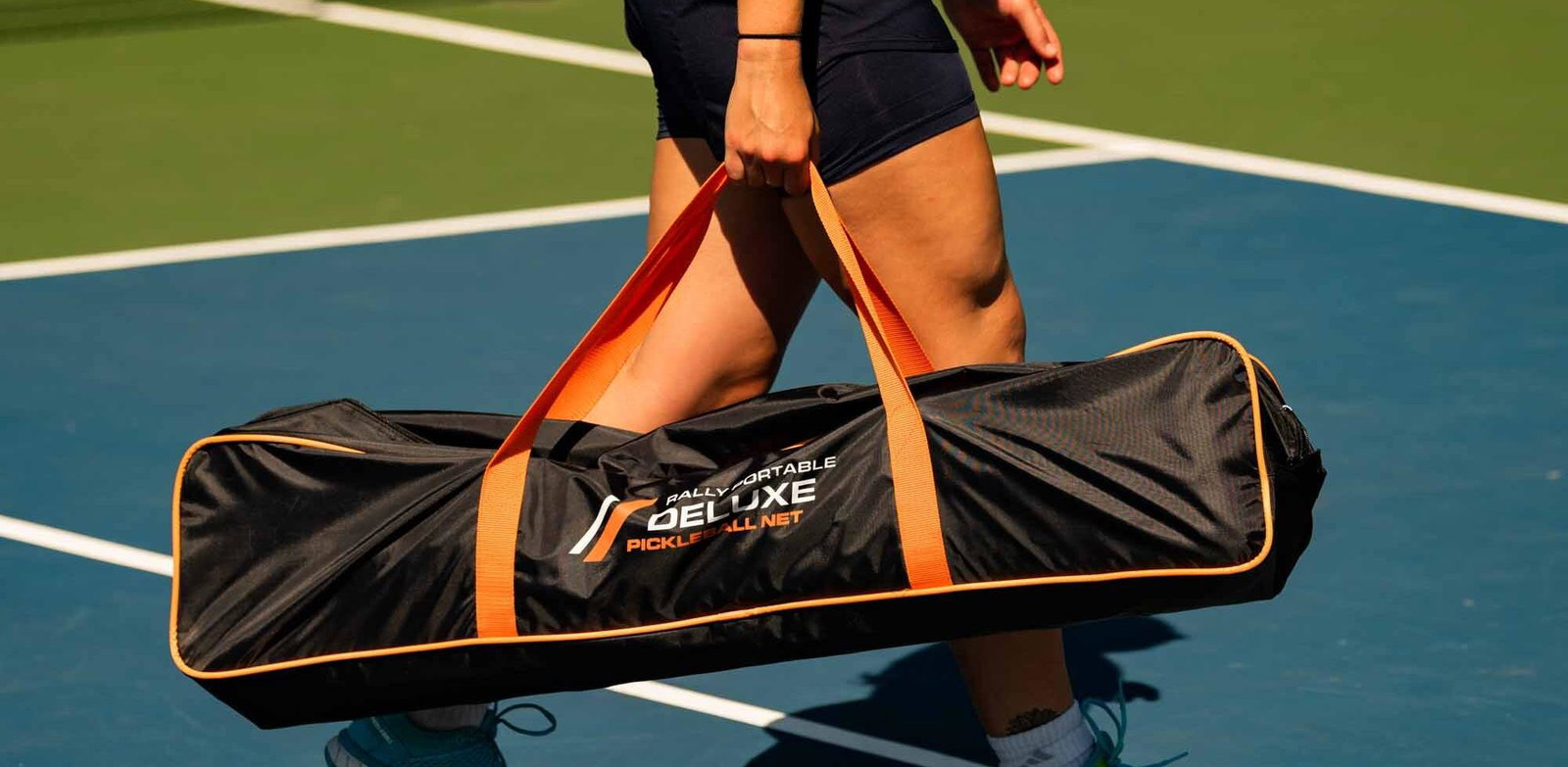
This is the net you throw in a trunk. It is for schools, for rec players who need to bring the court with them, for anyone whose playing surface is a gym floor on Tuesday and a park slab on Saturday.
The classic design has not changed much in years. You get a steel frame that snaps or slides together, a net that attaches to the ends, and a thin center post that keeps the middle from sagging to the ground. It is bombproof in the sense that matters most for this category, which is that it survives being tossed around by people who did not pay for it. Setup runs anywhere from four to ten minutes depending on the design and how many times you have done it before. Sets like the Rally Deluxe Net System and the PICKLE-BALL 3.0 Net System are tried and trusted options that will last a very long time.
The only real innovation in this space is the SwiftNet 2.1 Portable Net System, which replaces the sagging center post problem entirely by using a tensioned carbon fiber beam to hold the net at the correct height across its full width. It sets up fast once you have practiced a few times, and it is genuinely pleasant to play on compared to anything else you can carry. It is also pricey. What you get for that money is a strong warranty and a beam made in the USA out of aerospace grade carbon fiber, which is a real answer to the question of why it costs what it costs.
NOTE: One thing to understand before you buy anything in this tier: every fully portable net struggles to generate enough tension to stand up to a ball. Shots that catch the tape lose all their momentum and flub over instead of ricocheting back or popping up predictably. For casual play and for teaching, that is not a big deal. In anything competitive, it will drive you crazy, and no amount of fiddling with a portable frame is going to fix it.
Tier Two: Semi-Portable Roll-Away Nets
.jpg)
You want something you can take down, but if you are being realistic about it, you are mostly just going to roll it out of the way. That describes a huge number of shared-use sport courts and backyard courts, and it is the reason this category has grown the way it has.
These systems have locking wheels that make moving them on and off the court easy. They still come in a bag, and they can still be broken down, but breaking one down takes real time and you will not want to do it often. Expect to spend between $300 and $1,000 depending on the performance and features you want.
At the entry end, the PickleNet Plus is essentially a portable net with wheels added. That makes it a smart buy for schools and community centers that need mobility more than they need feel, but it carries the same tension limitations as tier one and does not have the solid, planted quality that competitive players notice immediately.
The PickleNet Deluxe has been a staple in shared-use facilities and backyards for years, and it earns that position with a proven durability record and genuinely easy handling. If you want one recommendation in the middle of this category without overthinking it, this is the safe answer.
For nets that live outside, rust stops being a hypothetical and becomes a schedule. The Dominator Rolling Portable Net solves that with aluminum. Their base model is well built and strikes a real balance between price and performance, and the squared frame design adds rigidity that shows up over years rather than weeks.
If you are shopping the top of this tier, or if you are genuinely torn between roll-away and stay-put, the Dominator Pro Portable Net is best in class. It is still easy to move on and off the court and light enough to relocate entirely, but it delivers pro tier net tension, height accuracy, and durability. That combination is rare at any price.
Tier Three: Stay-Put Competition Nets
.jpg)
Facilities, public parks, backyard retreats, and anyone who wants a net that can be rolled aside but not casually carried off should be shopping this tier. These are competition grade systems built to live outdoors, and the fact that they are hard to walk away with after hours is a feature, not a compromise, for anything in a public space. They move on and off shared-use courts with some effort, and none of them require anchoring into the playing surface.
The gold standard for years has been the Douglas Premier Portable Net System. A heavy steel frame, a lift and lock wheel system, and a long track record have made it the default for most public courts in the country running a net at this level. If you have played on a good public court lately, you have probably played on one.
It has competition now. The Dominator Pro Max Net uses a clever hidden wheel system so it reads as permanent while staying much easier to reposition, and it does it with a thick but relatively light rust-proof aluminum frame. Net tension and everyday usability are top tier. I love it for upscale courts and premium backyard setups. What it does not have is the rugged, take-a-beating quality of the Douglas, so think carefully about it for high-traffic public installs.
For the best of the best, look at the C&D Championship Net. It is solid, sleek, rugged, and comes closer to the performance of a true in-ground system than anything else that rolls. You see C&D nets on the nicest courts in the country for a reason, and they cost accordingly. They are available with or without wheels depending on what you need, and they carry a generous ten year warranty.
Tier Four: Permanent Net Posts
.jpg)
These are the least popular systems on the list, and only because dedicated courts are far less common than shared-use ones. They are also the most important to get right, because they take real investment and they are not coming back out of the ground without a project.
Permanent systems are built around the posts and the sleeves those posts drop into, since that hardware does all the heavy lifting. Every system worth buying includes a tensioning crank and a center strap so you can set the net to the correct height. There are a number of options out there and, to be honest, most of them do the job very well.
For a lower profile, sleek look in rust-proof aluminum, the Dominator Net Posts package, which includes net and sleeves, is a strong option. For something more rugged and closer to bombproof, look at the Pickleball Central Steel Net Posts, though be aware you will need to buy the net and sleeves separately with that system.
What Actually Matters When You Compare Nets
A few things separate a net you stop thinking about from one you fight with every session.
Net tension. This is the single biggest difference between tiers and the hardest thing to evaluate from a product photo. A properly tensioned net plays predictably off the tape. A loose one turns every net cord into a coin flip.
Height accuracy. The net should sit 36 inches high at the sidelines and 34 inches at the center. Sagging center posts and stretched-out tape are why so many rec nets play low in the middle, which quietly changes how everyone learns to hit.
Frame material. Steel takes abuse better and costs less. Aluminum does not rust, which matters enormously for anything that lives outside year round. Neither answer is wrong, but pick deliberately rather than by default.
Wheels. Locking wheels are the whole point of the middle two tiers. Check whether they lift and lock, whether they roll on the surface you actually have, and whether the locks hold under a real bump.
Warranty and theft. A ten year warranty tells you what a manufacturer expects its frame to survive. And for public installs, a net that is difficult to carry off is a net you still own next month.
There are a lot of great net systems out there, including some that did not make this list. But if you can answer how often your net needs to move and how far, you have already done the hard part of narrowing it down. The rest is matching your budget to the tier you actually belong in.
Check out every category of net systems here
Replacing the Net, Not the Whole System
Before you spend money on a new system, it's worth knowing that on almost every net out there, the frame isn't the part that wears out, the net is. Frames tend to outlive the nets hanging on them by years, particularly aluminum ones, so a system that feels tired and plays sloppy usually just needs a fresh net.
The wear usually starts at the top. The headband, or tape, absorbs every ball that catches the cord, and on cheaper nets it's also where the stitching gives out first. Once that tape has stretched or started pulling away from the mesh, you'll notice you can't crank the sag out of the middle anymore no matter how much tension you put on it. Sun handles the rest. UV breaks down the mesh over time, so an outdoor net will fade, stiffen, and eventually start opening up around the spots that get hit most, while the grommets pull through and the bottom hem tears where the rod or bungee runs.
How long you get out of a net depends almost entirely on sun exposure and traffic. A net living outside on a busy public court is usually looking rough somewhere in the two to four year range, while the same net on a backyard court that sees play a few times a week, or one that lives indoors in a gym, can go five years or more without much complaint. The real signal isn't age though, it's whether the thing still holds accurate height. If you've tensioned it properly and set the center strap and it still won't sit at thirty four inches in the middle and thirty six at the posts, that net is finished regardless of how it looks from ten feet away.
Most net systems have replacement nets available for purchase, so it's worth checking whether the company that built your system sells a replacement for it directly, since a net matched to the frame will fit better than a generic one.
Check out pricing and availability for the most common replacement nets (and parts) HERE
Whatever those numbers come out to, the math almost always favors replacing. A new net on a sound frame costs a fraction of a new system and gets you most of the way back to how the whole thing played when it was new, which makes it the cheapest real upgrade available to anybody who already owns a decent frame.
Related articles
.jpg?width=592&height=237&optimizer=image)
Which Honolulu paddle should you buy? A guide to the lineup
We break down the paddles by shape, core, and surface so you can find the one that fits your game.
5 hours ago
-Joseph Sutton

Best pickleball paddles for women 2026
Discover our top 7 best picks for every playing style, including pro favorites from Anna Leigh Waters and Anna Bright.
4 days ago
-Hannah Johns
The top 5 paddles for power and forgiveness
These paddles give you real pace on drives and put-aways while staying stable and predictable when you miss the sweet spot.
4 days ago
-Joseph Sutton

Best dressed at the Rate Las Vegas Open
The pros brought bold patterns to the court in Sin City.
8 days ago
-Victoria Radnothy