(2).jpg?width=1320&height=528&optimizer=image)
The history of pickleball paddles
Author’s note: This is by all means a living document that will be updated as more information comes to light about the history of paddles in an era without clear documentation and often overlapping accounts.
I. The Origin (July 1965)
Four Seattle families — the Pritchards, McCallums, Bells, and Browns — summered together on the southwest shore of Bainbridge Island, Washington, on a compound of three waterfront cabins with a weathered badminton court behind them. One rainy day in July 1965, Joel Pritchard and Bill Bell came back from golfing to find bored, whining children. The adults ended up on the badminton court with a plastic ball and whatever paddles were lying around, and within days they had taken the court over entirely. Barney McCallum was summoned the following weekend, handed a crude paddle, and was hooked on sight. He would become the sport's third founder and the man who turned its paddle into a product.
II. The Equipment Problem — and the First Paddles
The founders grabbed whatever was in the shed: paddleball paddles, badminton racquets, and ping-pong paddles, with the net left at badminton height. Joel soon lowered it to hip height — roughly 36 inches, the height of his own waist — so the group could hit harder.
The ping-pong paddles were the first thing to fail. They were undersized and started breaking almost immediately.
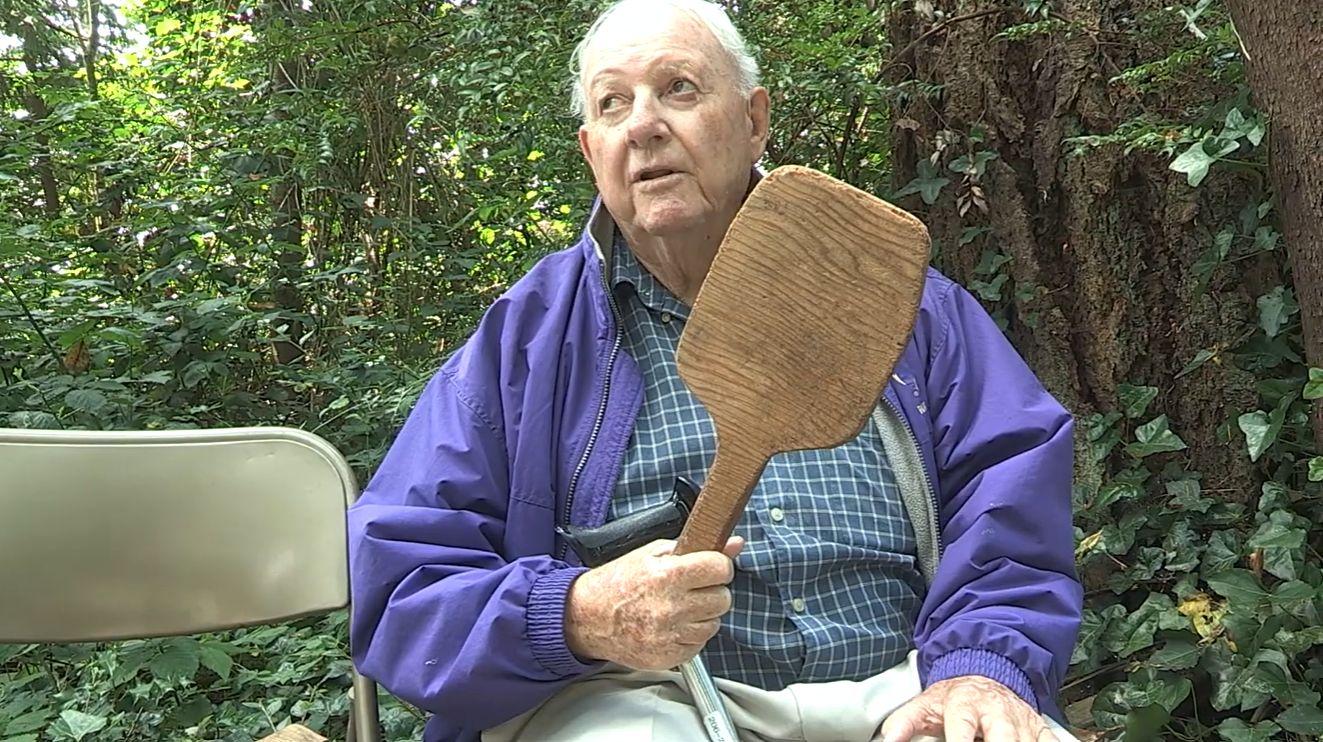
So Joel and Bill went to Joel's father's woodworking shed on the property, found scrap plywood, sketched the shape of two paddles, and cut them out with a band saw. These first paddles were thin plywood, cut straight from the sheet, with no handle buildup, no grip, no paint, and no design. Those were the paddles used the following weekend. In his words, the shapes have changed only slightly since: today's paddle is essentially that first paddle.
III. Pickle-Ball, The Corporation (1968)
On February 13, 1968, the group filed Articles of Incorporation for Pickle Ball Inc. (later Pickle-Ball, Inc.) — "to develop the game of Pickle Ball and to sell and promote said game in a lawful manner."
Five people were asked to invest $500 each; three opened their pocketbooks: Joel Pritchard, Bill Bell, and Barney McCallum. The company existed less for profit than logistics — Barney needed an entity to buy plywood and handle buildups and to process incoming money. In 1974 disclosures, Pickle-Ball Inc. showed net assets under $1,500. Pritchard said it was profitable but that they never took a dime out. Barney was blunter: none of them were in it for the money, and it was never even a consideration.
~1972 — Pickle-Ball Inc. filed for the "Pickle-ball" trademark, which remains live.
IV. The Wooden Paddle, Engineered
Barney knew the wood was the key to the paddle, and experimented systematically. He worked through the options by elimination: ¼-inch plywood was too light and flimsy, ½-inch too heavy and short on touch, leaving ⅜-inch as the sweet spot. He then traded up from 3-ply to ⅜-inch marine 5-ply — considerably stronger, and not stocked by every lumberyard — which became the secret wood, green enough in David's memory to suggest marine grade or treatment.
Manufacturing. Barney's father had a well-appointed woodworking shop in the basement of his Seattle home — including a table saw, rare at the time — which made it easy to rip plywood into strips the width of a paddle, then into squares. A band saw cut the shape.
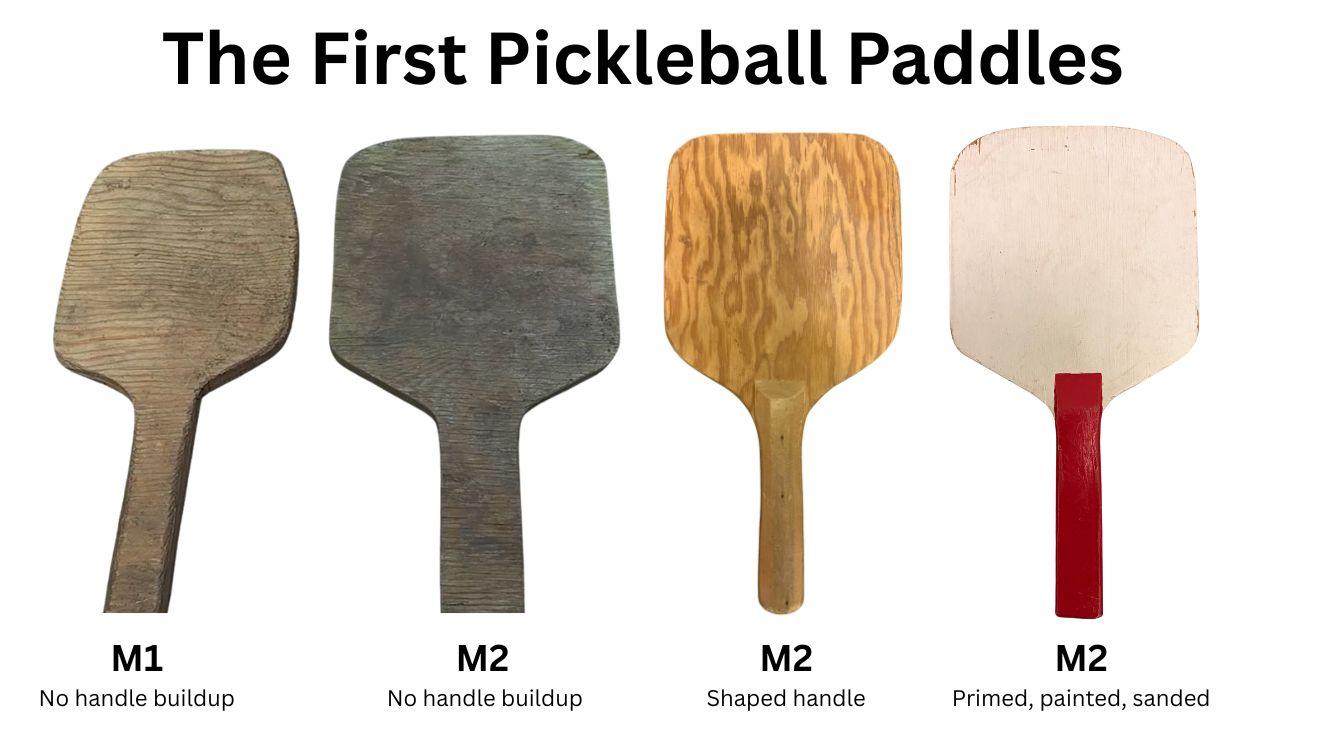
The M1 and M2. Barney named his two prototypes M1 and M2, for "McCallum number one," explicitly after the convention for naming an airplane. David was in high school; his grandfather thought him too young to run the saws until Barney vouched for him. The M2 stuck. In Barney's words in 2013, it is basically the shape used today, and it has never been tampered with. The "Evolution of a Paddle" sequence in that video lays the progression out side by side: M1 → M2 without handle buildup → M2 → the first painted models, with an early Diller at the end.
Finishes and handles — the 1969 turning point. According to David, from 1965 to 1969 the paddles were flat wood with no paint. In late 1969 they began adding a grip and gloss paint. Then came the built-up handle: a piece of wood stapled and glued on, milled where they bought the plywood. Barney worked out that the buildup should be softwood, not hardwood — softwood absorbs perspiration. They painted only the head white, deliberately leaving the handle bare so it wouldn't get slippery. Once played with, the design proved itself.
The assembly line: Barney sourced the wood; David cut, glued, and nailed the handles, applied primer, and leaned the paddles against a basement wall to dry. The primer lifted the grain, so he sanded and applied two coats of enamel. These paddles were unnamed and had no silkscreen graphics. They sold roughly 40–50 paddles a month; Barney charged about $5 each and paid David a dollar apiece to make them.
1974 — Outsourcing production
David left for college just as demand grew, and Barney lost his paddle-builder. A contact led him to the Pacific Northwest Center in Seattle, a facility whose workshop taught trades to people with disabilities. (In the 2013 video Barney calls it the Northwest Center for the Disabled, just off Elliott Avenue. The woodshop boss, Frank, a WWII veteran injured in a bobsled accident in Germany after the war, agreed to build the paddles.
Barney would pull up every three or four weeks with marine plywood on the roof of his station wagon; the workers would run out to greet him and insisted on carrying the finished paddles back to the car themselves. He said it was like they saw him as Santa Claus, and that it touched his heart.
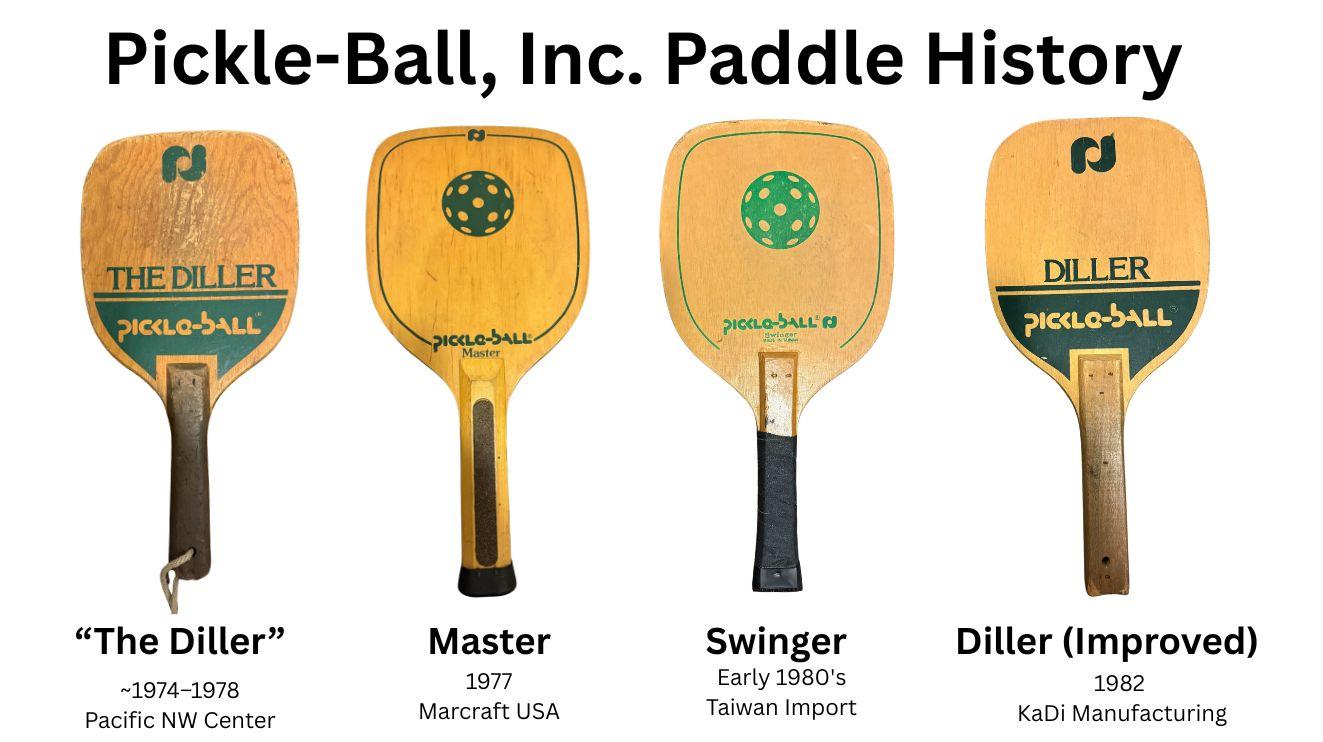
The named paddles
|
Year |
Paddle |
Details |
|
~1974–1978 |
Diller |
Built by the Pacific Northwest Center for three or four years. Named by David McCallum after the dill pickle. Not a clever name, he concedes — but they sold tens of thousands. The first pickleball paddle available in stores. |
|
1977 |
Master and Pro |
With the Diller still in production, Barney and David contacted an East Coast platform-tennis paddle manufacturer to produce the second- and third-named paddles. The Master had a walnut handle with cork inlay; the Pro used the same wood but was fancier, with a leather grip. |
|
Early 1980s |
Swinger |
A Taiwan-made import version of the Pro, with a rope strap on the grip so the paddle couldn't fly out of the hand. |
|
1982 |
Diller (improved) |
Given the Swinger's rope leash, and made from 8mm Baltic birch imported from Poland — a practice that continued until Pickle-Ball Inc. was sold in 2016. |
1975–1978 — The press breaks it open
A 1975 article in The National Observer produced bags of letters arriving daily at Pickle-Ball Inc. ordering the $29.50 starter set — four paddles, four balls, and a net. Barney bought every badminton net he could locate in America. The paddles he shipped had no fancy handle, just a shape cut out of plywood, and the money went into a cigar box. Tennis magazine followed in 1976 with "America's Newest Racquet Sport," and Dick Squires published The Other Racquet Sports in 1978.
1978 — The paddle, as officially described
Squires's book captures the state of the paddle at the end of the wooden era:
-
Made of wood, though experiments with plastic and metal were underway
-
Overall length not to exceed 15½ inches
-
Maximum head width 8 inches
-
Maximum weight 15 ounces; most players considered 10–12 ounces ideal
-
"Cheapies" around $5; the "deluxe" model about $12
-
The head squared off rather than oval — Barney's explanation was simply that it made them a little different
-
The head may not be strung, and no texturing materials — sandpaper, rubber, or glue granules — permitted on the surface
1979 — Pickle-Ball Inc. dealer price list
|
Paddle |
Construction |
Price (low qty) |
Price (bulk) |
Positioning |
|
Swinger |
Green head graphics, wrapped handle with thong, 5-ply wood |
$3.00 |
$2.80 |
"A good beginner's paddle" |
|
Master |
Green head graphics, walnut handle with cork inlay, 7-ply wood, made in USA |
$5.95 |
$5.65 |
All-around play; smaller handle for women and younger players |
|
Pro |
Mahogany stain, white graphics, 7-ply wood, tan leather grip, made in USA |
$8.25 |
$7.85 |
"For the more competitive player" |
|
6-pack of balls |
— |
$2.50 |
$2.40 |
— |
Early 1980s — KaDi Manufacturing
Needing better control over production and shipping, Barney was referred to a small, local, women-owned woodworking business: KaDi Manufacturing, Inc., named for Karlene "Ka" Field and Diane "Di" Meinke. By 1985 KaDi had moved to a larger shop in Snohomish, WA. Employee Roberto Rodriguez rose to shop foreman and built the company's ball-drilling machine, nicknamed "MacGyver."
KaDi eventually took over all Pickle-Ball Inc. manufacturing — the Diller, then the Master and Pro II — and helped resolve longstanding problems with plywood type, handle material, and finishes. The paddles got stronger and delivery got faster. The partnership lasted 35 years.
V. The Composite Revolution (1984)
The problem
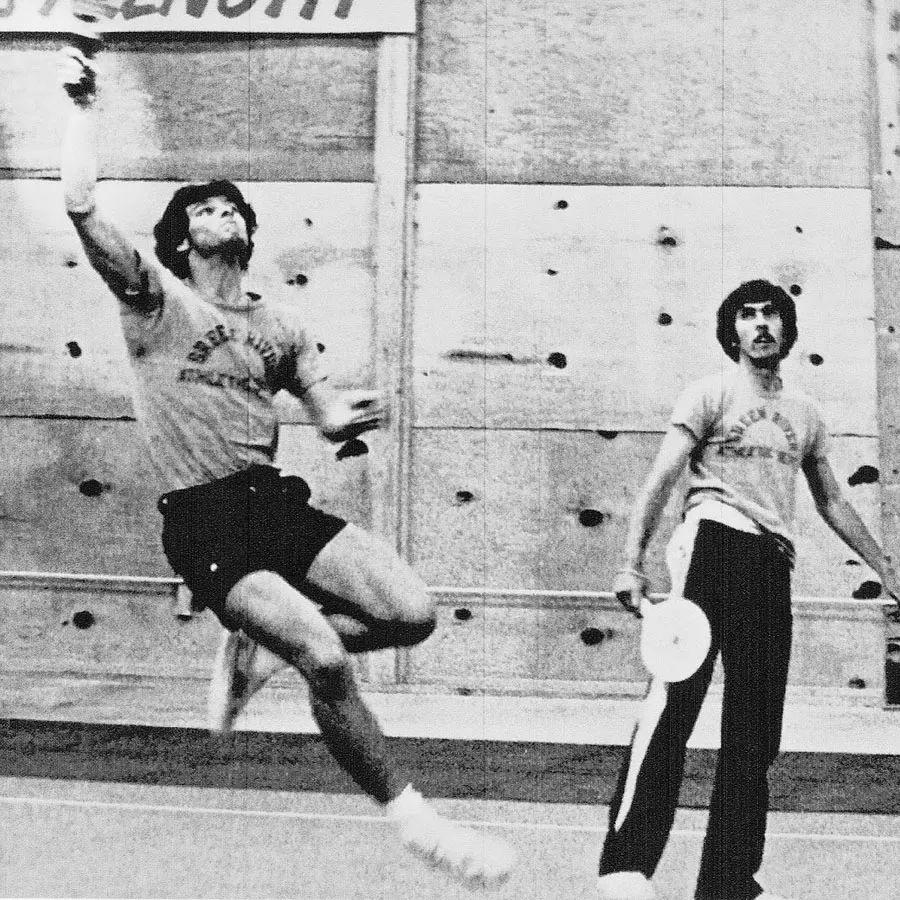
Steve Paranto first played in 1974 at Green River Community College, near where the sport was invented. His professors went on strike for the first two weeks, so he and his tennis friends played pickleball all day. Their paddles were wooden with holes in them, weighing about 13 ounces — very heavy.
Steve built a court at his first house, tearing up the whole backyard for concrete — which his parents thought foolish until they played on it. His father Arlen Paranto, an industrial engineering manager at Boeing and an inveterate inventor with several patents, then built his own court at Lake Ohop.
Steve and his partner kept losing in semis and finals to the same opponents. Frustrated, he did the math and complained to his father:
-
Tennis racket : tennis ball ≈ 7× heavier
-
Pickleball paddle : pickleball ≈ 13× heavier
The ratio was wrong.
The insight
Arlen knew Boeing's aircraft floor panels: a composite honeycomb core with facings, used throughout Boeing jets. When Boeing cut a floor panel, it routed the edge about a quarter inch inside and filled it with putty. When he learned Boeing had surplused a large quantity, he decided to try.
The economics, in his telling: Boeing paid about $1,000 per 4×8-foot floor panel sheet. Surplus sold it for 50 cents a pound. Boeing employees paid 25 cents a pound.
December 21, 1984 — Prototype #1
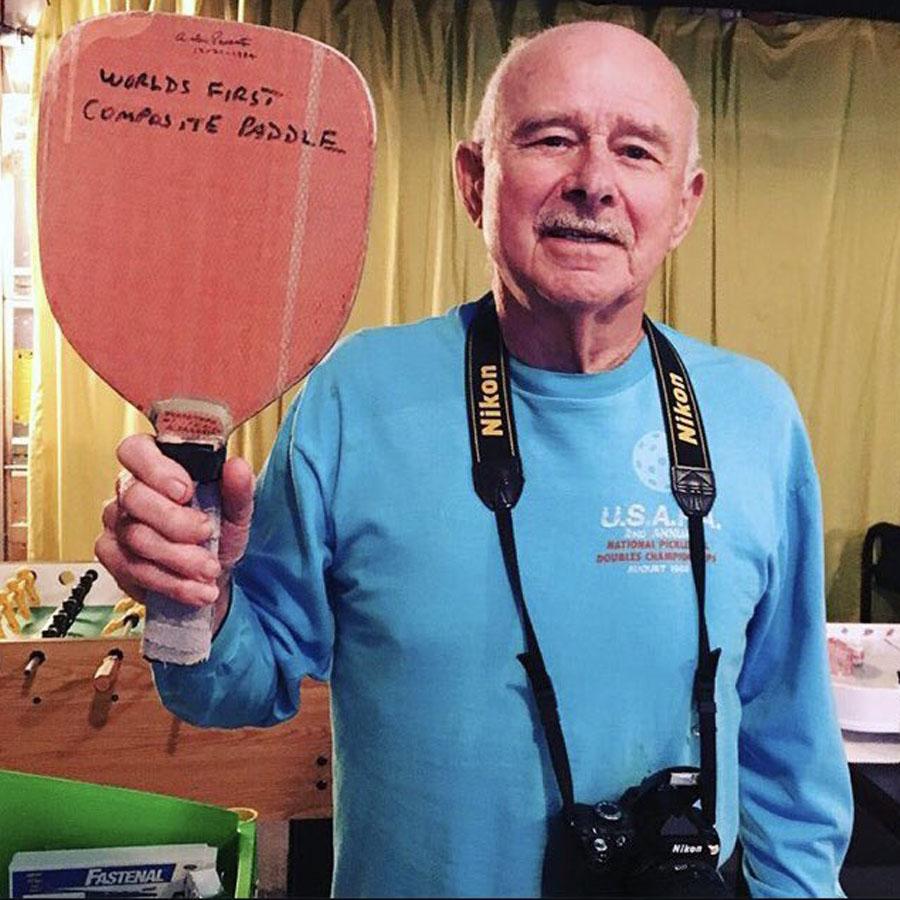
Arlen cut paddles using carbide cutters, the same way Boeing did, routed the edge, and filled it with putty — replicating Boeing's own method. The framed photo of the surviving paddle is labeled in his hand: "WORLD'S FIRST COMPOSITE PADDLE — Prototype #1, Dec. 21, 1984."
He told Steve nothing. About two weeks later he showed up and threw two paddles on the ground. Steve had no idea his father had been working on it.
They went straight to the backyard court. First hit: the sound was completely different. The feel was different. Steve could feel the ball come off faster — he describes it as a light bulb going off. Arlen's reaction was the same: more responsive and more accurate than wood, and far better to play with.
About a week later, Steve and his high-school friend Richard Skevington entered the next tournament, played the same opponents who had been beating them, and won.
Specifications of the first composite paddles
-
Facings: fiberglass (not graphite — that came later)
-
Core: honeycomb — "just like everything you see now is basically a copy of some sort of that material," per Steve
-
Made from Boeing surplus floor paneling, bought at the Boeing Surplus Store in Kent, WA
-
Panels came in grades #1, #2, and #3 — #1 lightest, #3 heaviest
-
Grade #1 produced 6-ounce paddles; grade #3 produced 7-ounce paddles — against ~13-ounce wood
-
Cores available in Nomex, aluminum, and graphite
The edge guard — an under-appreciated invention
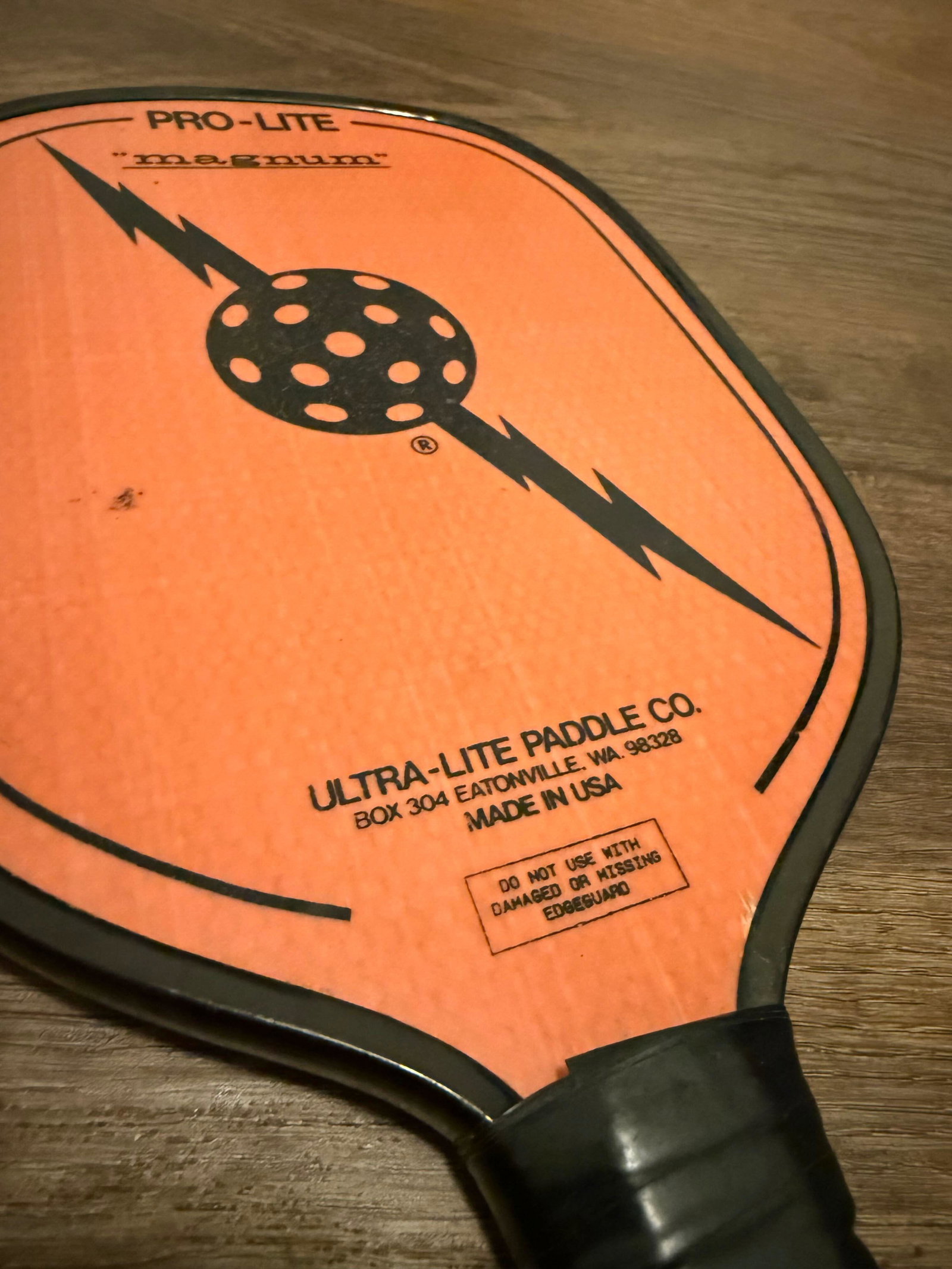
The putty-filled edges of the first models broke apart after a few minutes of hitting. Arlen then designed and manufactured an extruded edge guard as an injection mold — sealing the exposed diameter of the paddle and protecting the core and layers from delamination. Vinyl edge guards were added to later models.
This was the first use of an edge guard on a pickleball paddle, and every edge guard today uses this design and material type. Arlen could patent neither the edge guard nor the paddle, because in both cases a competitor could simply change the material.
The 20–22 step garage process
Arlen made every portion of the paddle in the family garage in Eatonville, Washington — except the molded edge guard extrusion. His own written build sheet lists:
-
Buy surplus floor panel sheets from the Boeing Surplus Store in Kent, WA
-
Sort by grade (#1 light, #3 heavy; Nomex, aluminum, or graphite cores)
-
Lay panels on a 4×8 plywood sheet with a Boeing surplus foam sheet applied
-
Apply paddle-shaped router guides (Boeing surplus plexiglass, Boeing surplus double-backed tape)
-
Route out the paddle with a surplus Boeing carbide router bit
-
Sand the edges
-
Silkscreen the design
-
Attach handle overlays cut from 4×8 foam sheets, hand-beveled
-
Bond on the extruded edge guard
-
Attach end caps, hand-extruded using a drill press and a hand-machined two-part die
Then grip the paddle. Steve describes it as a 20-to-22-step assembly line, one step at a time — in the garage.
Arlen's cost per paddle, excluding labor:
|
Component |
Cost |
|
Blade (Boeing floor panel @ 40¢/lb) |
~18¢ |
|
Handle buildup foam |
5¢ |
|
End caps |
~2¢ |
|
Edge guard |
$1.00 |
|
Grip |
$1.50 |
|
Silkscreen paint |
5¢ |
|
Total, excluding labor |
under $3.00 |
Labor stayed cheap because, as an industrial engineer, he kept improving his own tooling. He noted that today's paddles are expensive because the material, bought new rather than as scrap, is very expensive.
Pro-Lite is born
.jpg)
Arlen first marketed his paddles in 1984, naming them Pro-Lite to signify a lightweight paddle. First-generation paddles sold for $15 to $20.
The lightning bolt. Arlen wanted a graphic signifying something light and fast but couldn't draw a lightning bolt he liked. One day he and Steve were working on the design while The Natural, starring Robert Redford, played in the background. In one scene a lightning bolt strikes a tree, then appears on Redford's bat. They both said: that's our lightning bolt. They replayed the movie until they could copy its likeness.
Adoption
Arlen had not set out to build a company — he wanted to help his son win tournaments. But everyone who used his paddles won, and demand followed.
Steve describes counting the conversion at tournaments: six of our paddles, eight, ten — until the count inverted: only ten wood paddles left... only Earl is still using wood. Randy Bither described the shift: paddles moved faster, produced more action, and behaved more consistently on the edges, turning pickleball into a genuinely quick-response game.
A surviving letter dated July 8, 1985 to the Ultra-Lite Paddle Co. encloses money for a fiberglass paddle and asks it be sent as soon as possible — because people who never used to beat the writer are now beating him with one.
Why it changed the sport
Steve identifies two distinct effects:
-
Accessibility. Seniors and children could play more easily with a lighter paddle in their hands. Many seniors switched for this reason alone.
-
Athleticism. Elite athletes could move their hands so much faster that the sport became a showcase of hand speed and reflexes.
The Magnum
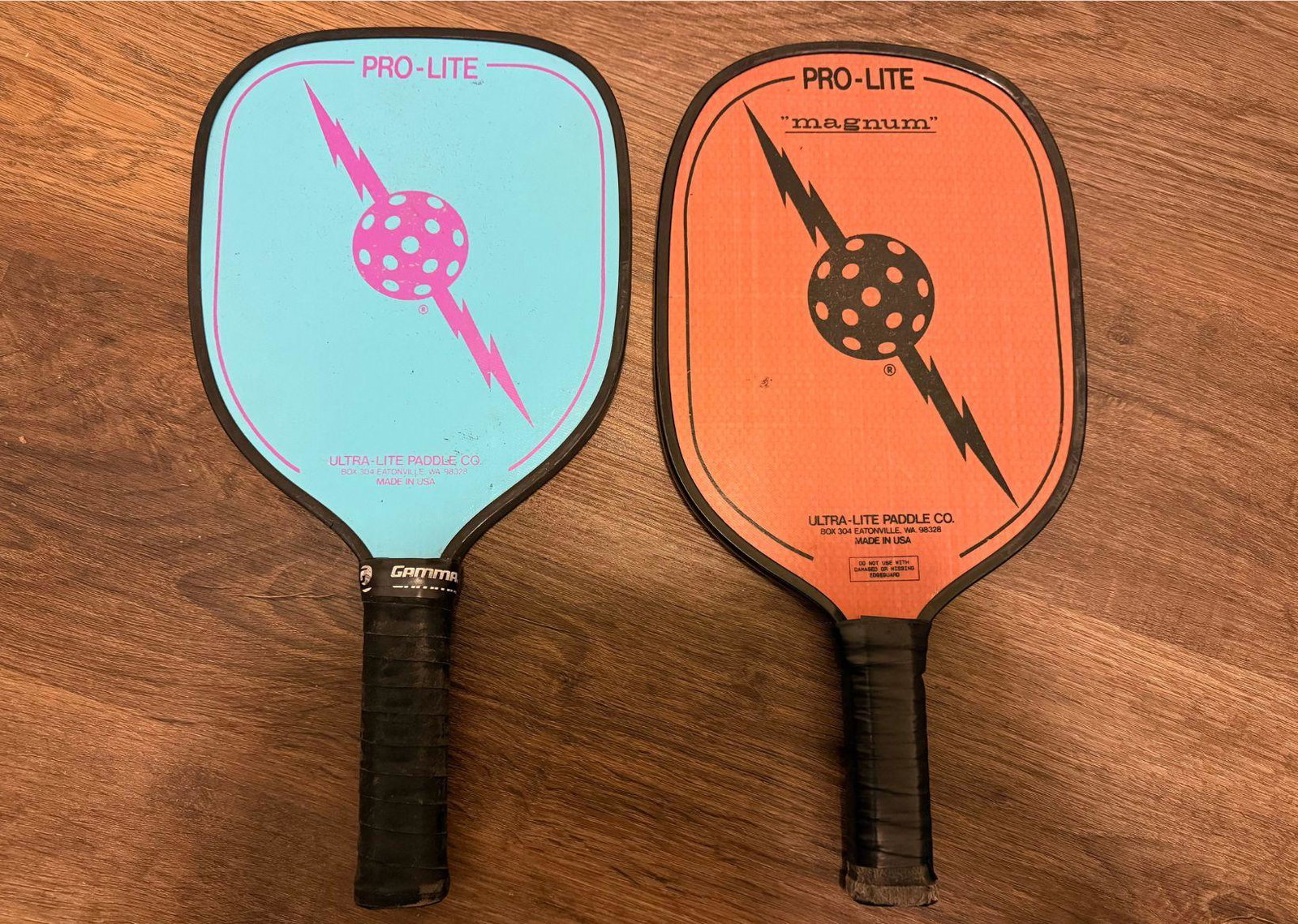
Observing that tennis rackets were getting bigger, Arlen developed the Magnum — a larger face with a bigger sweet spot and a much better hitting area. As he notes, virtually all paddles today are that size or larger.
VI. Consolidation (1984–2005)
|
Year |
Event |
|
1984 |
The U.S.A.P.A. was organized, with Sid Williams as first Executive Director and President. The first rulebook was published in March. The first National Doubles Championships were held in Tacoma, WA. And Arlen Paranto invented the first composite paddle. |
|
Mid-1990s |
Arlen sold Ultra-Lite Paddle Co. to Frank Candelario. The highest-priced paddle at the time was $25. |
|
2004 |
Mark Friedenberg bought Ultra-Lite from Candelario and renamed it Pro-Lite Sports. |
|
2005 |
The third major manufacturer arrives: Steve and Heidi Wong founded S-Type Sports, LLC. First paddles: the Stryker, then the Slammer. (Renamed Onix Sports in 2012; sold to Escalade Sports in 2015.) |
Appendix A — The Paddle at a Glance
|
Era |
Paddle |
Material |
Weight |
Key innovation |
|
July 1965 |
Borrowed equipment |
Ping-pong paddles, badminton racquets, paddleball paddles |
— |
None — and the ping-pong paddles broke |
|
July 1965 |
First cut paddles |
Scrap plywood, band-sawn |
— |
Purpose-built shape; no handle, no paint, no grip |
|
1965–1969 |
M1 / M2 prototypes |
Flat wood, unpainted |
— |
M2 becomes the enduring shape; squared-off head; named like aircraft |
|
Late 1969 |
Refined M2 |
⅜" marine 5-ply plywood |
— |
Grip + gloss paint; softwood built-up handle (absorbs sweat); head painted white, handle left bare |
|
~1965–1980s |
Homemade experiments |
Plexiglass with drilled holes; wood with dimes set into the head |
varied |
Earliest known swingweight tuning |
|
~1974–1978 |
Diller |
5-ply wood; later 8mm Baltic birch |
— |
First paddle sold in stores; named for the dill pickle |
|
1977 |
Master |
7-ply wood |
— |
Walnut handle with cork inlay |
|
1977 |
Pro |
7-ply wood, mahogany stain |
— |
Leather grip; competitive-tier paddle |
|
Early 1980s |
Swinger |
5-ply wood (Taiwan) |
— |
Rope wrist strap so the paddle can't fly loose |
|
~1974–1984 |
Typical wood paddle |
Plywood |
~13 oz |
Max 15½" length, 8" head width, 15 oz; 10–12 oz "ideal" |
|
Dec. 21, 1984 |
Pro-Lite Prototype #1 |
Boeing honeycomb core, fiberglass facings |
6–7 oz |
The composite revolution. Putty-filled edges, taped |
|
Mid-1980s |
Pro-Lite (production) |
Composite; Nomex / aluminum / graphite cores |
6–7 oz |
Extruded edge guard (first ever), end caps, foam handle buildup, silkscreen lightning bolt |
|
Later 1980s |
Magnum |
Composite |
— |
Larger face, bigger sweet spot — the template for nearly every paddle since |
|
2005 |
Stryker, then Slammer |
Composite |
— |
S-Type Sports (later Onix) enters as third major manufacturer |
Appendix B — The Three Foundational Manufacturers
-
Pickle-Ball, Inc. (Pritchard, Bell, McCallum) — the wooden lineage: M1/M2 → Diller → Master → Pro → Swinger → Pro II. Made by hand, then by the Pacific Northwest Center, then a Taiwan supplier and an East Coast platform-tennis maker, then KaDi Manufacturing for 35 years. Sold 2016.
-
Ultra-Lite / Pro-Lite (Arlen and Steve Paranto, 1984) — the composite paddle, the honeycomb core, the edge guard, the magnum face. Sold to Frank Candelario mid-1990s; to Mark Friedenberg in 2004, who renamed it Pro-Lite Sports.
-
S-Type Sports / Onix (Steve and Heidi Wong, 2005) — Stryker and Slammer; renamed Onix 2012; sold to Escalade Sports 2015.
After these three paved the way, companies and home-based businesses of every size began producing paddles. Wood paddles remain available alongside graphite and fiberglass ones — and Barney McCallum never minded. Everyone has their own idea, in his view, and that's the fun of it.
Sources
Primary printed source:
Lucore, Jennifer, and Beverly Youngren. History of Pickleball: More Than 50 Years of Fun! March 2018, 191 pp.
The first comprehensive history book about the sport, written by pro player and Hall of Fame inductee Jennifer Lucore and her mother, Beverly Youngren. Chapters drawn on here: "Pickleball Timeline – History of the Game," "The Summer of '65," "Pickle-Ball, The Corporation," and "Paddles."
Additional sources:
-
olympicvideonews, "Pickleball Birthplace Bainbridge Island" — published August 11, 2013; 84,057 views as of capture; full transcript available. The earliest recorded Barney McCallum account in this collection, and the closest to his own unedited voice. Sole source for the M1/M2 airplane-naming convention, the plexiglass and dime-weighted paddles, and the Pickle-Ball box photo shoots. Also the source of the "Evolution of a Paddle" stills used for article imagery.
-
Pickleball Channel, I ♥ Pickleball: "The Origins of Pickleball: How It All Began" — published August 7, 2015; 447,853 views as of capture. Source of the first-person accounts from Barney McCallum, David McCallum, Carol and Scott Stover, and Jim Weller.
-
Pickleball Channel, I ♥ Pickleball: "Origins of the Modern Paddle" (Arlen and Steve Paranto, with Randy Bither), also produced for the 50th anniversary.
-
Anna Copley's interview with Steve Paranto
-
Arlen Paranto's own written build sheet, "Pro-Lite Paddles 1984"
-
The framed photograph of Prototype #1, annotated in Arlen Paranto's hand
Related articles
Dylan Frazier serves up 'Star Wars' style with Volair
May the Force be with your next fit.
11 days ago
-Victoria Radnothy
.jpg?width=592&height=237&optimizer=image)
Which Honolulu paddle should you buy? A guide to the lineup
We break down the paddles by shape, core, and surface so you can find the one that fits your game.
13 days ago
-Joseph Sutton
.jpg?width=592&height=237&optimizer=image)
Gearbox Pressure X MPP vs. EPP: Which one should you play?
Gearbox built two Pressure X paddles on the same core system and frame, then tuned one for a fast release and the other for longer dwell.
13 days ago
-Joseph Sutton
Best pickleball paddles for women 2026
Discover our top 7 best picks for every playing style, including pro favorites from Anna Leigh Waters and Anna Bright.
17 days ago
-Hannah Johns