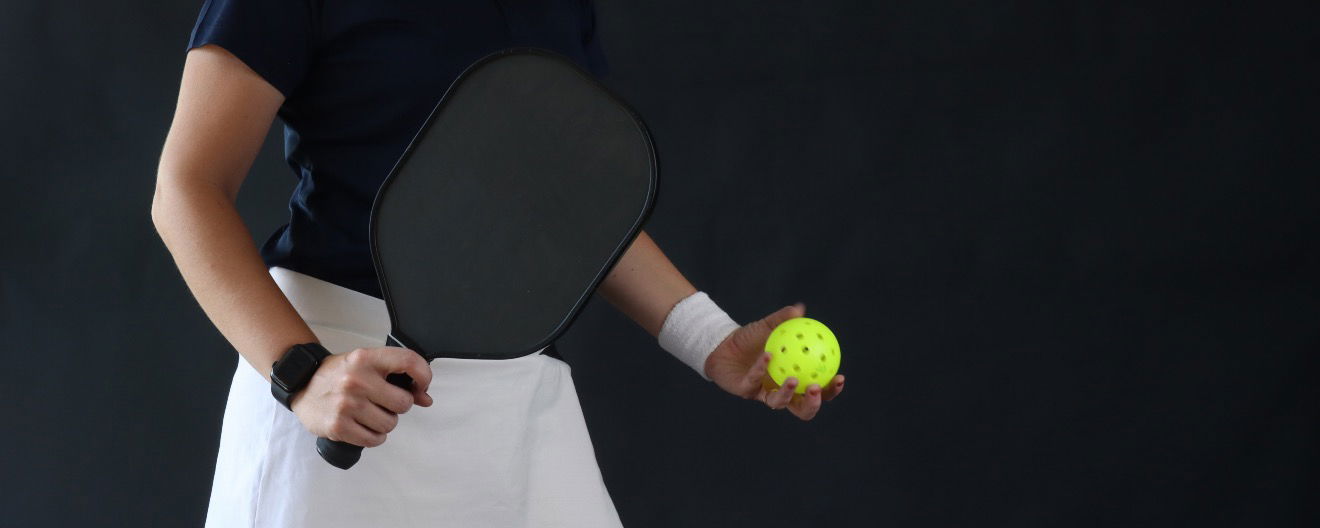
A closer look at pickleball grip styles
There are many ways to hold a pickleball paddle.
Each has some advantages and disadvantages, so select the grip that works for you.
Continental Grip
The Continental grip is when the hand is placed so the index knuckle is on the second bevel of the handle. Think about how you would hold a hammer or how you would shake hands. In other words, turn your wrist slightly counterclockwise for right-handed players and slightly clockwise for left-handed players.
This grip works well for when you need to hit a forehand and then transition quickly to hitting a backhand. It’s considered a “neutral” grip.
Most pros use this particular grip because of the ability to make quick transitions. It also provides good control and power.
One of the disadvantages of the grip is its limited ability to generate topspin like the Western grip. Because the hand isn’t turned one way or the other, it’s harder to generate spin and doesn’t promote the upward momentum needed to create topspin. Many pros use the Continental and can switch to a Western grip depending on what shot needs to be executed.
Eastern Grip
Similar to tennis, the index knuckle is on the third level of the paddle handle. This grip helps provide good control for forehand shots. Hold your paddle directly out in front of you with your opposite hand. Take the hand you are holding the paddle with and place it on the face of the paddle. Slide your hand down the paddle and “shake hands with the paddle grip.”
This grip is popular because it provides good control, especially on forehands, making it easier to hit those shots to specific spots and create angles. However, the best part of this grip is the comfort and ease. It aligns more naturally to the hand. Comfort is important, as the player will have one less thing to worry about when hitting a shot. That’s why it’s good for beginners.
The disadvantage to the Eastern grip is that the topspin is limited. It’s much more difficult to generate this spin. In addition, some players will realize the grip is less comfortable for executing powerful backhand shots, especially on those that go wide or low.
The grip provides a lot of versatility between forehand and backhand shots, but it doesn’t allow for the same power or control when hitting backhands. Finesse can be an issue when trying to execute slices and drop shots as well.
Western Grip
The Western grip is when your hand is further around the handle of the paddle. This grip allows for more topspin and can really help generate topspin on the backhand side.
To achieve the Western grip, start in an Eastern grip position and turn your wrist 90 degrees clockwise for right-handers or 90 degrees counterclockwise for left-handers.
Because the paddle is much smaller than a tennis racket, you may not see this grip used as much. However, it’s not uncommon to see some pros change to this grip mid-rally for certain shots, including ones to generate backhand topspin.
Because the hand is further around the handle, it allows for a greater range of motion, making it easier to have an upswing through the ball, which leads to more topspin.
A disadvantage of the Western grip is it may not allow for enough flexibility compared to other grips. Sometimes the advantage of creating more topspin is limited because control and accuracy are not as easy, especially on dinks and short volleys.
The Western grip also may feel foreign to players moving to pickleball from other racket sports where the grip is commonly used. Just because it works for tennis, doesn’t mean it’s the best choice for pickleball. Many of the pickleball shots, especially at the more advanced levels and pro game, require more finesse and volleys.
Panhandle Grip
This is the kind of grip you would use if you were shaking hands with someone. The hand wraps around the paddle in a natural position. It allows for some versatility for both forehands and backhands, but it doesn’t offer power in comparison to other grips.
One of the advantages of this grip is comfort. There should be less strain on the hand with this grip and it should feel fairly natural. It’s easy to use and very suitable for beginner-level players.
It’s also consistent. With a straightforward approach to positioning, players are more likely to develop repeatable techniques and the ability to work on other aspects of shots and strategy.
As far as disadvantages go, the Panhandle grip has limitations when it comes to creating topspin or backspin. Some players may find it challenging to manage drops and finesse shots as the Eastern and Western are more suitable for specialty shots.
Two-Handed Grip
Lots of players, at a lot of different skill levels, put two hands on the paddle – the left hand going on top for right-handed players and the right hand going on top for the left-handed players.
The main advantage of the two-handed grip is increased power and stability on backhands. With two hands on the paddle, the player can generate more power on groundstrokes and drives. The support of the top hand creates leverage and puts more energy into the shot, resulting in more force.
The stability of holding the paddle with two hands helps reduce mishits and helps with control on shots in the non-volley zone as well as defensive shots.
For players who struggle with backhands, particularly in the non-volley zone, the two-handed shot can provide a level of control and comfort and also make backhand shots more powerful.
It’s not uncommon to see players, particularly those at a higher level, switch from one hand to two, depending on the shot. A lot of pros favor a two-handed backhand and even more rely on two-handed dinks in the non-volley zone.
Key considerations
In pickleball, grip styles are a bit more standard than they are in tennis, making them less extreme. The most extreme grips are the ones considered different from the traditional Continental and Eastern.
Too much pressure on the grip will cause a lot more errors than gripping the paddle in an unconventional way. Make sure your grip pressure is more “loose” and less “tight.” Putting more of the handle in the fingers and less in the palm is also preferable. A “tight” pressure will cause shots to rebound off the paddle harshly and will be difficult to keep in play.
“Looser” is better. Think about somewhere around a 3-of-10 pressure on the paddle. That will help you on softer shots, drop shots, and dinks. A “looser” grip will also help reset harder drives and give you more control.
In the end, the best grip for a player depends on that player’s style, ability, and the shots the player is trying to hit at any given time during a game. Players experiment with different grips, oftentimes changing grips mid-game, or even mid-rally.
There’s no correct or incorrect way to grip the paddle. Do what feels right for you and be willing to change when necessary.
Related articles
The top 5 paddles for power and forgiveness
These paddles give you real pace on drives and put-aways while staying stable and predictable when you miss the sweet spot.
1 day ago
-Joseph Sutton
Project Coyote brings the heat as Proton players celebrate 14 medals in Mesa
The Coyote is a 15mm elongated paddle and Proton’s most powerful paddle yet.
16 days ago
-Guest Author
20 things pros wish they knew earlier in pickleball
These quick tips can help you level up your game fast.
22 days ago
-Victoria Radnothy
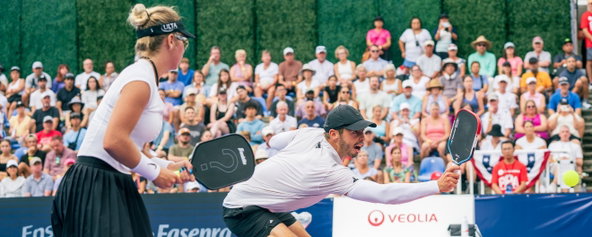
What pickleball paddles do the pros use? Top 20 players in 2026
Wondering what pickleball paddles the best players in the world are actually using?
23 days ago
-Hannah Johns