Five pickleball tips to improve your game from beginner to 4.0
Getting better at pickleball doesn't necessarily require mastering an advanced shot or developing a powerful serve. Sometimes, the biggest improvements come from understanding the fundamentals and executing them more consistently.
Coach Jess, a professional player and coach with thousands of hours of coaching experience, shared five concepts that players of all levels — from beginners to 4.0 players — can implement to improve their games.
From controlling the kitchen line to making smarter decisions during transition, these five adjustments can help players gain an advantage on the court.
1. Win points at the kitchen line
The kitchen line is where players have the best opportunity to apply pressure and finish points. Getting there should be a priority, especially for the returning team.
Unlike tennis, pickleball's non-volley zone prevents players from attacking volleys while standing too close to the net. Instead, players must work to create opportunities to hit the ball aggressively from above net height.
The closer players get to the kitchen line, the better their chances of finding attackable balls and putting opponents on the defensive.
Jess recommends using the return of serve as an opportunity to move forward. Returning players should advance toward the kitchen line as their opponents prepare to hit the third shot, aiming to arrive in position to apply pressure.
Once there, the goal is to hold the line without giving opponents easy opportunities to target their feet.
2. Follow the “what goes down must come up” pattern
One of the simplest ways to understand pickleball strategy is to recognize how ball placement influences the next shot.
When a player sends the ball downward toward an opponent's feet, the opponent often has to lift it back over the net. That higher return can create an opportunity to attack.
This principle is especially important during dink rallies, when players are trying to force their opponents into uncomfortable positions.
Rather than hitting every ball as hard as possible, players should focus on keeping the ball low and targeting their opponents' feet. Doing so can make it more difficult for opponents to attack while creating opportunities to take control of the rally.
The concept applies throughout the court, too. Players should pay attention to their opponents' positioning and look for opportunities to hit controlled shots that force them to lift the ball.
3. Get stable before you hit
Moving forward is important, but rushing through a shot can undermine an otherwise good approach.
Jess emphasizes the importance of being balanced when making contact, particularly while moving through the transition zone between the baseline and kitchen line.
Players who run through the ball while hitting often struggle with control. Their momentum can cause them to send shots too high or too far, leaving them vulnerable to an opponent's next attack.
Instead, players should time their movement around their opponents' contact points.
As an opponent prepares to hit, players should briefly establish a stable position, allowing them to assess the incoming shot and respond with better control. A split step can help, but Jess notes that the essential principle is being balanced and ready before the ball arrives.
Think of it as a game of red light, green light: move forward when appropriate, then get stable as the opponent makes contact.
This approach can improve shot consistency and help players maintain their balance as they work toward the kitchen line.
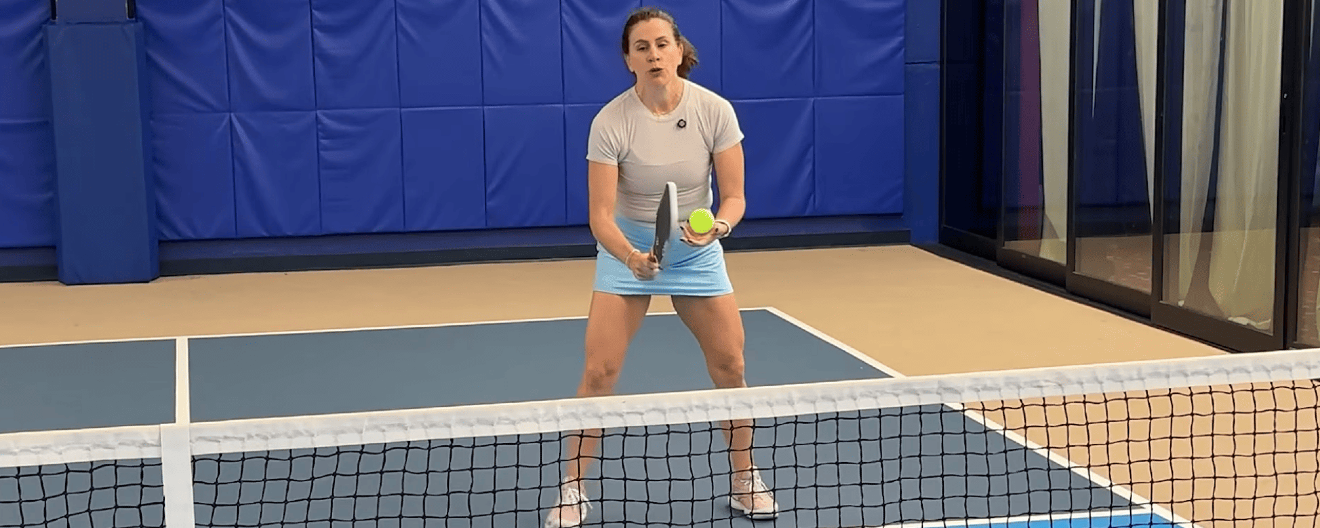
4. Keep your paddle up and in front
Paddle position can make a significant difference in a player's ability to react, block and counterattack.
Jess recommends keeping the paddle in front of the body, around the midsection, rather than letting it hang near the knees.
A low paddle position forces players to make a larger movement when the ball comes their way. Against opponents who speed up the ball, that extra motion can leave them scrambling to make contact.
Keeping the paddle up shortens the distance it must travel and makes it easier to protect the body against fast shots.
Players should also avoid taking unnecessarily large swings. Whether dinking or attacking, a compact motion helps maintain control and prepares them for the next ball.
The same principle applies while moving laterally or retreating. Keeping the paddle in front allows players to stay organized and ready to respond, rather than swinging wildly or losing their positioning.
5. Stop driving every ball in transition
Jess identifies this as one of the most common mistakes she sees players make, including those at advanced levels.
When players are still moving through the transition zone, they often try to drive bouncing balls rather than play a controlled shot that allows them to advance.
The problem is that a drive hit from a difficult position can leave the ball sitting up, giving opponents an easy opportunity to attack. Players may then become stuck hitting defensive shots from below net height instead of reaching the kitchen line and establishing control.
Jess recommends dropping the ball toward the opponents' feet and using the shot to buy time to move forward.
The objective isn't simply to get the ball over the net. It's to play a shot that allows you to improve your position and continue advancing toward the kitchen.
A controlled drop can help players complete that transition, while an overly aggressive drive can leave them exposed to repeated attacks.
Before driving a bouncing ball, consider where you are on the court. If you're still in transition, prioritize control, target your opponents' feet and work your way forward.
The bottom line
Improving at pickleball doesn't always mean adding another shot to your repertoire. Often, it means making better decisions with the shots you already have.
Prioritize the kitchen line, target opponents' feet, stay balanced through contact, keep your paddle in front and resist the urge to drive every ball during transition.
By applying these five concepts more consistently, players can improve their positioning, create better attacking opportunities and make life more difficult for their opponents.
Related articles
How to completely change your pickleball serve in 10 minutes
A few simple adjustments could help you add power, improve accuracy and eliminate the yips.
6 days ago
-Pickleball.com Staff
.png?width=592&height=237&optimizer=image)
Five ways to elevate your dink game like a pro
These strategies can help you make smarter decisions and gain the upper hand in kitchen line battles.
6 days ago
-Pickleball.com Staff
Five mindset shifts every pickleball player should know
Michael Lloyd shares lessons that changed the way he approaches the game, from redefining aggression to letting the ball dictate every shot.
7 days ago
-Pickleball.com Staff
Want to improve fast? Start with these 5 priorities
Build a smarter game with these must-practice fundamentals alongside coach Jordan Briones.
11 days ago
-Pickleball.com Staff