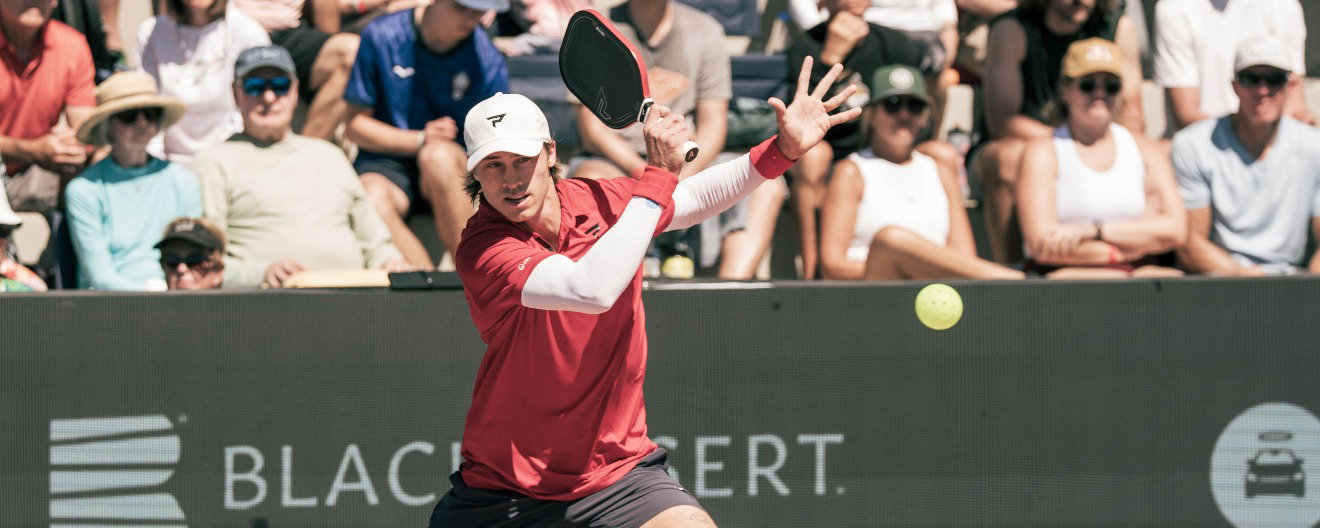
How to build a reliable forehand drive in pickleball
The best way to hit a forehand drive in pickleball is to combine compact mechanics with full-body rotation and controlled acceleration.
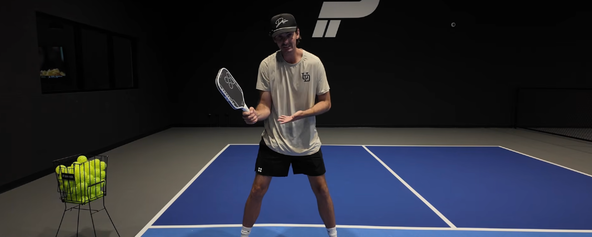
Start in a balanced athletic stance with your knees slightly bent and your paddle up in front of you. As the ball comes to your forehand side, turn your shoulders and hips early so you’re coiled and ready to generate power. Avoid a big backswing. Keep it short and efficient so you can time the shot cleanly.
When the ball reaches you, contact it slightly in front of your body at about waist height. This forward contact point is what allows you to transfer energy cleanly through the ball. Drive through the shot by rotating your hips and torso, letting your body (not just your arm) create the pace. A slight upward brushing motion can add topspin, which helps the ball dip into the court and stay in bounds even when hit hard.
Finish with a smooth follow-through toward your target and recover quickly into position. The most effective forehand drives are not the hardest swings, but the ones that are well-timed, well-balanced, and aimed intentionally, often at an opponent’s feet, the middle of the court, or wide openings that pull them out of position.
Here are some of the most effective drills to develop a consistent and powerful forehand drive in pickleball—with a focus on timing, contact point, and controlled power rather than just hitting harder.
1. Wall drive drill (solo consistency)
Stand 8–12 feet from a wall and hit continuous forehand drives.
- Focus on compact swing and clean contact in front
- Aim for a consistent height (just above net level if imagined)
- Try to keep a steady rhythm without over-swinging
This builds repetition and helps you groove timing quickly.
2. Drop-feed drive drill (control under setup)
Have a partner or use your non-dominant hand to gently drop-feed balls to your forehand.
- Start slow and focus on turning shoulders early
- Hit each ball with controlled topspin or flat drive
- Aim cross-court first, then progress to down-the-line
This helps you learn correct body positioning before adding speed.
3. Cross-court target driving drill
Place cones or targets deep cross-court.
- Drive forehands from midcourt or baseline
- Try to land 7–10 consecutive shots into the target zone
- Emphasize depth and control over power
Cross-court drives are higher percentage and more useful in real play.
4. “Feet-first” pressure drill (game simulation)
Partner stands at the kitchen line while you drive from the baseline or transition area.
- Aim specifically at their feet or hip area
- They try to block or reset the ball
- You focus on keeping drives low and heavy
This simulates real match pressure and teaches purposeful targeting.
5. 3-shot progression drill (timing and decision-making)
Work through a sequence:
- Soft feed
- Forehand drive
- Reset or approach shot
Repeat the pattern while focusing on:
- Staying balanced after each drive
- Recovering quickly into position
- Not over-hitting the drive
6. Shadow-to-contact drill (technique refinement)
Without a ball, rehearse the motion:
- Turn shoulders
- Load back leg slightly
- Simulate compact swing and forward contact
Then immediately pick up a ball and execute the same motion. This links mechanics to real timing.
Across all forehand drive drills, the key focus is to consistently contact the ball in front of your body, which allows for better control, cleaner energy transfer, and more accurate shot placement.
Keep your backswing short and compact so you can accelerate quickly through the ball rather than getting caught in a large, slow motion.
Generate power by using your hips and torso to rotate through the shot instead of relying primarily on your arm, since full-body engagement creates more stable and repeatable drives.
Finally, prioritize controlled depth over pure speed by aiming to hit deep, purposeful shots that land in the court consistently rather than simply trying to hit the ball as hard as possible.
Related articles
What makes Ben Johns so good at pickleball?
Zane Navratil breaks down the G.O.A.T.'s game to identify exactly what makes Ben Johns so tough to beat.
4 days ago
-Pickleball.com Staff
Who is Elliott Schupp? The next up-and-comer pickleball athlete you need to watch
He just won his first title on the PPA Tour, here's how he got there.
6 days ago
-Victoria Radnothy
Five ways to add power and consistency to your pickleball drives
Ashley Griffith explains how better spacing, body rotation and topspin can help players attack with confidence without sacrificing control.
7 days ago
-Pickleball.com Staff
Five tips to improve your pickleball game quickly
Dr. Michael Oakson shares advice on ready position, kitchen line defense, serve returns, counterattacks, and targeting opponents’ weaknesses.
7 days ago
-Pickleball.com Staff