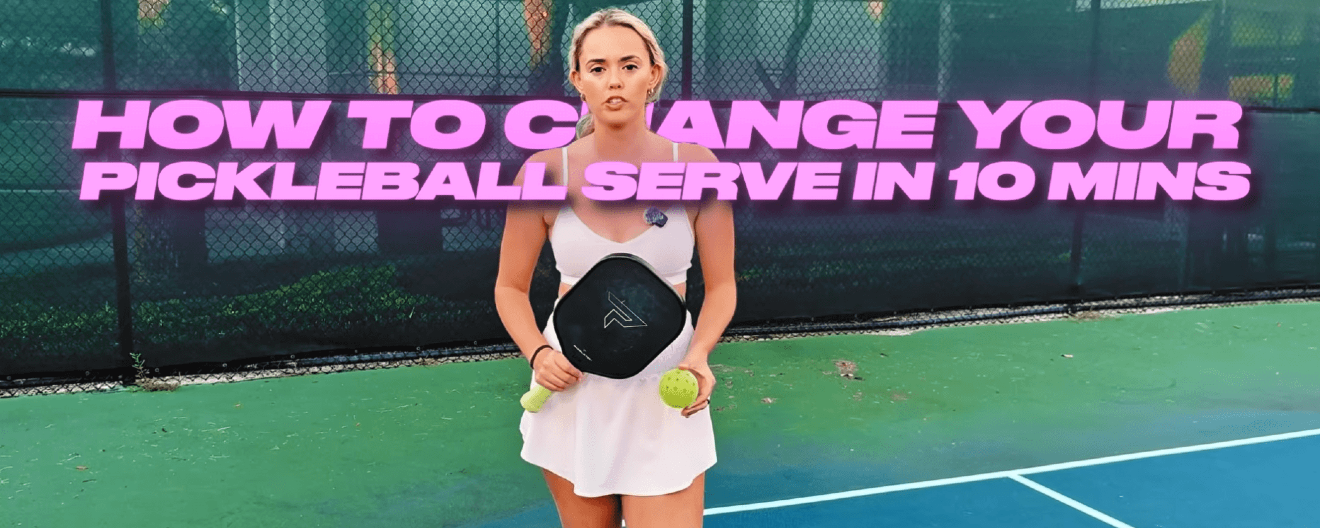
How to completely change your pickleball serve in 10 minutes
A few simple adjustments could help you add power, improve accuracy and eliminate the yips from your pickleball serve.
Your serve sets the tone for every point, but many players overlook some of the small details that can make a major difference.
PPA Tour pro Ava Ignatowich recently broke down several simple ways players can improve their serves, from their footwork and contact point to target selection and swing mechanics.
Here are some of her biggest takeaways.
Start with your footwork
There are two common ways to set up your feet when serving: an open stance and a closed stance.
With an open stance, both feet face forward and are positioned slightly more than shoulder-width apart. The motion begins by loading onto the outside foot before transferring your weight toward the inside foot as you swing.
A closed stance, meanwhile, starts with the inside foot forward and the outside foot behind. As you make contact, the back leg swings forward into the court.
Neither stance is necessarily better than the other. Ignatowich prefers the closed stance because she feels it allows her entire body to move forward through the serve and generate more power.
Regardless of which stance you use, she recommends thinking about pushing into the ground before beginning your swing.
Think of it like you're an "earth bender" trying to shake the ground.
That force from the floor can help create more explosiveness throughout your body and add power to your serve.
And you don't necessarily have to get extremely low to do it. Even players who can't bend deeply because of an injury can push into the ground while maintaining a relatively upright position.
Keep your head still at contact
One of the simplest changes could also be one of the most important: keep your eyes on the ball through contact.
Ignatowich says many players make the mistake of looking toward their opponent too early during the serve.
When your eyes leave the ball, your head can move. And when your head moves, it can trigger movement throughout the rest of your body.
Your shoulders and arms can shift, throwing off the mechanics of your swing.
Keeping your eyes on the ball helps keep your head still and allows you to make cleaner contact.
It might seem like a small detail, but it can have a major impact on your serve.
Know where you're serving before you hit
Don't simply step behind the baseline and hit the ball.
Have a target in mind.
Ignatowich encourages players to pay attention to their opponents during the first few points of a match. Figure out whether they prefer their forehand or backhand and identify which side is stronger.
From there, you can make smarter decisions about where to serve.
And don't limit yourself to one target.
Players should be comfortable serving deep and wide, short angles, down the middle and directly at the body.
The body serve is particularly useful because it can force an opponent to take a step backward before making contact. That extra movement can lead to uncomfortable returns and potentially create pop-ups.
"Body is a big one that people forget," Ignatowich said.
Stop hitting the same serve over and over
Variety can make your serve much more difficult to read.
Ignatowich recommends making a habit of hitting at least three different types of serves during a match.
That could mean mixing up your placement, spin or depth.
For example:
- Topspin wide
- Topspin to the body
- Slice wide
- Slice to the body
- Short slice
- Lob serve
The key is to avoid becoming predictable.
If an opponent is standing extremely wide, you may want to attack the middle. If they're positioned toward the middle, you can look to serve wider.
But don't assume their positioning always tells the whole story.
An opponent might intentionally stand wide because they want you to serve toward their backhand. If you recognize that they're trying to bait you into a particular target, the body can become the best option.
The goal is to constantly evaluate what your opponent is giving you and what they're trying to take away.
Use your shoulders to improve your aim
Players who use a more closed stance can also use their front shoulder to help aim their serve.
If you're trying to serve toward the T, point your front shoulder more toward the middle of the court.
If you want to serve wider, open your chest more toward the sideline.
The basic idea is simple: Your swing will naturally have more freedom to travel in the direction your upper body is pointing.
Instead of relying entirely on your hand to control the direction of the serve, use your entire body to help guide the ball.
Fighting the yips? Loosen your grip
If your serve has suddenly become unreliable, tension could be the culprit.
Ignatowich says players struggling with the yips should first check how tightly they're gripping the paddle and whether they're carrying tension in their arm and shoulder.
She uses shadow swings to help players recognize that tension.
The goal is to create a loose, fluid swing: one that produces an audible "whoosh" as the paddle moves through the air.
If you can't hear that whoosh, you may be swinging too tightly.
"When I teach people how to serve, I always show them some shadow swings first," Ignatowich said.
A tense arm can make it difficult to generate speed and consistency. And once a player starts worrying about missing, that tension can become even worse.
That's why Ignatowich recommends checking the looseness of your fingers and arm before changing everything else.
Your serve doesn't necessarily need a complete overhaul. Sometimes, a few small adjustments — pushing into the ground, keeping your head still, choosing a target and loosening your swing — can make a significant difference.
And if all else fails, just listen for the whoosh.
Related articles
Pickleball Line Call Etiquette: the importance of fairness and sportsmanship
Zane Navratil shares what to do (and not to do) with line calls on the court.
5 hours ago
-Pickleball.com Staff
Elliott Schupp’s secret to success? Wall drills on a fridge
The youngster found the perfect surface to practice wall drills... his Frigidaire.
14 hours ago
-Victoria Radnothy
What makes Ben Johns so good at pickleball?
Zane Navratil breaks down the G.O.A.T.'s game to identify exactly what makes Ben Johns so tough to beat.
5 days ago
-Pickleball.com Staff
Who is Elliott Schupp? The next up-and-comer pickleball athlete you need to watch
He just won his first title on the PPA Tour, here's how he got there.
7 days ago
-Victoria Radnothy