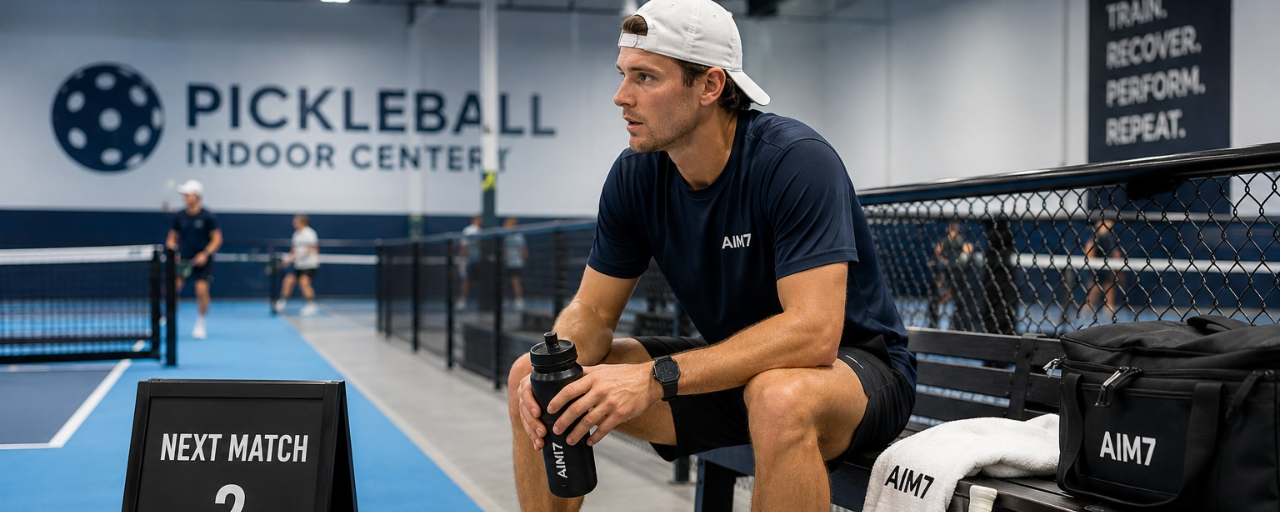
Should pickleball players take creatine? Benefits, dosage, safety, and what the research says
It's late in the third game. Or it's your second match of the morning and your legs already feel like they belong to somebody else.
The rallies are getting shorter — not because anyone started playing better, but because nobody can cover the middle anymore. You're a step late to balls you ran down an hour ago.
Somebody in your group swears creatine is the fix. Somebody else says it's for bodybuilders, or that it will wreck your kidneys, or that it'll just make you puffy.
Creatine is the most studied supplement in sports nutrition. It has more than thirty years of human research behind it, and it works about as well for a 62-year-old as it does for a college athlete (1, 9). It is also badly misunderstood, oversold by the people selling it, and dismissed by people who have never read a study on it.
Here's what the research actually says: what creatine does, what it doesn't do, how much to take, which kind to buy, whether it's safe, and whether it's worth your money as a pickleball player.
What creatine actually is
Creatine is not a steroid, a stimulant, or a drug. It's a compound your body already makes — about one to two grams a day — from three amino acids. You also get it from food, mostly red meat and fish. Roughly 95% of the creatine in your body is sitting in your skeletal muscle right now (1).
Here's the simplest way to think about what it does.
Every hard effort you make on the court — the sprint to a wide ball, the lunge for a dig, the push off the kitchen line — is powered by a molecule called ATP. ATP is a battery, and it's a small one. Your muscles drain it in a matter of seconds during all-out work.
Creatine is the recharger. It sits in the muscle as phosphocreatine and immediately hands a charge back to that battery so you can go again (1).
Supplementing doesn't change how the system works. It changes how much charge you're carrying. Taking creatine raises the amount stored in your muscle by roughly 20% (1). More stored creatine means a faster recharge between efforts — which matters most when the efforts keep coming.
What this means for you: creatine doesn't give you a new gear. It shortens the time it takes to get back to the gear you already have.

What the research shows
Across pooled human trials, that ~20% increase in muscle stores translates to 5–15% improvements in power, maximal strength, and repeated high-intensity efforts (1, 2). That last category — repeated high-intensity efforts — is the one that describes a pickleball match.
This is the part worth sitting with. The repeated-effort benefit is a direct consequence of having more fuel in the muscle. More stored phosphocreatine means faster ATP resynthesis between hard efforts, which is exactly the demand a long rally or a long day of pickleball places on you. That mechanism doesn't ask what else is in your week.
Strength training compounds it. When creatine is paired with resistance training, pooled trials show roughly 8% greater strength gains and about 14% greater muscular endurance compared with the same training alone (2, 3). If you already lift, creatine makes that work pay more.
That shows up as actual tissue. Pooling 35 randomized trials in more than a thousand adults, creatine added to resistance training built about 2.4 pounds of lean muscle beyond what the same training built on its own (15). The effect held regardless of age.
One nuance worth getting right, because it is easy to misread. In that all-ages pooled data, the gain was clear in men (3.2 pounds) and did not reach statistical significance in women (0.6 pounds) (15). That is not the same as saying creatine doesn't build muscle in women. Far fewer trials have enrolled women, so the female estimate is imprecise — a gap in the evidence, not a finding of no effect.
.jpg)
When researchers looked at women directly, the picture firmed up. A 2026 meta-analysis of seven trials in 608 postmenopausal women found creatine plus resistance training added 0.8 pounds of lean muscle and about 16 pounds of leg-press strength over training alone — both statistically significant (16). In older women, strength gains show up reliably once a program runs 24 weeks or longer (17). Both findings carry the same condition as everything else here: at least 5 grams a day, paired with training.
What that means if you're a woman reading this: the muscle benefit is real, it's smaller than the headline number, and it rewards patience. Expect a season, not a month.
Quick tip: If you want the muscle, lifting isn't optional. In that same analysis, creatine taken without resistance training produced no meaningful lean-mass gain at all (15). The muscle comes from the training — creatine makes the training pay more. The repeated-effort benefit on court and the cognitive benefit under sleep loss are a different story. Those don't require a barbell.
🎯 Creatine is one of nine.
There are dozens of supplements marketed to pickleball players. Most of them do nothing. We ran every one through a five-question screen and found nine that survive scrutiny. Get The Ultimate Pickleball Supplement Guide — it's free.
Doses, timing, how long before you feel it, and an honest evidence rating for every one.
What creatine will not do
Let's kill the biggest overclaim now.
Creatine will not improve your skill. It will not tighten your dinks, soften your third-shot drop, or fix your shot selection at 9-9. There are no studies examining creatine specifically in pickleball players. And in the closest sport we have data on, creatine loading in competitive tennis players produced no meaningful improvement in stroke quality, ball velocity, or precision (7).
That finding is worth taking seriously, not explaining away. Skill comes from reps, coaching, and time on court. Nothing in a jar touches it.
This distinction matters if you're chasing a rating. Your DUPR moves on match outcomes, not on strength tests. Creatine's value doesn't show up in a single match result. It shows up across a season, in the physical base you build underneath your game — and in whether you're still able to build it at all.
.jpg)
Where it actually shows up in your pickleball
Three places.
Late in a match, and in your second or third match of the day.
This is creatine's home turf. It is specifically the supplement for repeated bursts with short recovery, which is the exact structure of a long third game or a morning of back-to-back matches. When your ability to produce force again — thirty seconds after the last time, or an hour after the last match — is what decides the point, creatine is what's left in the tank.
Stopping, starting, and changing direction.
Accelerating to a wide ball, braking at the kitchen line, recovering your base — these are short, high-output efforts, and you make hundreds of them in a session. Better-fueled muscles handle them with more control and less accumulated cost as the session wears on.
Your training, if you do it.
Creatine may let you complete slightly more quality work: an extra rep, one more set at the same output. Those additions accumulate over weeks and months into real strength and lean mass (2, 3). That's a slower pathway to the court, and a durable one.
Notice what the first two have in common: creatine helps you repeat, not helps you peak. It isn't a pre-match supplement. There's no dose you take before a big game that does anything at all — the effect comes from what's already stored in the muscle when you walk on.
Creatine after 50 — the part most players miss
If you're over 50, this may be the most useful section in this article, and it has almost nothing to do with winning matches.
Starting in your forties, you lose muscle mass, strength, and power every year. That loss is what eventually decides whether you're playing at 75. It affects balance, how confidently you move, and how well you catch yourself when you trip on a court seam.
Creatine measurably slows that curve. In adults over 50, creatine combined with strength training added 1.37 kg of lean muscle beyond what training produced by itself (8). That's roughly three pounds of muscle you would not otherwise have.
And here's the finding almost nobody knows: the muscle-energy response to creatine appears to be larger in older adults than in younger ones (9). This is not a young person's supplement that older players can also use. If anything, the case for it strengthens with age.
For a lot of players, that's the real reason to take it. Not the second match this Saturday. The fourth decade of playing.
.jpg)
Can creatine help you recover between matches?
Partly, and the honest answer has edges.
Some studies show creatine helps restore force production and reduces certain markers of muscle damage after hard exercise. Others don't. Results vary depending on the protocol, the dose, the training status of the subjects, and what's being measured (2, 10).
Where it's most plausible is the scenario this article opened with: you play, you get an hour, and you have to perform again. Restoring force output between rounds is exactly the mechanism creatine has (2, 10).
What creatine is not is a recovery shortcut. The things that actually determine how you back up day to day haven't changed:
- Adequate sleep
- Enough calories and protein
- Fluid and electrolyte replacement
- Real rest between hard sessions
- Gradual progression of playing and training volume
Creatine is one piece of that. It is not a substitute for any of it.
Creatine, your brain, and bad sleep
Your brain runs on ATP too. Same battery, same recharger.
Creatine supplementation does increase creatine stores in the brain, though the increase is smaller and more variable than what happens in muscle (4, 14).
Here's the honest split in the evidence. In healthy, well-rested adults, the cognitive research is inconsistent — no reliable improvement in executive function or overall cognition (5, 6). Creatine is not a nootropic, and it won't make you sharper on a normal Tuesday.
But when the brain is under energy stress, the picture changes. In a randomized crossover trial, a single large dose of creatine improved processing speed and blunted some of the cognitive damage from 21 hours of sleep deprivation (13, 14). Creatine appears to matter most exactly when your brain's energy demand is highest and its supply is compromised (4, 5, 6).
If you've ever played a tournament after a 4 a.m. alarm and a bad hotel bed, you know what that looks like on court: slow reads, late split steps, poor decisions in the transition zone. This research is early, and it doesn't yet tell us that everyday supplementation produces the same protection (13, 14). But for players who compete on short sleep, travel to events, or work night shifts, it's a real and separate reason to consider it — one that has nothing to do with muscle.
How much creatine should you take?
.jpg)
Two approaches. Both end in the same place.
| Option 1 — Load | Option 2 — Just start | |
|---|---|---|
| Week 1 | 20 g/day (0.3 g/kg), split into four 5 g doses, for 5–7 days | 3–5 g/day |
| After that | 3–5 g/day | 3–5 g/day |
| Full muscle saturation | About 1 week | 3–4 weeks |
| Trade-off | Faster, but more likely to cause temporary water retention or mild stomach upset | Slower, gentler, easier to remember |
Loading gets you there faster. It does not get you anywhere better. Muscle saturation ends up at the same level either way (1, 11).
For most pickleball players, skip the loading phase. Take 3 to 5 grams a day and be patient for a month. The only real reason to load is a hard deadline — a tournament three weeks out that you decided to prepare for late.
Which kind should you buy?
Creatine monohydrate. That's the answer.
Monohydrate has been studied for more than thirty years and consistently comes out safe, effective, and cheap (1, 11). The premium forms on the shelf next to it — creatine hydrochloride, buffered creatine, ethyl ester, liquid creatine — have never beaten plain monohydrate in a controlled trial (11). You would be paying more for the same result, and often for less actual creatine.
One more filter: buy a product that's been independently tested by NSF Certified for Sport or Informed Sport. Supplements aren't verified before they reach the shelf, and independent analyses keep finding products with less active ingredient than the label claims — or with ingredients the label never mentioned. Third-party testing doesn't make creatine work better. It confirms that what's in the tub is what's on the label. If you compete in sanctioned events, treat this as non-negotiable.
Quick tip: Creatine monohydrate is one of the cheapest supplements in the store. If you're paying a premium for an "advanced" or "next-generation" version, you're paying for marketing.
When should you take it?
Whenever you'll remember.
Creatine isn't caffeine. There's no acute effect and no window to hit. Once your muscle stores are saturated, daily consistency is the only thing that matters. The clock doesn't (1, 11).
Breakfast, post-workout, before you play, with dinner — all equivalent. Pick the one attached to a habit you already have. Taking it with a meal slightly improves uptake and reduces the chance of stomach discomfort (11, 14).
The failure mode with creatine isn't bad timing. It's forgetting for five days.
"Will it make me gain weight?"
The most common question, and the answer is smaller than people fear.
Creatine can increase body weight slightly, mostly in the first weeks and mostly during a loading phase. Typically 1 to 2 pounds. That weight is water pulled into the muscle cell — intracellular water, not body fat and not bloat under the skin (11).
If it still bothers you, skip loading. Taking 3 to 5 grams a day without a loading phase largely avoids it.
One note specific to this sport: pickleball is played outdoors on hot courts, and summer tournaments are brutal. Pay attention to fluid intake while you're supplementing. This is not a reason to avoid creatine — it's a reason to drink more, not less, on hot playing days.
Is creatine safe?
Creatine is among the most extensively studied supplements available, and the evidence supports its safety in healthy adults at recommended doses (1, 11, 12).
Four things you've probably heard that the research does not support (1, 11, 14):
- It does not damage healthy kidneys. Some people show a small rise in blood creatinine. That reflects normal creatine metabolism, not kidney injury (11, 12). Healthy adults have taken up to 10 grams a day for years without harm to kidney function (11, 12).
It does not cause cramping or dehydration. The opposite claim has been tested and isn't supported.
It does not affect testosterone.
It does not cause hair loss.
The side effects that are real are mild: temporary water retention, mild stomach discomfort, and loose stools if you take a large dose all at once. Splitting doses and taking creatine with food handles most of it.
Talk to a healthcare professional first if you have existing kidney disease, take medication that affects kidney function, or are pregnant or breastfeeding.
So should *you* take it?
The answer depends less on your rating than on your situation. Most players find themselves in more than one of these.
If you play 3–4 times a week
This is a straightforward yes. Your play is built on repeated high-intensity efforts with short recovery, and that is the single best-evidenced thing creatine does. The benefit doesn't wait on anything else in your week.
If you compete in tournaments
The case is stronger still. Multi-match days are the same demand stacked on itself. Start creatine 4 to 6 weeks out from your season so your muscle is saturated well before it matters, not the week of.
If you're over 50
Take it, and take it whether or not you compete. But pair it with resistance training — that's the condition every one of those lean-mass results was produced under (8, 15), not an optional extra. The response may be larger than it is in younger players (9), and the outcome you're protecting is your ability to keep playing at all.
If you travel to events or sleep badly
Worth considering for a reason that has nothing to do with your legs. Creatine's clearest cognitive effect shows up under sleep deprivation (13, 14), which is the condition most players compete in on day one of a tournament.
If you also strength train
You get more, and for one benefit it's the whole ballgame. Creatine plus resistance training outperforms training alone on both strength and muscular endurance (2, 3), and the lean-muscle gain doesn't show up without the training (15). The on-court and cognitive benefits don't ask you to lift. The muscle does.
Your first 30 days: A simple protocol
- Buy creatine monohydrate. Unflavored powder, NSF Certified for Sport or Informed Sport. Skip every premium form.
Take 3 to 5 grams a day. Skip the loading phase unless you have a tournament in under three weeks.
Attach it to an existing habit. Same time, same trigger — with breakfast, with your protein shake, with dinner. Consistency is the whole game.
Drink more water than usual, especially through the first two weeks and on hot playing days.
Lift, if you want the muscle. Creatine and resistance training compound each other, and the lean-muscle benefit doesn't appear without the training (15). If you don't lift, creatine is still worth taking — the on-court and cognitive benefits stand on their own. But muscle is the one thing you have to earn in the gym.
Don't judge it before day 21. Nothing happens in week one without loading. Full saturation takes three to four weeks.
At day 30, check the right things. Not your DUPR. Ask whether you're still moving well late in the third game, and how your second and third matches of the day feel compared to a month ago. That's where the effect lives.
Quick tip: A tournament is the worst possible time to introduce a new supplement. Everything here needs weeks to work, and the only thing a new product can do on match day is upset your stomach.
Related articles

In defense of pros wearing jewelry on the court
Pickleball's top athletes love to add a little extra shine.
25 days ago
-Victoria Radnothy

20 things pros wish they knew earlier in pickleball
These quick tips can help you level up your game fast.
25 days ago
-Victoria Radnothy
Must-try singles pickleball drills, straight from the pros
Take your game to the next level with practice tips from the world’s top players.
35 days ago
-Victoria Radnothy
How to build a powerful pickleball serve: Tips from the pros
Here are some simple adjustments to add pace, consistency, and control.
41 days ago
-Victoria Radnothy