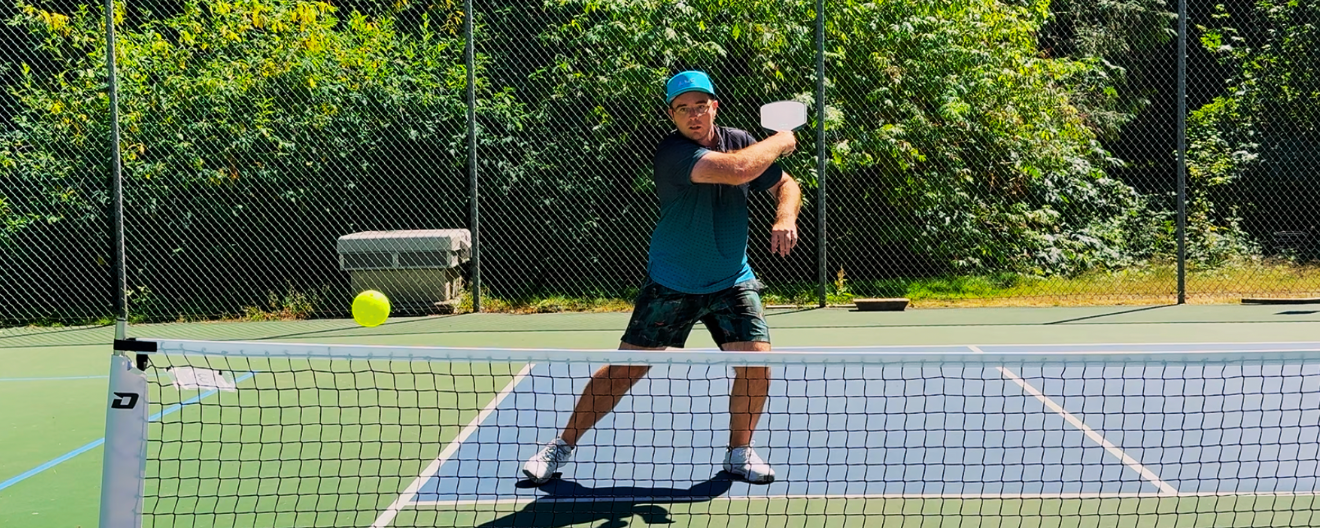
Slice and dice: The fake dink that attacks up the line
Most dink rallies settle into the same groove. You trade crosscourt with the player diagonal from you because that is where the net sits lowest and the court runs longest, and after a few exchanges both of you stop thinking about anything except the next ball coming back on the same angle. That comfort is exactly what you are going to use against your opponent. The slice and dice is a misdirection shot that lives inside a normal crosscourt dink and then breaks up the line at the last possible moment, and when you sell it well the point is often over before your opponent has finished leaning the wrong way.
There are two versions worth learning, and the names tell you what your paddle is doing. The slice is a ball you cut across and under, so it carries backspin, floats low over the net, and dies quickly once it lands. The dice is a ball you roll, brushing up the back of it for topspin so it dips down into the court and arrives a little faster and a little heavier. Both start from the same disguised setup and both travel up the line rather than back across the diagonal. The slice is the softer, sneakier of the two, and the dice is the one you reach for when you want the ball on your opponent a beat sooner.
Start on the forehand
The forehand is the natural place to build this shot because it gives you the most room to hide what you are doing. On that side you have a longer swing path, a more comfortable contact point out in front, and enough wrist to change the face angle late without your body announcing it. Learn the timing and the disguise on the forehand first, get comfortable selling the crosscourt look and then breaking up the line, and the mechanics will carry over once you want to add the backhand.
Earn the surprise before you use it
The shot only works if a dink up the line would surprise the player across from you, and it can only surprise them if you have given them a reason to expect something else. That means you have to dink, and dink honestly, for a good stretch of the rally first. If you have not sent a single ball back crosscourt, there is no pattern for you to break and nothing for your opponent to lean into. Trade a few clean crosscourt dinks, let them settle into the rhythm and start shading their weight and their eyes toward the diagonal exchange, and only then look for your moment. The setup is not wasted time. It is the entire reason the redirect works.
Hold the disguise until the very last instant
Everything about the shot should look identical to the crosscourt dink you have been hitting all rally. Same grip, same paddle preparation, same relaxed posture over the ball, same contact point in front of you. Your opponent is reading your body and your paddle for the earliest hint of where the ball is going, and the moment any of it changes early you have handed them the answer and turned a disguised shot into a telegraphed one. The redirect happens at contact and only at contact. Keep the front of the shot honest, let them commit to defending the crosscourt ball they are certain is coming, and change the face angle at the last possible moment.
Pick your spot and let the deception do the work
You are aiming at one of two places. The first is the open court past your opponent, up the line where they are no longer standing because they drifted with the crosscourt pattern. The second is their shoulder or hip, the jammed spot on the paddle side that is awkward to react to and hard to answer cleanly even when they get to it. Both of those targets win because your opponent's weight is going one direction while the ball goes another.
That is why this is a misdirection shot and not a power shot. The advantage you are creating comes from your opponent's momentum, not from how hard you hit the ball, and the instant you decide to muscle it you lose the disguise, raise your error rate, and give away the surprise you spent the whole rally building. The up-the-line ball also travels over the highest part of the net near the sideline and has less court to land in than the crosscourt one, so pace only shrinks your margin. Trust the placement. A soft ball into space your opponent has abandoned beats a hard ball they can see coming.
For the slice, the redirect comes from a high to low cutting motion. You take the paddle across and under the back of the ball with an open face, which strips the pace off and keeps the ball low and dying up the line. For the dice, you brush low to high up the back of the ball to put topspin on it, which lets you send it up the line with a little more speed while the spin pulls it back down into the court. Same disguised setup for both, and the only real decision is whether you want the ball to float and die or to dip and arrive quickly.
Adding the backhand
Once the forehand feels natural, the same shot is available off the backhand, and it is worth having because opponents who have learned to watch your forehand will not expect the redirect from the other wing. The principles do not change. You cut under the ball for the backhand slice up the line or roll up the back of it for the backhand version of the dice, and you hold the crosscourt disguise exactly as long. The backhand roll up the line in particular is a genuine weapon at the kitchen once you trust it, because so few players are looking for it.
Be ready for the counter
Against better opponents you cannot assume the trick ends the point. Skilled players recover quickly, and even when you catch them leaning the wrong way there is a good chance they get a paddle on the ball and send it back at you. If you have already mentally chalked up the winner, that return will catch you flat and hand the advantage right back. So plan on the ball coming back. Reset your feet, get your paddle up in front of you, and be prepared for the fast exchange that follows.
The good news is that you enter that hands battle with the edge. You moved first, your opponent is reacting off balance, and their counter is likely to be a defensive block rather than a clean attack. That head start does not guarantee anything, but a small advantage at the start of a hands battle is often all it takes to tip the exchange your way. Sell the dink, break it up the line at the last second, and then stay ready to finish what the misdirection started.
Related articles
Five pickleball tips to improve your game from beginner to 4.0
Coach Jess breaks down concepts that can help players win more points, improve consistency, and avoid common mistakes on the court.
6 hours ago
-Pickleball.com Staff
How to completely change your pickleball serve in 10 minutes
A few simple adjustments could help you add power, improve accuracy and eliminate the yips.
6 days ago
-Pickleball.com Staff
Five mindset shifts every pickleball player should know
Michael Lloyd shares lessons that changed the way he approaches the game, from redefining aggression to letting the ball dictate every shot.
7 days ago
-Pickleball.com Staff
Want to improve fast? Start with these 5 priorities
Build a smarter game with these must-practice fundamentals alongside coach Jordan Briones.
11 days ago
-Pickleball.com Staff