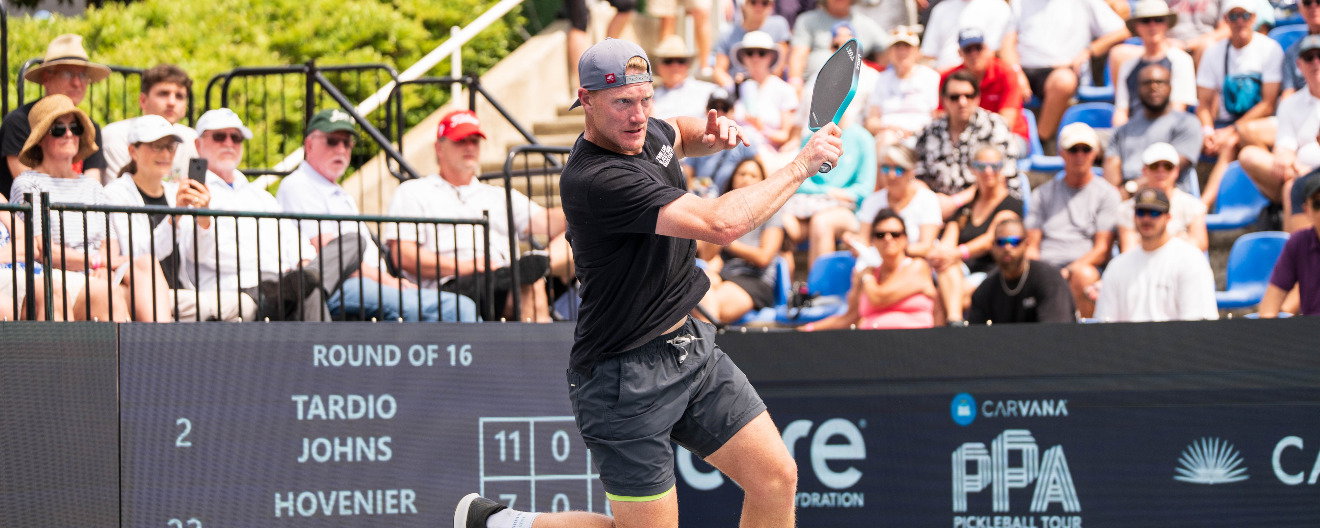
The best one-hour pickleball practice plan, courtesy of John Cincola
Practice makes perfect, but it has to be right kind of practice.
For longtime pro pickleball player and coach John Cincola, the “right” type of practice comes down to intentionality.
In a recent video on his YouTube channel, Cincola breaks down an hour-long practice sequence that is designed to move players from controlled warm-up work into realistic point play while constantly reinforcing intentional repetition.
Here’s a full breakdown of Cincola’s training method.
1. Dink Warm Up (First 10 Minutes)
Cincola recommends starting every session with dinks, usually straight ahead with a partner before moving crosscourt in one direction and then the other.
Depending on your skill level, you may want to rotate through different dink variations in this part of the warmup:
- Topspin roll dinks
- Reset dinks
- Short-hop dinks
- Crosscourt backhand dinks
- Any variation you’re not as comfortable with
Also consider adding cooperative challenges such as trying to hit 50 consecutive dinks without an error. Cincola believes introducing stakes can force players to concentrate more fully on each shot.
2. Fast Hands and Volley Work
For this step, you’re still at the kitchen line but are hitting almost exclusively volleys.
Cincola recommends splitting this section into two parts: pattern volley drills and live hands exchanges.
-
Pattern Volley Drills
- In pattern volley drills, players hit in predictable patterns so they can focus strictly on mechanics and clean contact. These patterns include forehand-to-forehand exchanges and backhand-to-backhand exchanges.
-
Live Hands Exchanges
- The ball can go anywhere in these drills, which demands that players be able to read pace, spin, and direction in real time. Cincola recommends moving to these drills second because players have ideally already sharpened their technique in the earlier drills.
3. Skinny-Court Dink Games
After roughly twenty minutes on court, the time has come to start transitioning to more competitive situations at the kitchen line.
The idea here is to use only one half of the court, but players can still be creative with how they construct points:
- Playing straight ahead
- Playing crosscourt
- Rotating sides and patterns
For more variety, Cincola suggests adding other stipulations based on the skills you want to practice more:
- Dinks only with no attacks
- Only attacking balls out of the air, not off the bounce
4. Transition Zone Drills: The Roll and the Reset
Now, players can work on skills outside of the kitchen.
For the roll and reset drill, one player stands in the transition zone while the other remains at the kitchen line.
The kitchen player feeds an attackable ball and continues applying pressure with aggressive shits to keep the transition player back. The transition player works on resetting balls softly back into the kitchen.
For the transition player, the focus is:
- Resetting under pressure
- Softening difficult balls
- Controlling touch from midcourt
For the attacking player, the focus is:
- Applying offensive pressure
- Taking balls out of the air
- Maintaining aggressive positioning
5. Drops and Drives from the Baseline
Next comes baseline work focused on drops and dives.
Cincola recommends players choose one variation to work on at a time:
- Crosscourt drops
- Down-the-line drives
- Roll drops
- Push drops
The main idea is that players should not simply hit balls mindlessly. Every shot should have a defined purpose, target, and trajectory.
Cincola also stresses the importance of situational awareness during this phase. Players should evaluate which shot choices work best under different circumstances.
For example, consider:
- If falling backward after a difficult ball, does a drive or drop feel more effective?
- If stepping into the ball aggressively, which option creates better offense?
This portion of practice is designed to help players understand their own tendencies and preferences in real situations.
6. Point Play and Skill Integration
The final phase combines everything together through point play.
Cincola often uses skinny singles so players can work on every aspect of rally construction:
- Serves
- Returns
- Transition play
- Kitchen positioning
- Dinking
- Attacking
- Countering
The goal is to stack every previously practiced skill into realistic points.
Players may play:
- Straight ahead
- Down the line
- Full skinny singles with side switching
This final stage is essential because it connects isolated drills to actual gameplay decisions and movement patterns.
By following this practice sequence or something similar, players will train every major area of the game with structure, focus, and intentionality.
Try this practice routine the next time you hit the courts and see how it works for you!
Related articles
.png?width=592&height=237&optimizer=image)
DUPR rating too low? Start reporting your rec games
Your weekly games can help your DUPR rating reflect how you really play.
16 days ago
-Joseph Sutton
The dark side of rec pickleball: The clique court
Not every court is welcoming.
19 days ago
-Victoria Radnothy
Three players you don’t want to see at open play
Every pickleball court has its regular cast of characters, but some of the toughest competitors don’t look the part.
22 days ago
-Victoria Radnothy
Four reasons to add structure to your rec play
Your group's system probably works fine, but here's what you get if you add a little structure on top of it.
25 days ago
-Joseph Sutton