.png?width=1320&height=528&optimizer=image)
How Beer City Open Built the Volunteer Culture Every TD Dreams Of
When you walk into the Beer City Open in Grand Rapids, Michigan, something feels different before you even pick up a paddle.
A parking monitor waves you in with a smile. A volunteer points you toward check-in before you have to ask. When you leave — whether you won your bracket or lost in the first round — someone in the parking lot calls out, "Thanks for coming! We hope you had a great time!" It sounds small. But it stays with you.
That's not accidental. It's the result of years of intentional culture-building by the Grand Rapids Pickleball Club, and it's why the Beer City Open has become one of the best player experiences in pickleball.
How It Started
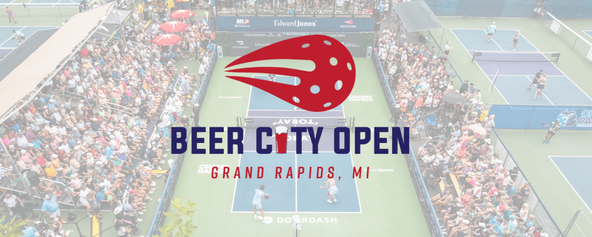
The Beer City Open launched around 2017–2018 with a modest $12,000 prize pool for the pros and a big belief that Grand Rapids could host something special. It has grown considerably since — this past year, BCO welcomed 1,254 players and hosted Major League Pickleball, with professionals competing on four dedicated courts (two warm-up, two broadcast) while amateurs played across 14 additional courts.
The volunteer program grew right alongside it.
Paul Richards — known affectionately in the community as the pickleball main man for GRPC — attended the US Open pickleball tournament around the same time BCO was getting off the ground. What caught his attention wasn't just the competition. It was how the volunteers operated. "Why not bring that home?" he thought.
He reached out to Jim Ludwig — who ran the US Open at the time — and asked him a number of questions about how they had organized their volunteers. Paul took it from there, instituting the Volunteer Captain strategy at BCO. As the program grew, Nichole Miller stepped in and became an integral part of continuing that growth — helping shape the volunteer culture into what it is today.
What started as a small operation now runs over 500 volunteers annually — down intentionally from roughly 600 the year prior, as the team focuses on efficiency and doing more with better-placed people rather than simply more of them.
The Structure Behind the Scenes
Running 500+ volunteers doesn't happen by accident. The BCO team has built a clear leadership structure to make it work.
At the top are Paul and Susan Richards alongside Andrea Koop, a PPA Pro player who brings both credibility and connection to the professional side of the sport. Below them, Nichole and Tom Miller assist in overseeing the Volunteer Captains — the VCs — among their many other responsibilities in keeping the event running.
Paul and Nichole work closely together on the VC layer, and both are deeply intentional about who fills each role. Not everyone is suited for every job. The VIP Tent needs a certain kind of person. Parking — which Paul describes as the hardest position to fill after losing strong leaders in that area — requires someone who can stay composed and keep things moving under pressure.
Volunteer Captains are expected to be problem solvers and to follow the chain of command. If a bathroom's water gets stuck on, the volunteer tells their VC. The VC takes direct responsibility to contact the city and get it fixed. That clarity of ownership is what keeps things from falling through the cracks at an event this size.
VCs also determine how many volunteers they need in their area — a number that shifts year to year based on what changed, what MLP brought with it, and what feedback surfaced after the previous event.
A Year-Round Commitment
The work doesn't start the week of the tournament.
Paul holds meetings throughout the year with the VC team — starting in October, potentially again in January, and then monthly as the event approaches. Every meeting is capped at one hour. Respecting people's time is non-negotiable.
Sign-ups open to the public around March through the GRPC website. Most volunteer shifts run three hours, though some roles require longer commitments based on the nature of the work. Once you commit, you're expected to follow through.
This year, the team added a new role: Floaters. These are volunteers whose entire job is to roam the event and respond to whatever comes up. When a walkie-talkie broke mid-tournament, a floater stepped in immediately and had it handled. That kind of responsive coverage is only possible when you have the right people who understand their purpose — and that comes from the culture Paul and Nichole have built.
What Volunteers Get
Volunteering at BCO isn't just a feel-good ask. The club invests in the people who show up.
Perks include event entry to fulfill their responsibilities, official BCO apparel, dedicated volunteer parking, a food coupon each day of the event, and for Volunteer Captains specifically, pre-registration priority for the tournament itself. Throughout the year there are volunteer get-togethers, and at the end of every season, BCO hosts the BCO/GRPC Volunteer Appreciation Celebration.
That celebration is something to see. With over 100 raffle prizes — including approximately 20 paddles, 19 gift cards, and envelopes containing $100 bills — it's a genuine celebration. And you don't purchase raffle tickets. You earn them based on the number of shifts you worked. The more you show up, the more chances you have.
The total cost to the club for volunteers runs $10,000–$12,000 per year. For an event with 1,254 players, a professional field, and MLP on the same grounds, that's an investment that pays back in reputation, retention, and the kind of word-of-mouth no marketing budget can buy.
What Makes It Work — and What Makes It Hard
When asked what he's most proud of, Paul didn't hesitate: the volunteers who come back year after year. "They know what they are doing," he said. That institutional knowledge — built across seasons and refined through feedback — is irreplaceable.
BCO has even received compliments from MLP staff members specifically about the volunteer program. For a team that works as hard as this one does, that recognition means something.
Paul also shared something that might be the most underrated benefit of a strong volunteer program: "The more people you get involved, the more opportunities there are." Volunteers are connected with people Paul isn't — and when they feel ownership over the event, they naturally bring in sponsors through those connections. It's word-of-mouth amplified. As Paul put it, it really is the gift that keeps on giving.
But it isn't without challenges. Volunteer Captains sometimes burn out. Losing a strong VC in a critical area — like parking — creates a gap that's genuinely difficult to fill. Managing difficult spectators is another reality. Volunteers and VCs are trained on de-escalation and tact, because the experience of every single person on the grounds — player, spectator, MLP guest — matters.
Paul put it simply: "Volunteers are the most important resource. We coach them to make sure guests are happy and given the best experience."
He referenced Augusta National — the Masters — as a benchmark. Everyone leaves with a positive experience. That's the standard BCO sets for itself, and it shows.
What This Means for Tournament Directors
You don't need to be running a 1,200-player event to take something from what BCO has built.
The principles scale. Start with the right people, not just warm bodies. Define roles clearly. Build a chain of command so problems get solved at the right level. Invest in your volunteers — not just with perks, but with recognition, consistency, and respect for their time. And collect feedback every year so you're always getting better. It's a fantastic way to get the community involved, get buy-in for your tournament and just generate excitement for your event.
If you ever have the opportunity to attend Beer City Open in Grand Rapids, Michigan — go. Walk the courts. Watch how the parking lot greeters interact with players. Notice how smoothly transitions happen between sessions. You'll come away with ideas you can bring back to your own tournament, whatever its size.
The BCO team is already looking ahead to continued growth, ongoing facility improvements, and new possibilities on the horizon. What they've built is remarkable — and it's still growing.
Beer City Open is hosted annually by the Grand Rapids Pickleball Club in Grand Rapids, Michigan. For more information, visit www.beercityopen.com or follow GRPC on social media.
Related articles
Behind the Schedule: Beer City Open
Nothing frustrates a player more than warming up on an open court for 30 minutes, only to find they're still in the queue with no court to walk onto right at start time.
75 days ago
-Brandon Schmeling

Two Disputes, Two Outcomes: Getting Players to the Desk When Things Go Sideways
104 days ago
-Jenna Timmer
Team Events Within A Tournament: Live Walkthrough Webinar
116 days ago
-Tyrece Warner
The DUPR Reset Confirmed Something We Already Knew About Getting Better
123 days ago
-Tyrece Warner