The 2% Rule: How Summer Heat Quietly Costs You Points (And How to Fix It)
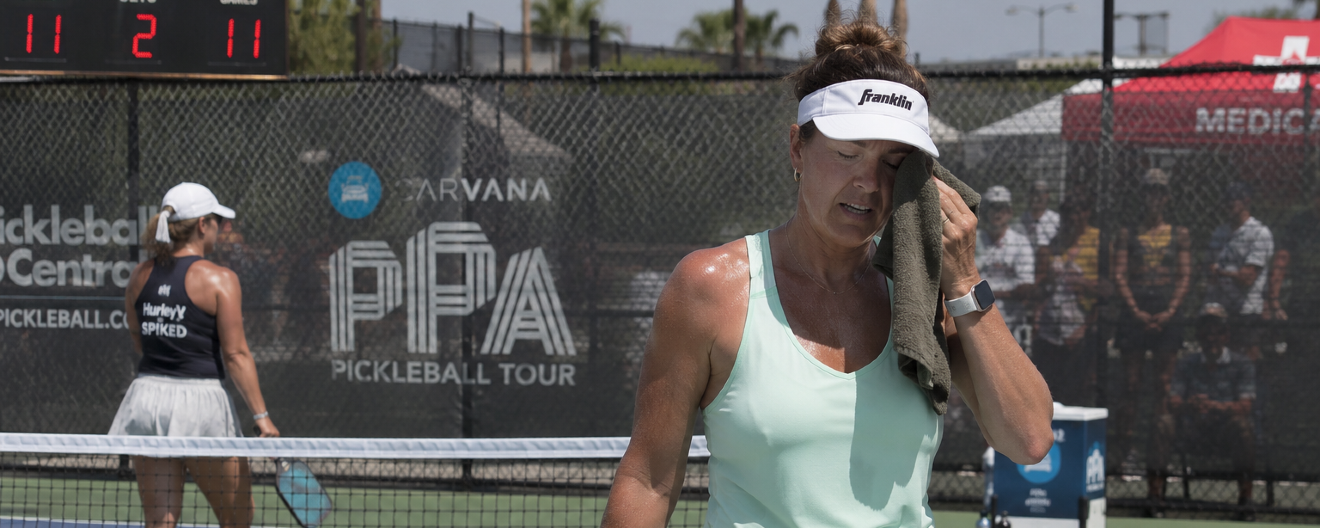
It's the third game of the morning. Your legs feel heavy, your dinks are floating long, and you're a half-step late to the kitchen. It's easy to blame conditioning, or just the heat.
Often it's simpler than that. You're dehydrated — and you probably were before you ever stepped on the court.
Summer is prime pickleball season, and hydration is one of the simplest ways to protect both your performance and your safety in it.
Research consistently shows that losing as little as 2% of your body weight through dehydration can impair endurance, increase cardiovascular strain, make effort feel harder, and reduce cognitive performance — including attention, reaction time, and decision-making (Cheuvront & Kenefick, 2014; Wittbrodt & Millard-Stafford, 2018). For a 180-pound player, that's under four pounds of sweat. In pickleball, it shows up as slower footwork, missed shots, and fatigue arriving a game early.
Here's why heat hits pickleball players especially hard. Unlike many sports with frequent substitutions or long recovery periods, pickleball often means multiple games over several hours with only short breaks. Add high temperatures and humidity, and it's easy to lose more fluid through sweat than you realize.
Sweating is your body's primary cooling mechanism. But every drop carries away water and electrolytes that help regulate body temperature, maintain blood volume, and support normal muscle and nerve function. If those losses aren't replaced, your body has to work harder to do the same amount of work.
The good news: staying hydrated doesn't require an elaborate plan. A few simple habits before, during, and after play can help you maintain energy, recover more effectively, and keep playing your best all summer. Let's break it down.
Start Hydrating Before You Play
Hydration begins well before the first serve. Arriving at the courts already dehydrated makes it harder for your body to regulate its temperature once you start sweating.
The American College of Sports Medicine recommends drinking 5–7 mL of fluid per kilogram of body weight — about 0.08 to 0.1 ounces per pound — at least four hours before exercise. If your urine is still dark or you've had little to drink all day, add another 3–5 mL/kg (roughly 0.05 to 0.08 oz/lb) about two hours before play (ACSM, 2007).
For a 180-pound player, that's about 14 to 19 ounces four hours out, and another 8 to 14 ounces two hours out if you're running behind.
If you know you'll be playing in hot weather or tend to sweat heavily, choosing a beverage that contains sodium before play can help your body retain fluids more effectively.
Quick tip: Don't use thirst as your only guide. By the time you feel thirsty, you've often already lost enough fluid to begin affecting performance.
Sip Early, Sip Often — Don't Play Catch-Up
Hydration is easier to maintain than it is to catch up.
Rather than draining a whole bottle during a timeout, take small, consistent sips throughout your match. Spreading hydration across your session is more comfortable and replaces sweat losses as they happen.
A practical starting point is 4–8 ounces every 15–20 minutes, though your needs vary with body size, sweat rate, intensity, and conditions (ACSM, 2007).
To personalize that range, use a simple formula: divide your body weight in pounds by 30. That's roughly how many fluid ounces to drink every 10–15 minutes. A 180-pound player aims for about 6 ounces every 10–15 minutes. Bigger players and heavy sweaters land at the top of the range; in hot, humid conditions, you'll likely need more.
Monitoring your body weight before and after play can help you fine-tune your strategy over time (ACSM, 2007; Cheuvront & Kenefick, 2014).
Quick tip: Keep your water bottle courtside so drinking becomes part of your routine between games.
Water Isn't Always Enough
Water is the foundation of hydration, but longer sessions in the summer heat often require more than water alone.
Sweat contains electrolytes, particularly sodium, which helps regulate fluid balance, nerve signaling, and muscle contractions (Shirreffs & Sawka, 2011). The longer you play and the more you sweat, the more sodium you lose.
For many recreational matches lasting less than an hour, water is usually sufficient. But consider adding electrolytes if you're:
-
Playing longer than 60–90 minutes
-
Competing in multiple matches or tournaments
-
Exercising in hot or humid conditions
-
A heavy or “salty” sweater (for example, white salt stains on your clothing or hat after playing)
Sports drinks, electrolyte powders, or electrolyte tablets can all help replace sodium losses during longer sessions. They may also improve fluid retention compared with water alone, particularly when sweat losses are high (ACSM, 2007; Shirreffs & Sawka, 2011).
It's also important to remember that more isn't always better. Drinking excessive amounts of plain water without replacing sodium during prolonged exercise can contribute to exercise-associated hyponatremia, a potentially serious condition caused by low blood sodium. While uncommon in recreational pickleball, it highlights the importance of balancing fluids and electrolytes during prolonged activity.
Quick tip: If you're spending several hours on the court, alternate between water and an electrolyte-containing beverage rather than relying only on water.
Rehydrate After Your Match
Hydration doesn't end when the final point is over. Replacing fluids afterward restores hydration and prepares you for your next workout or match.
The National Athletic Trainers' Association recommends drinking approximately 16–24 ounces of fluid for every pound of body weight lost during exercise (McDermott et al., 2017). Including sodium with your post-match meal or beverage can improve fluid retention and support more complete rehydration.
Water-rich foods such as fruit, vegetables, yogurt, and soups also contribute to your daily fluid intake.
Quick tip: If you're playing again later that day or competing in a tournament, prioritize rehydration immediately after your match rather than waiting until you get home.
Your Hydration Plan at a Glance
4 hours before play
Drink 5–7 mL of fluid per kg of body weight (about 0.08–0.1 oz/lb).
2 hours before play
If needed (e.g., urine is still dark or you've had little to drink), add another 3–5 mL/kg (about 0.05–0.08 oz/lb).
During play
Sip consistently. A practical guide: drink your body weight (lb) ÷ 30 in fluid ounces every 10–15 minutes, adjusting upward in hot or humid conditions.
After play
Replace sweat losses by drinking 16–24 ounces of fluid for every pound of body weight lost during exercise.
Electrolytes
Consider an electrolyte-containing beverage for sessions over 60–90 minutes, tournaments, hot or humid conditions, or if you're a heavy sweater.
|
Don't try to remember all this at 2-2 in the third. We turned this entire plan into a one-page hydration cheat sheet — pre-match amounts in ounces (no metric conversions), the during-play formula, when to reach for electrolytes, and the warning signs to catch early. Screenshot it, print it, tape it inside your paddle bag. |
Watch for Early Signs of Dehydration
Your body often gives warning signs before dehydration significantly impacts performance. Pay attention to symptoms such as:
-
Dark yellow urine
-
Dry mouth
-
Headache
-
Fatigue
-
Dizziness
-
Muscle cramping
-
Difficulty concentrating
-
Feeling unusually hot, or that exercise is harder than normal
If these develop, move to a shaded or air-conditioned area, begin drinking fluids, and allow your body time to cool before returning to play. If symptoms progress to confusion, vomiting, fainting, or difficulty cooling down, seek medical attention immediately, as these may be signs of heat-related illness (Casa et al., 2015).
|
Take the Whole Plan to the Court Knowing how much to drink is one thing. Remembering it in 90-degree heat, three matches deep, with two minutes between games, is another. That's why we built Beat the Heat: Your Ultimate Hydration Guide — a free one-page cheat sheet that turns everything above into something you can actually use courtside. Inside you'll find:
It was built by Pratik Patel, RD, CSSD — a registered sports dietitian and former NFL performance nutrition coach who has spent over a decade managing hydration for professional athletes. One page. No math. Free. |
The Bottom Line
Playing pickleball in the summer doesn't require drinking sports drinks all day or hauling around gallons of water. It simply requires matching your fluid intake to the demands of your day.
Start your match well hydrated, drink consistently throughout play, use electrolytes when you're spending extended time on the court or sweating heavily, and replace the fluids you lose afterward.
These simple habits can help you stay energized, maintain focus, recover more effectively between matches, and keep enjoying pickleball through the hottest months of the year.
References
American College of Sports Medicine, Sawka, M. N., Burke, L. M., Eichner, E. R., Maughan, R. J., Montain, S. J., & Stachenfeld, N. S. (2007). American College of Sports Medicine position stand: Exercise and fluid replacement. Medicine & Science in Sports & Exercise, 39(2), 377-390.
Casa, D. J., DeMartini, J. K., Bergeron, M. F., Csillan, D., Eichner, E. R., Lopez, R. M., Ferrara, M. S., Miller, K. C., O'Connor, F., Sawka, M. N., & Yeargin, S. W. (2015). National Athletic Trainers' Association position statement: Exertional heat illnesses. Journal of Athletic Training, 50(9), 986-1000.
Cheuvront, S. N., & Kenefick, R. W. (2014). Dehydration: Physiology, assessment, and performance effects. Comprehensive Physiology, 4(1), 257-285.
McDermott, B. P., Anderson, S. A., Armstrong, L. E., Casa, D. J., Cheuvront, S. N., Cooper, L., Kenney, W. L., O'Connor, F. G., & Roberts, W. O. (2017). National Athletic Trainers' Association position statement: Fluid replacement for the physically active. Journal of Athletic Training, 52(9), 877-895.
Shirreffs, S. M., & Sawka, M. N. (2011). Fluid and electrolyte needs for training, competition, and recovery. Journal of Sports Sciences, 29(Suppl. 1), S39-S46.
Wittbrodt, M. T., & Millard-Stafford, M. (2018). Dehydration impairs cognitive performance: A meta-analysis. Medicine & Science in Sports & Exercise, 50(11), 2360-2368.
Related articles
Should Pickleball Players Take Creatine? Benefits, Dosage, Safety, and What the Research Says
Creatine is the most studied supplement in sports nutrition with 30+ years of research backing it. Here's what actually works for pickleball players—and what doesn't.
11 days ago
-Guest Author
Is open play dying?
Packed courts and tougher competition are reshaping pickleball—here’s what’s behind it, and two simple ways to preserve the community.
42 days ago
-Joseph Sutton
.png?width=592&height=237&optimizer=image)
Why you play great in drills and fall apart in games
Two things separate drilling from live play, and neither one is mechanical.
48 days ago
-Joseph Sutton
Your mid-match reset: How to stop the spiral and reconnect to the ball
We all have bad days on the court, but that doesn’t mean we have to be trapped in that negative flow the rest of the day.
67 days ago
-Joseph Sutton