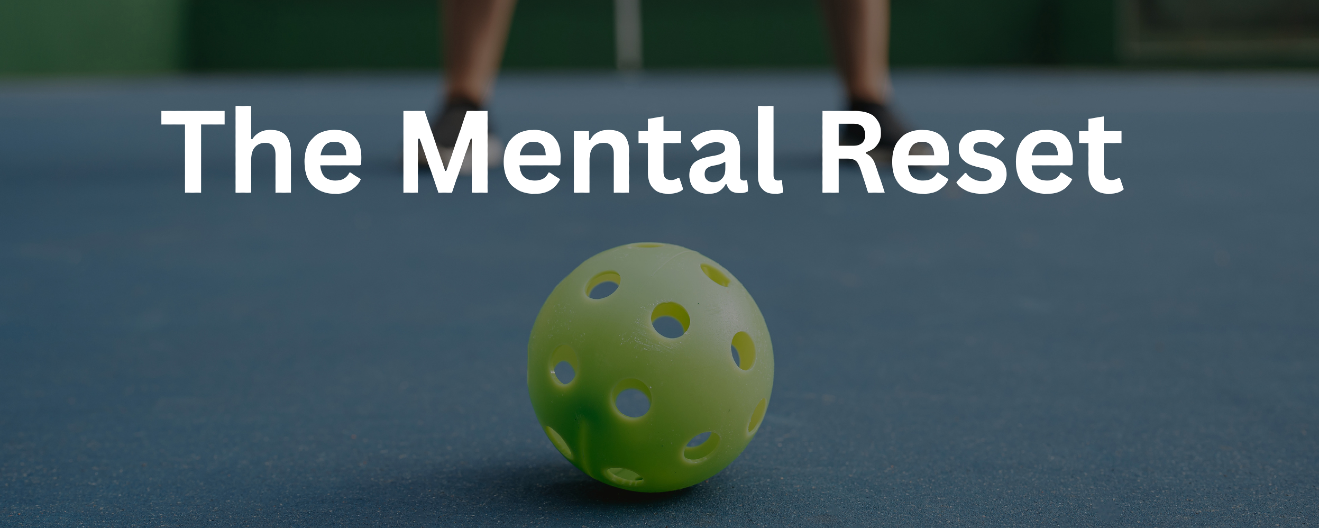
Your mid-match reset: How to stop the spiral and reconnect to the ball
We all have bad days on the court where we just aren’t “on,” but that doesn’t mean we have to be trapped in that negative flow the rest of the day, or even the rest of the game you’re in right then. Instead of just grinding harder, consider using a simple reset you can customize to be exactly what you need to slow down and get back to the basics.
While this mid-match reset won’t necessarily fix any mechanics, what it does is interrupt the spiral long enough for you to prepare for and play the next ball clean, and most of the time that next clean ball is all you actually need to get going again. It is a small routine you can run between points, and yes, you may feel a little silly the first few times you do it. Do it anyway. The players who can reset mid-game are not calmer by nature, they just have a way back.
Here is the one I use.
Step 1: Take a deep breath and let go of the self-judgement
When a game starts getting away from you, your nervous system is part of the problem. Your heart rate climbs, your grip tightens, and your attention narrows onto everything that is going wrong. A single long exhale is the fastest tool you have to push back against that. The breath itself matters less than the exhale, so let it run a beat longer than feels natural.
The harder part is the second piece, which is dropping the running commentary in your head. "What is wrong with me today" and "I can't believe I missed that again" feel like motivation in the moment, but they are doing the opposite. That commentary occupies the exact attention you need for the next shot, and it keeps your focus pointed backward at the mistake instead of forward at the ball that is about to come over the net. You do not have to feel good about the last point, but in the words of Ted Lasso, “Be a Goldfish,” and move right on.
Step 2: Bounce the ball on the dead center of your paddle
This is the step people skip because it looks pointless and feels silly, but I’ve found that when I’m making good contact, everything about my game gets better. Bouncing the ball a few times on the middle of your paddle gives your hands and eyes a simple task that you ultimately should be recreating on every shot you hit. This exercise gets you reacquainted with the sweet spot of your paddle, something I know for me is a must to turn my game around mid-match.
Want to make it a little more fun? Add some hits on the edgeguard in to really lock in on the ball, but just know that if you miss you may be chasing the ball around while others wait, something that may do the opposite of adding confidence.
Step 3: Say your mantra, I use “Follow the ball, nothing else matters”
Mine is "follow the ball, nothing else matters,” and in that moment that is all I allow myself to think about. I free my mind of game mechanics, previous mistakes, the hot paddle my opponent is using, or anything else. I know for me that if my eyes and focus are locked in on the ball, I’m much more likely to be ready for it and make good contact, and those are the first steps to turning my game around.
When you tell yourself to follow the ball, you are aiming your attention at the thing you are trying to do rather than at how your arm is supposed to move. Players tend to perform better when they focus on the target and the ball instead of policing their own mechanics, because mechanics handled consciously in the middle of a point tend to get stiff and slow. "Follow the ball" keeps your eyes and your intention where they belong. "Nothing else matters" clears out the rest of it, the score and the missed shots and whatever you imagine your partner is thinking. None of that is on the next ball. The next ball is the only thing you can play.
Your mantra can be something different, find your own if those words do not land for you, but keep it short, keep it present tense, and point it at something outside your own body.
What the reset actually does
This routine does not make you a better player in the moment and it will not rescue a match where you are simply being outplayed. What it gives you is a clean mindset and clear goal based in fundamentals that will let you stop beating yourself and make the opponent beat you.
Build the routine when the stakes are low so it is automatic when they are not. Run it in rec games, run it in warmups, run it on points you are already winning. By the time you actually need it, the breath and the bounce and the mantra should feel like reaching for something you have always had in your pocket, because by then you will have.
Related articles
.png?width=592&height=237&optimizer=image)
DUPR rating too low? Start reporting your rec games
Your weekly games can help your DUPR rating reflect how you really play.
16 days ago
-Joseph Sutton
Which JOOLA paddle is right for you? Your complete buying guide
Choosing the perfect paddle can feel overwhelming, but the experts at Pickleball Central make it a whole lot easier.
28 days ago
-Victoria Radnothy
How to build a powerful pickleball serve: Tips from the pros
Here are some simple adjustments to add pace, consistency, and control.
41 days ago
-Victoria Radnothy
Cardio isn’t the key to better pickleball, according to this trainer
Skip the cardio and build strength instead.
43 days ago
-Victoria Radnothy