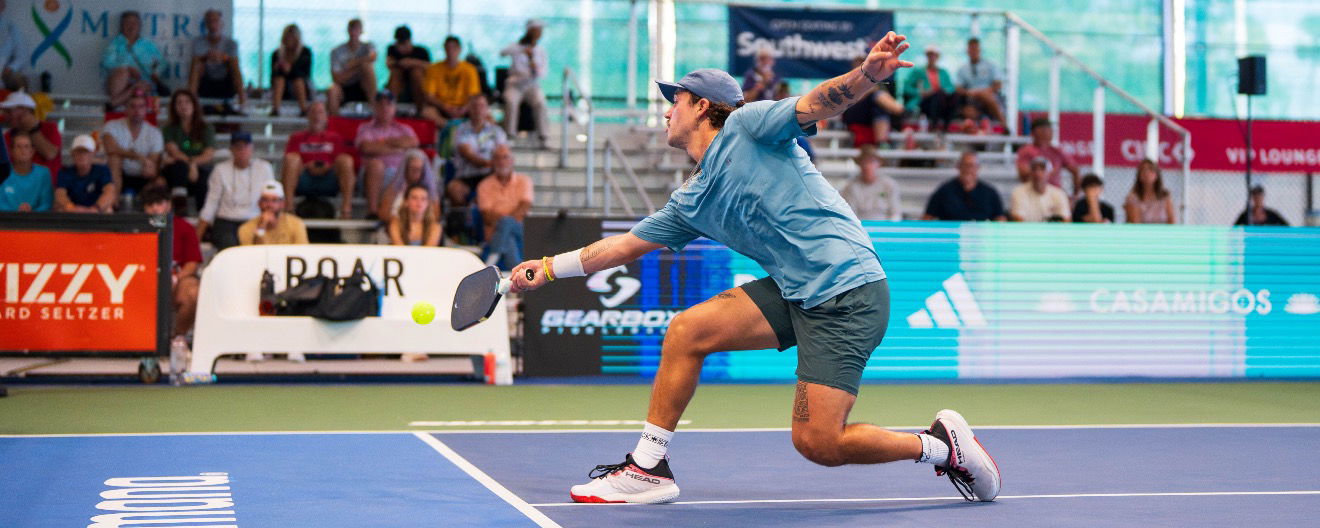
A closer look at pickleball footwork with Michael Loyd
Michael Loyd has some good footwork advice to elevate your pickleball game.
Proper footwork makes every shot easier. With less strain comes more accuracy, and you can save energy for the latter stages of a match. Good footwork also prevents injuries from lunging or twisting awkwardly.
Poor movement turns good players into average ones, so footwork is extremely critical.
1. Stay low, stay balanced
“Bend at the knees, not at the waist,” began Loyd. “One of the main benefits from this is you’re going to be in a more athletic, natural stance. It also keeps your head up for more court awareness. Another benefit from this is you’re going to have a lower center of gravity for quicker changes of direction.”
To work on this, Loyd recommends the chair drill where you rally with a partner, but stay as low as possible as if you’re about to sit in a chair. Loyd also recommended watching Andrei Daescu play for a masterclass in staying low and balanced on court.
2. Split step timing
“Your split step is your ready hop as your opponent makes contact. Keep weight on the balls of your feet, not your toes or heels,” said Loyd.
Loyd shared a drill to practice this.
“Have your partner across the net say "Hit!" every time they swing, and you’re going to try to land your split step exactly then,” he explained.
3. Side shuffle, don’t crossover
“In the kitchen, never turn your hips away from the net. It kills vision and balance. Instead, we want to side shuffle or crab shuffle. This keeps the paddle ready and eyes forward on our target,” said Loyd.
Loyd demonstrated a drill to practice this footwork. Stand at the kitchen line and have your partner feed balls to random sides so you can practice side shuffling across the kitchen line without crossing your feet.
Loyd also recommended watching JW Johnson play for excellent side shuffling technique.
4. Small steps to the ball
“Don’t lunge. Instead, use micro adjustments to get the perfect spacing. Large steps are used to cover ground, but can throw you off balance if the ball is too close to you,” said Loyd.
Small and quick steps keep you in better control with every contact point. Look to Anna Leigh Waters for a masterclass in this footwork area.
“To drill this, we’re going to play micro-step-only rallies. Your partner feeds the ball in, and you can’t take a step longer than a shoe length. This is great because it forces you to get all those little adjustment steps in before each and every shot,” demonstrated Loyd.
5. Earn your way to the kitchen
“Don’t sprint through the transition zone without stopping. More times than not, you’ll eat a body shot. Here, we’re going to want to stop, split step, and set our feet every time our opponent contacts the ball,” said Loyd.
Loyd also emphasized to stay facing forward. If a ball gets behind you, use a scoop volley with a locked wrist.
To drill, practice your split step as your partner feeds you balls. Split step before every single time you hit the ball.
6. Recovery paths and court awareness
“After a wide shot, recover diagonally towards the center. This is going to cut off way more angles than running straight back. In doubles, we also want to keep our peripheral vision on our partner. This allows us to practice together,” said Loyd.
“To practice this, you and a partner are going to recover together. Both players are going to be shuffling back to the center after every wide shot while at the kitchen,” he added.
7. Footwork under pressure
When tired, footwork is the first to go, so Loyd recommended to train tired.
“At the end of practice, we’re going to do a 60-second rapid fire rally with constant split steps. A good mental cue here is to have your feet first and then your hands second. You want to move before you swing,” he said. “Whenever I’m tired at the end of matches, I remind myself about soft hands and quick feet. This helps me stay engaged and ready for each and every shot.”
Hungry for more? Read the complete pickleball footwork blueprint from Pickleball Hub.
For more tips from the best in the game, follow us on Instagram or X (formerly Twitter).
Related articles
Five pickleball tips to improve your game from beginner to 4.0
Coach Jess breaks down concepts that can help players win more points, improve consistency, and avoid common mistakes on the court.
5 hours ago
-Pickleball.com Staff
How to completely change your pickleball serve in 10 minutes
A few simple adjustments could help you add power, improve accuracy and eliminate the yips.
6 days ago
-Pickleball.com Staff
.png?width=592&height=237&optimizer=image)
Five ways to elevate your dink game like a pro
These strategies can help you make smarter decisions and gain the upper hand in kitchen line battles.
6 days ago
-Pickleball.com Staff
Five mindset shifts every pickleball player should know
Michael Lloyd shares lessons that changed the way he approaches the game, from redefining aggression to letting the ball dictate every shot.
7 days ago
-Pickleball.com Staff