
Don’t copy the pros: 12 pickleball habits hurting your game
You might think you are helping your game by watching professional pickleball and copying what the pros do.
While that can sometimes be true, Zane Navratil says there are also plenty of habits at the pro level that can actually hurt recreational players.
Here are those habits:
1. Your ready position is too low
Professional players often use a lower ready position because they are facing precise, controlled attacks. Recreational players, however, deal with far more unpredictable shots. Keeping your paddle too low forces you to react late, especially against hard hitters. Raising your ready position will help you defend and counter more effectively.
2. You are forcing advanced wrist shots too early
Shots like backhand flicks and roll dinks require a strong foundation. Many players try to replicate these advanced techniques before they have developed consistency. Instead of jumping straight into wrist-heavy shots, focus on control and gradually build up to adding wrist action.
3. Not every dink should be aggressive
At the pro level, aggressive dinks are used strategically. At the recreational level, players often attack simply to outdo their opponent. You should only attack a dink when you are balanced, in position, and the ball is high enough. If those conditions are not met, a controlled dink is the smarter choice.
4. You are overusing the two-handed backhand
The two-handed backhand is useful, but relying on it too much can limit your game. It reduces your reach and makes certain defensive shots more difficult. A one-handed backhand is still essential for extending your range, defending your body, and creating more shot opportunities.
5. You are prioritizing placement over power at the wrong time
When you get a high ball, trying to hit the perfect spot often leads to unnecessary errors. Professional players may go for precise placement because their opponents can handle power. At most levels, however, hitting with pace is more effective. On high balls, focus on strong, controlled power instead of perfect placement.
6. You are ignoring the value of slice
Slice returns are less common at the pro level because players know how to handle spin. At the recreational level, many players struggle with it. Developing a slice return can give you an advantage and disrupt your opponent’s rhythm.
7. You are driving too many third shots
Professional players often hit third-shot drives, but they also have excellent control on their drops. If you only drive the ball, you miss the opportunity to develop a key skill. Learning when and how to hit a soft third-shot drop is essential for advancing your game.
8. You are attacking low balls without a plan
Pros sometimes attack low balls because they recognize specific weaknesses in their opponents. Recreational players often attack in those situations without a clear reason. If the ball is low and you are not in a strong position, it is usually better to continue the rally and wait for a better opportunity.
9. You are mixing up your shots too much
Changing shots constantly might seem like a good strategy, but it is often unnecessary at lower levels. If a particular shot or pattern is working, you should continue using it until your opponent proves they can adjust.
10. You are trying to reset very shot
Resetting the ball is one of the most difficult skills in pickleball. While it is important, many players rely on it too often. At the kitchen line, it is often more effective to look for a counterattack rather than simply trying to neutralize the point.
11. You are copying pro equipment without thinking
Professional players choose paddles based on their own strengths and playing style. Those same paddles may not be suitable for recreational players. It is more important to find equipment that complements your own game rather than copying what the pros use.
12. You are skipping the fundamentals
The most common mistake is trying to play like a pro without mastering the basics. Advanced shots and strategies only work when they are built on consistency and control. Focusing on fundamentals will lead to more improvement than trying to replicate highlight-reel plays.
Watching professional pickleball can be helpful, but blindly copying it can do more harm than good.
Players improve faster when they focus on skills that match their level and build a strong foundation before adding advanced techniques.
Related articles
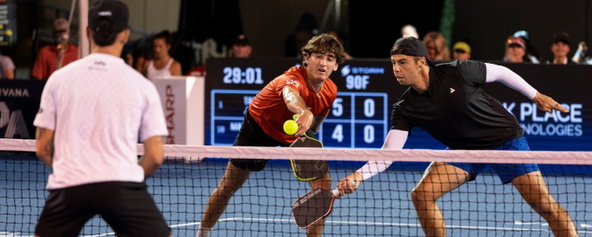
Gabe Tardio embraced the right side
It helped the 21-year-old reach the top of men’s doubles.
2 days ago
-Victoria Radnothy
Five pickleball tips to improve your game from beginner to 4.0
Coach Jess breaks down concepts that can help players win more points, improve consistency, and avoid common mistakes on the court.
5 days ago
-Pickleball.com Staff
How to completely change your pickleball serve in 10 minutes
A few simple adjustments could help you add power, improve accuracy and eliminate the yips.
11 days ago
-Pickleball.com Staff
.png?width=592&height=237&optimizer=image)
Five ways to elevate your dink game like a pro
These strategies can help you make smarter decisions and gain the upper hand in kitchen line battles.
11 days ago
-Pickleball.com Staff