Opinion: Why lefties are at a disadvantage in pro pickleball
A common misconception in pickleball is that the best combination of doubles partners is one right-handed player playing with one left-handed player. There is some truth to the concept at the amateur level, but as is so often true, things are different at the highest level, the pro level. Especially in pro men’s doubles, a lefty is at a disadvantage. The disadvantage is smaller in women’s doubles and mixed doubles, but it exists, nonetheless. Let’s break down why the pro game is different, and why a lefty is at a disadvantage, focusing on men’s doubles.
The pro game is different than the amateur game in so many ways. What is relevant for this discussion is the issue of the ability to control the ball, and to hit it where intended. Pros, far better than amateurs, can target an opponent’s weak spot once identified. The amateur, especially at the common 3.5/4.0 level, may be able to identify the right spot to hit the ball, but will still have trouble consistently hitting the right shot to that spot. Conversely, the pros will be able to consistently hit the target and if that target is a true weak spot, one side will have a potentially decisive advantage.
How does this apply to lefties? First, let’s define the situation. Assume the typical match, with two right-handed players against one righty and one lefty. The left-handed player will play the right side, with stacking, so that his team will have two forehands covering the middle at all times. Of course, this results in that team also having both backhands to the outside.
Men’s pro pickleball is all about trying to identify a safe zone to hit the ball. As the game has sped up, finding a safe zone has become more important than ever. The vast majority of rallies have all four players at the kitchen line, dinking and looking for an opening to speed it up. The main goal when dinking is to (1) not miss, (2) not leave the ball up, (3) not place the ball where it can be attacked, i.e., to hit it to a safe zone. There are situations where a dink is offensive, such as a strong roll to an opponent’s backhand, but by and large the goal of a dink is defensive in nature; you’re trying to not lose the point, rather than trying to win it.
In the pro game, the most common safe dink is crosscourt. With four right-handed players on the court, this results in the left side players exchanging crosscourt backhand dinks, and the right-side players exchanging forehand dinks. However, put a lefty on the court and the situation changes. Now, the right-side player is dinking forehand, but to the lefty’s backhand. This is an obvious advantage. It may not seem like a big edge, and indeed it may be a small edge, but in pro pickleball a small edge is significant.
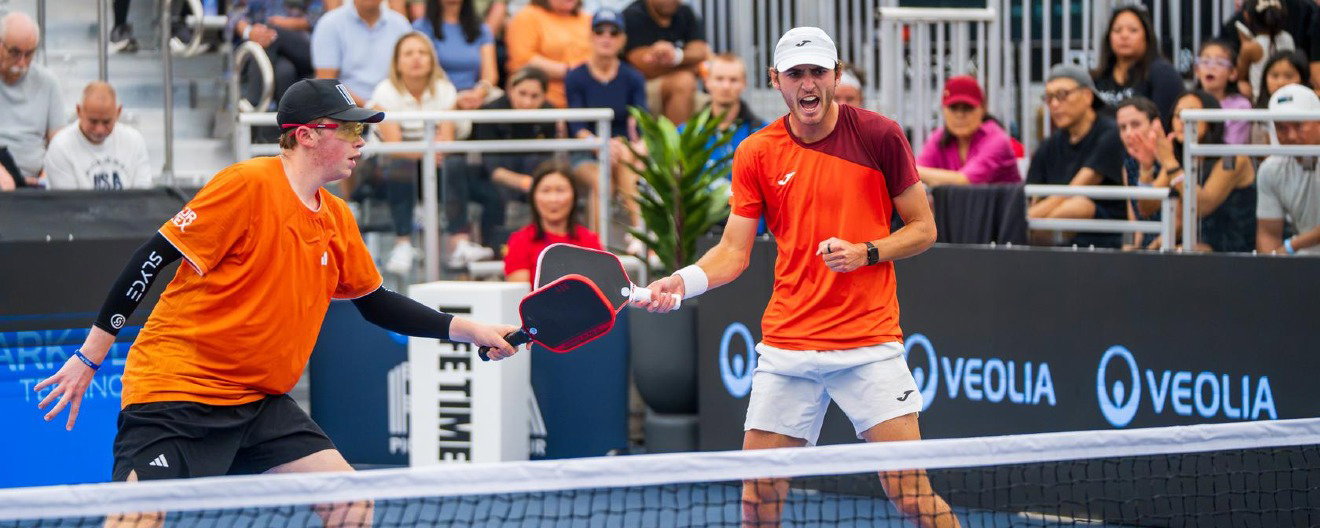
A great example of these issues in action was provided in March at the 2026 Newport Beach Open in a quarterfinal match between #3 seed JW Johnson/CJ Klinger and #18 seed Collin Johns/Len Yang.
At the time, it was hard for any team outside of the top four teams to make the semifinals. Gabe Tardio/Ben Johns, Federico Staksrud/Andrei Daescu, Hayden Patriquin/Christian Alshon, and Johnson/Klinger were consistently taking the four semifinal spots at tournament after tournament. Johns and Yang were decided underdogs. But one advantage they had was Collin Johns’ brain. Johns is one of the best strategists in identifying weaknesses in his opponents, and he also has the all-important discipline to follow through on a winning strategy. In the match against Johnson/Klinger, you can see in the video how he is constantly coaching Yang.
So, what was the strategy Collin Johns came up with and what can we see from the replay of the match? The steps are simple and straightforward, and demonstrate the weak spot of a lefty in men’s doubles:
- 1. Johns/Yang dink consistently to Klinger’s backhand. Especially in the important points at the end of game three, Johns/Yang pound dink after dink to Klinger’s backhand.
- 2. Johns moves well toward the center, so he can hit forehand dinks to Klinger’s backhand. He has no fear of an aggressive dink outside to his forehand, as it is harder for Klinger to be aggressive off the backhand. If Johnson’s partner was right-handed, this strategy would not work, as the partner would be hitting forehands and could hit more aggressive dink.
- 3. Yang does not want to dink line to Klinger’s backhand, as that risks an erne. He also does not want to do the traditional crosscourt dink to Johnson’s backhand, as that likely just engenders a dink back to Yang’s backhand. Instead, Yang often dinks middle, which is more likely to cause a dink back to the middle, that allows the next dink to go effectively to Klinger’s backhand, repeating the advantageous pattern.
- 4. Klinger tries to get out of the difficulty of dinking backhand to the opponent’s forehand by moving to his right, running around his backhand to try to hit forehand dinks. But, in doing so, Klinger just opens the middle more. In addition, moving right forces him to hit the more unnatural shot of an inside out forehand instead of the easier and more effective topspin roll.
Johnson and Klinger are clearly superior players to Johns and Yang. But, in large part due to the effective strategy, Johns/Yang go on to win 11-7, 2-11, 11-6.
We can see this same pattern repeated with other lefties. For example, Pablo Tellez is known to run well around this backhand dink. Augie Ge probably has the best response of any lefty, as he has developed a strong two hand backhand roll dink.
The one advantage that people claim for a lefty is that it allows two forehands to be in the middle. But, in men’s pro doubles, how much use is a second forehand in the middle? Just look at how much court left-side players take, whether it is Ben Johns, Hayden Patriquin, Christian Alshon, or others. These players will take every middle ball, and indeed many balls over the center line on their partner’s side of the court. Having a second middle forehand offers no additional advantage.
None of this is to say left-handed players cannot win in pro pickleball. Of course they can. We just saw JW Johnson and Augie Ge repeat as champions at Daytona Beach. But, contrary to popular belief, there is no advantage to being a lefty in men’s pro pickleball. Instead, they have a soft spot, an area that smart teams can exploit. Opponents often do not spot this advantage, or if they do, they do not have the discipline of a Collin Johns to stick to the right strategy, point after point.
The next time you watch a PPA men’s doubles match that involves a lefty, watch to see if the other team exploits the lefty’s backhand. That is the soft spot, the safe area. But will the opponents target it? You will be surprised how often the answer is no.
Follow me on X @pickleball_jim
Related articles
More than a sport: Travis Rettenmaier gets real about life lessons learned on the court
"I met a great community in St. Pete and it gave me a whole new world," said Rettenmaier.
3 days ago
-Victoria Radnothy
Pickleball Worlds draws record 70,000 attendance, generates $2 million
Worlds was the biggest event in PPA Tour and Major League Pickleball history.
4 days ago
-Hannah Johns
Black Friday pickleball deals 2026: best deals on clothes & shoes
Here's what I'm shopping this holiday season.
4 days ago
-Victoria Radnothy
Judit Castillo’s second US gold medal headlines Proton Daytona Beach Open
Castillo played a hot hand all the way to Sunday, taking the win without dropping a game through her five matches.
5 days ago
-Jim Kloss