Partnership debate: Is Jorja Johnson the best partner for Anna Leigh Waters?
Jim Kloss
Dec 24 2025 7:00 AM ET
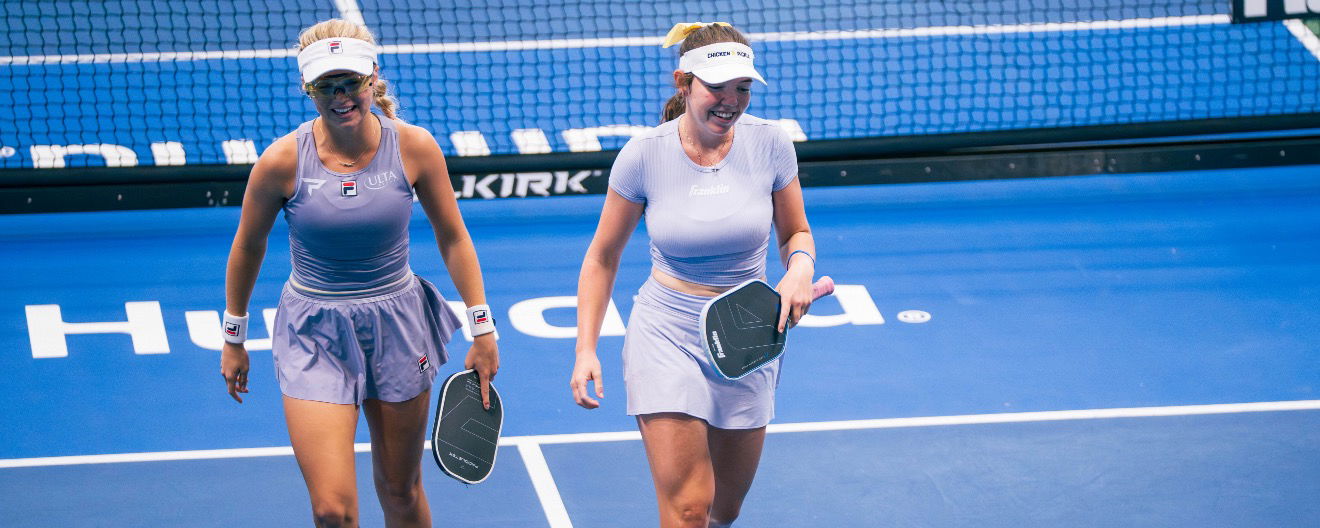
A big story at PPA Daytona Beach was the dominating performance in women’s doubles of the new partnership of Anna Leigh Waters and Jorja Johnson. It was described as a one-time thing, done solely because Anna Bright was not playing at Daytona Beach. Waters and Johnson completely dominated the field. They won every match and every game. But that is not all; they held their opponents to an average score of less than 3.5 points per game. That is domination.
Following the tournament, social media erupted with a discussion as to whether Johnson might be a better partner than Bright for Waters. Zane Navratil’s Daytona Beach summary, for example, touched on the subject, acknowledging fans’ interest in the question, while Navratil emphatically said Bright was “clearly” a better pickleball player than Johnson and thus Waters should absolutely stick with Bright. Navratil also predicted that Waters would stay with Bright for sure throughout 2026.
I agree with Navratil that I believe Waters will stay with Bright in 2026. But should she? Or is Johnson actually a better fit for Waters? I think it is actually a fair question to ask. Here’s three reasons why Johnson is arguably a better women’s doubles partner for Waters than is Bright.
1. Age/Upside
Waters is 18. Johnson is 18. Bright is 26. While Bright is certainly not old, even for pro sports, it is a simple fact that the older you are, the harder it is to maintain your level. Teenagers often make an early mark in tennis and pickleball, and often decline by age 30 and sometimes sooner. The younger the player, the more upside they have to improve. Being 18 and eight years younger than Bright, it is more likely that Johnson will improve significantly than it is that Bright will improve significantly. Further, Waters and Johnson could play together for 10 years and still only be 28 years old!
2. Right side experience
Whoever she plays with, Waters should be playing the left side. She is the best player, and you want the best player on the left. Johnson has pretty much become a right side specialist. She plays a great right side in mixed with her brother, JW Johnson. After Waters, Johnson is the best female mixed doubles player. Her record in 2025 at mixed is slightly, but clearly better than Bright’s record, even though Bright often plays with partners who are slightly better than JW Johnson (such as Hayden Patriquin and Andrei Daescu). Bright is very good at mixed, but Johnson has the edge. Johnson also routinely plays right side in women’s doubles. She often plays with Tyra Black, and in that partnership, Black appropriately plays left side. Bright, on the other hand, often and commonly played left side in women’s doubles before partnering with Waters. For example, Bright played predominantly left side when she partnered with Rachel Rohrabacher. Thus, Johnson has the edge in terms of right side experience.
3. Fit: Allowing ALW to be ALW
Third and most importantly, Johnson appears to be a better fit with Waters than is Bright. Johnson is very comfortable on the right, and she is used to playing a slightly deferential right side. Johnson obviously defers to JW Johnson in mixed, and when playing women’s doubles with Black, she allows Black freedom to take the middle with Black’s excellent forehand. At Daytona Beach, Johnson let Waters take the middle and a lot of court. Johnson let Waters dominate and set the tone. Rarely, if ever, did Johnson take a ball away from Waters. Johnson did the job of a right side player when playing with a dominant left side player. She focused on dinking, making balls, and being aggressive only when the opportunity clearly presented itself. Johnson was primarily there to not lose rallies, allowing Waters to win the rallies.
Bright, on the other hand, is more used to being the tone-setter. Bright is more aggressive overall than is Johnson. Even in mixed, we more often see Bright playing an offensive game than we do with Johnson. In women’s doubles, Bright, before Waters, was always the aggressive player in her partnerships. She was always the offensive machine, the one trying to win the rallies. We see that difference in MLP, where Bright plays left side with Kate Fahey and Bright is far more offensively oriented. For Johnson in MLP, she is there playing the comfortable right side role next to Black.
When playing with Waters, we see Waters on the left the majority of the time, but not always. While we do mostly see Bright on the right, we also see a tendency by Bright to still play an aggressive, offensive role. Bright poaches balls away from Waters much more often than Johnson does, and Bright tries shots to win rallies more often than Johnson does. It is understandable; Bright has always been the alpha player in women’s doubles, and she continues that role in MLP. Johnson is used to taking the beta role, and plays it year round. It is only natural for Johnson to be more comfortable deferring to Waters than it is for Bright. With Waters being so far and away the best female player, anything that takes balls away from her is a negative.
4. Summary
When examining the issue of the best partner for Waters in women’s doubles, the question is not, “Who is the second best female player?” The right question to ask is “Which woman is the best fit for Waters in women’s doubles?”
Bright is a great player. That is not an issue. But, Johnson is arguably the best right side woman player. Just as Gabe Tardio is the best fit to play right side with Ben Johns, there is a very solid argument that Johnson, not Bright, is the best fit to play right side next to Waters. I do not think we will see it happen in 2026, but maybe we should.
Follow me on X @pickleball_jim.
Related articles
Lacy Schneemann talks Texas roots on Pickleballers Podcast
From rodeos to aerospace engineering, Lacy has one of the coolest backstories in pro pickleball.
4 days ago
-Victoria Radnothy
The pros are going on the best side quests in Asia
From celebrating fake birthdays to ancient Chinese rituals, the pros are having a lot of fun abroad.
5 days ago
-Victoria Radnothy
What makes Ben Johns so good at pickleball?
Zane Navratil breaks down the G.O.A.T.'s game to identify exactly what makes Ben Johns so tough to beat.
5 days ago
-Pickleball.com Staff
Ready for her close-up: Anna Leigh Waters partners with L'Oreal Paris
ALW is only getting more iconic.
6 days ago
-Victoria Radnothy